
Collision Coverage Deductible Georgia Claims
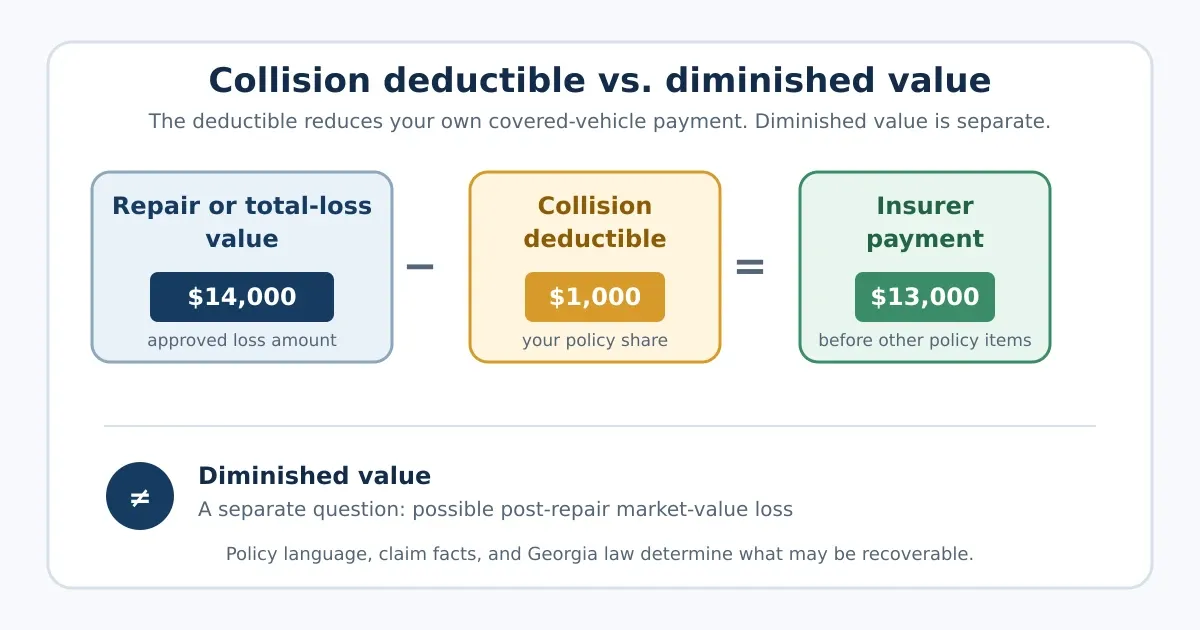
In Georgia, a collision or comprehensive deductible is the amount your own policy leaves you to pay after a covered vehicle loss. It is not a fee you mail to the insurer before the shop starts, and it is not the other driver’s liability limit. If the crash was yours, or the other driver has no usable coverage, that deductible is often the part of the bill you still pay.
Request a free case evaluation with Gastley Law or call (770) 557-2838 today.
The same subtraction can show up after theft, fire, or vandalism when comprehensive coverage applies. Gastley Law helps Georgia vehicle owners with property-damage and diminished-value claims from the last six years. This page is general information, not a reading of your policy.
The number matters for a diminished-value claim because it changes which check you are looking at. Your collision deductible comes out of your own insurer’s payment for the car. It does not, by itself, reduce what the at-fault driver’s insurer may owe for the market-value loss that remains after a repair. Those are different claims. The policy declarations page, not a general article, controls your deductible, limit, and exclusions.
Where a collision coverage deductible in Georgia comes off the check
Georgia’s Office of the Commissioner of Insurance and Safety Fire describes physical damage insurance as coverage for loss to your own vehicle. It splits that coverage into collision and comprehensive. Collision is for losses tied to a vehicle collision. Comprehensive, also called other-than-collision coverage, is for theft, vandalism, and fire-related losses.
State law does not require you to buy either one. A lender or leasing company usually does if the vehicle is financed or leased. The Commissioner’s auto insurance guide is the official source for those points.
The deductible is the portion of a covered loss that the policy does not pay. On a repair, the insurer commonly pays the approved repair amount minus the deductible for that coverage. On a total loss, the same idea usually shows up as the value minus the deductible. The policy’s valuation terms still control that number. Collision and comprehensive often carry different deductible amounts. Using the collision deductible for a theft claim, or the reverse, is a common mix-up.
If you only want the definitions of physical damage, collision, and comprehensive, start with Gastley Law’s overview of physical damage coverage in Georgia. This page stays on one payment question: which coverage applies, what the deductible does to that check, and what the subtraction does not do to a diminished-value claim.
Collision versus comprehensive
Use collision when the loss is a crash, including a hit to another vehicle or a fixed object. Some policies also treat other impacts as collision. Use comprehensive when the loss is other than collision, such as theft, vandalism, fire, or listed weather damage. A deer strike, a falling tree, or hail may fall on the comprehensive side. Only the policy form decides. Do not assume a weather loss uses the lower deductible.
Liability coverage is a different promise. It helps pay damage you cause to someone else. It does not repair your own car, and your collision deductible is not attached to it. If another driver’s insurer accepts a property-damage claim, your deductible should not be the first number subtracted from their payment.
How the deductible changes a repair or a total loss
Read the declarations page before you authorize work. It should list collision and comprehensive separately, with a deductible for each and a statement of whether that coverage is on the vehicle. Then match the loss to one coverage. A crash you caused is a collision question. A stolen car is a comprehensive question. A crash caused by an uninsured driver can still be a collision claim on your own policy, and uninsured-motorist property damage may also matter if you bought it.
| What happened | Whose payment | What the deductible usually does |
|---|---|---|
| You cause a crash that damages your car. | Your collision coverage pays the covered vehicle loss. | It comes off the repair payment or the total-loss value. It does not measure diminished value. |
| Another driver causes the crash and their insurer pays the repair. | Their property-damage liability pays. | Your collision deductible should not come out of their payment. A later diminished-value demand is a separate claim. |
| The other driver has no usable coverage. | Your collision coverage, and uninsured-motorist property damage if you bought it. | The collision deductible usually applies to your own payment. Whether any market-value loss is covered depends on that policy. |
| Theft, vandalism, or fire. | Your comprehensive coverage. | The comprehensive deductible applies, and it may differ from collision. A crash-based diminished-value claim is a different event. |
| The vehicle is financed or leased. | Whichever physical damage coverage the loss triggers. | The deductible still applies. The lender is often a loss payee and may have to endorse a total-loss check. |
Repair payment
On a repair, ask the insurer for the written estimate and the line that shows the deductible. If the approved repair is $4,800 and the collision deductible is $500, a typical payment is $4,300, and you owe the shop the $500. Those figures are an example of the subtraction, not a prediction of your claim. Supplements change the repair number. They do not create a second deductible. If hidden damage adds $900, the added payment is generally that $900, not $900 minus another $500. Confirm that in writing if a second estimate subtracts the deductible again.
Your right to choose a shop is separate from the deductible. O.C.G.A. § 33-34-6 limits an insurer’s ability to require a particular repair facility when you can get the work done at the same cost elsewhere. It does not erase the deductible, and it does not say the insurer must pay diminished value. Keep the final invoice, parts notes, and proof of what you paid the shop so the deductible is counted once. For how those repair choices work in practice, see the Georgia vehicle repair rule.
Total-loss payment
On a total loss, the deductible usually comes off the value the policy pays, not off a repair bill. If the insurer’s value is $14,000 and the collision deductible is $1,000, the physical-damage payment is often about $13,000 before the loan payoff. Taxes and fees can change that figure under the policy. Sales tax on a Georgia total loss is its own question, covered in whether insurance pays sales tax on a totaled car in Georgia. How the insurer picks the value is covered in how insurance determines a total loss in Georgia. Disagreeing with the value does not erase the deductible. It changes the number the deductible is subtracted from.
If you still owe more than that net payment, the gap is between you and the lender unless you bought separate gap coverage. Gap coverage is not collision coverage, and a standard physical-damage policy does not promise it. The options after a short payoff are laid out in what to do when a car is totaled with negative equity.
Why the deductible is not your diminished-value number
A repaired car can be worth less because it now has an accident history. That market-value gap is diminished value. It is not the deductible, and it is not the repair bill. The deductible is a contract amount you agreed to keep. Diminished value is a claimed loss in what the vehicle is worth after the covered damage and the repair.
In State Farm Mutual Automobile Insurance Co. v. Mabry, 274 Ga. 498 (2001), the Georgia Supreme Court held that, under the policy language before it, an insurer’s option to repair serves only to reduce, not eliminate, liability for the difference between pre-loss value and post-repair value. Mabry was a first-party contract case against the owners’ own insurer. It does not set a deductible.
That holding does not mean every current collision form pays diminished value. Whether your policy still covers the difference is a question of the form you bought. Read the limitation-of-liability and loss-settlement sections, or have them read, before you treat a denial as automatic.
A third-party claim is different again. If another driver caused the crash, a diminished-value demand usually goes to that driver’s property-damage liability insurer. Your collision deductible is not a credit against that demand. Georgia’s minimum property-damage liability limit is $25,000 per incident, but the at-fault driver’s policy may provide a higher limit. The applicable policy limit, not your collision deductible, caps the liability insurer’s payment. Georgia’s official auto insurance guide and the claim documents should be read together. Damage above the applicable limit is a separate collection problem, explained in what happens when a crash exceeds property-damage limits.
Gastley Law reviews Georgia property-damage and diminished-value claims. A past result does not predict a deductible waiver or a diminished-value payment. Separate the two numbers before you sign a release that mentions both.
Which claim the deductible belongs to
Put the deductible on the claim that uses your physical damage coverage. Leave it off a claim that the other driver’s insurer is paying, unless that insurer’s payment is short and you are using your own coverage for the unpaid part.
- Your own collision or comprehensive claim. The deductible for that coverage comes off the repair or total-loss payment. A diminished-value claim under the same policy is a coverage question, not a second deductible. The filing path is covered in first-party diminished value claims in Georgia.
- The at-fault driver’s insurer. Their liability payment should not be reduced by your collision deductible. Fault still decides whether that claim exists, which is covered in diminished value after an at-fault accident in Georgia.
- No usable coverage from the other driver. Your collision deductible usually applies if you repair the car through your own policy. An uninsured-driver diminished-value claim has its own proof issues, covered in uninsured driver diminished value claims in Georgia.
- Betterment and old damage. Worn tires, prior dents, and upgrades the policy does not cover stay with you. They are not the deductible, and they are not diminished value.
The broader choice between claiming under your policy and claiming against the other driver is explained in first-party versus third-party diminished value claims in Georgia. Use that page for the claim strategy. Use this page for the deductible line.
When a waiver is a policy promise, not a Georgia rule
Some insurers say they will waive the collision deductible if the other driver is clearly at fault and identified. That waiver is a policy term or a claim decision. It is not a statute, and the Commissioner’s auto guide does not promise it. Ask the adjuster to point to the waiver in the policy or to confirm it in the claim notes. A verbal “we usually waive it” is not a number you can take to the shop.
If the waiver depends on later recovery, you may still pay the deductible now. Any refund arrives only if your insurer collects from the other party, and the policy’s subrogation terms control how much of the deductible comes back. Recovery is not automatic. The mechanics of that pursuit, including the timing, are in subrogation recovery after a vehicle claim. Do not spend a repair budget on a refund that has not been issued.
A rental car is a separate coverage, often with its own daily limit. The collision deductible does not automatically buy a rental, and a rental limit does not reduce the deductible. If the shop needs the car for two weeks, compare that rental limit with the deductible so you know which bill is which.
Read the deductible before you accept a property-damage number
The deductible is a declarations-page number, not a figure the adjuster invents at the shop. Find the vehicle, then the collision line and the comprehensive line. Each line should name a dollar deductible. If a line says no coverage or shows a blank premium, that coverage is not on the car. Do not rely on a wallet card that only lists liability limits.
A renewal can change the deductible without a phone call. Compare the page in force on the date of loss with any newer page the insurer emails later. The date of loss controls which page applies. If you raised the deductible to lower the premium after the crash, that later change should not rewrite the claim.
Financed and leased vehicles add a loss payee. The lender’s name on the declarations page means the insurer may include the lender on a total-loss payment. It does not change the deductible. It does change who must endorse the check. Ask for that endorsement path in writing before you spend the payment on a replacement car.
Before you sign, separate three figures on the paperwork: the repair or total-loss amount, the deductible subtracted from your own insurer’s check, and any diminished-value amount someone is asking you to release. A release that settles “all property damage” can give up the market-value claim even when the only dispute in front of you was the deductible.
- Confirm the vehicle, the coverage, and the deductible on the declarations page in force on the date of loss.
- Ask which coverage the insurer is using, collision or comprehensive, and why.
- On a repair, compare the approved amount, the deductible, and the shop invoice so the deductible appears once.
- On a total loss, keep the value, the deductible, taxes, fees, and the loan payoff on separate lines.
- If a diminished-value claim is open, confirm in writing that the deductible is not being used to reduce that demand.
Request a free case evaluation with Gastley Law or call (770) 557-2838 today.
Frequently asked questions
Does Georgia require collision coverage?
No. Georgia requires liability coverage to drive, not collision or comprehensive coverage. A lender or lease can still require both physical damage coverages as a condition of the loan or lease. The Commissioner’s auto guide states that split.
Do I pay the deductible to the insurance company?
Usually you pay it to the repair shop, or you see it subtracted from a total-loss payment. You typically do not mail a separate deductible check to the insurer before a covered repair begins.
Does my collision deductible reduce a diminished-value claim?
Not when the diminished-value claim is against the at-fault driver’s insurer. The deductible comes out of your own collision or comprehensive payment. It is not a credit against the other driver’s property-damage liability. A claim under your own policy is different and depends on that policy’s language.
If the other driver is at fault, do I still pay my deductible?
Not if their liability insurer pays the repair or total loss in full. If you use your own collision coverage instead, your deductible usually applies up front. Any later reimbursement depends on recovery from the at-fault party, which the policy does not guarantee.
Does a supplement mean I pay the deductible twice?
No. A supplement adds newly found damage to the same claim. The deductible should be applied once to that claim, not once per estimate. A revised estimate is not a new claim and it is not a diminished-value appraisal.