
If you’re a driver in Georgia, there’s a critical insurance rule you need to know that sets our state apart. Unlike in most other places, you can file a diminished value claim against your own insurance policy even if the accident was your fault. This is a game-changer for many drivers who assume they have no options. This means you have the right to file a first-party State Farm diminished value claim and recover the money your car has lost in value. This guide is specifically for Georgia drivers, explaining how to use this unique advantage to your benefit and successfully get the compensation you are entitled to under state law.
In Georgia, a State Farm diminished value claim is a request for payment for the resale value your vehicle lost because it now has an accident history. Georgia drivers may have rights that drivers in many other states do not, including first-party diminished value rights under their own policy. The strongest claims usually include repair records, photos, proof of ownership, and an independent appraisal. If State Farm’s offer is low or the adjuster will not explain the calculation, Gastley Law can review the claim and explain your options. Call 770-557-2838 or request a case evaluation.
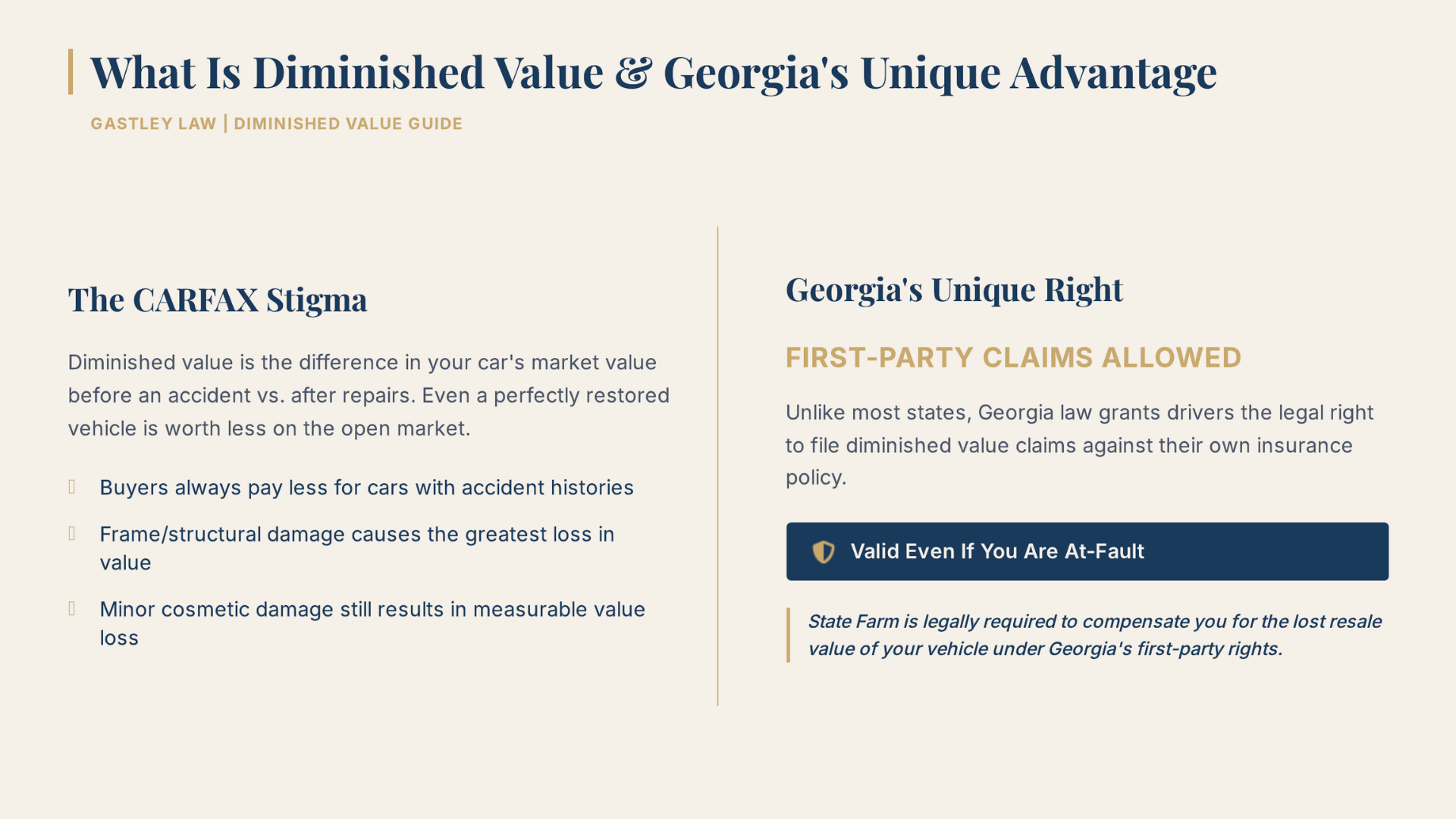
After an accident, your focus is usually on getting your car repaired and back on the road. But even after it’s fixed, your car isn’t worth what it was before the crash. A State Farm diminished value claim is how you recover that lost value. It’s a request for compensation for the drop in your car’s market price that happens simply because it now has an accident history. Think of it as the final step in making you whole again after a collision.
Diminished value is the difference between your car’s market value before the accident and its value after repairs. Even if your car looks brand new, its permanent accident record makes it less attractive to potential buyers. This is often called the “CARFAX stigma.” When someone is looking to buy a used car, they’ll almost always pay less for one that’s been in a wreck. That loss is the diminished value, and you have a right to be compensated for it. You can learn more about the specifics of what diminished value is and how it’s calculated.
Insurance companies are in the business of minimizing payouts, and State Farm is no exception. They often won’t tell you that you’re entitled to a diminished value claim. If you do file one, their first offer is likely to be very low. They might even try to discourage you from pursuing it at all. It’s important to know that you don’t have to accept their initial offer. You can, and should, negotiate for a fair amount. Having an expert handle your property damage claim can make a significant difference in these negotiations.
The main reason your car’s value drops is its newly acquired accident history. A vehicle with a clean record is always more desirable. Even with the best repairs, there’s a perception that the car may have underlying issues. The severity of the damage also plays a big role. Minor cosmetic damage might cause a small dip in value, but an accident that involves structural or frame damage will lead to a much larger loss. A future buyer will use that accident history as a powerful bargaining chip to demand a lower price, and that’s the value you’re trying to recover.
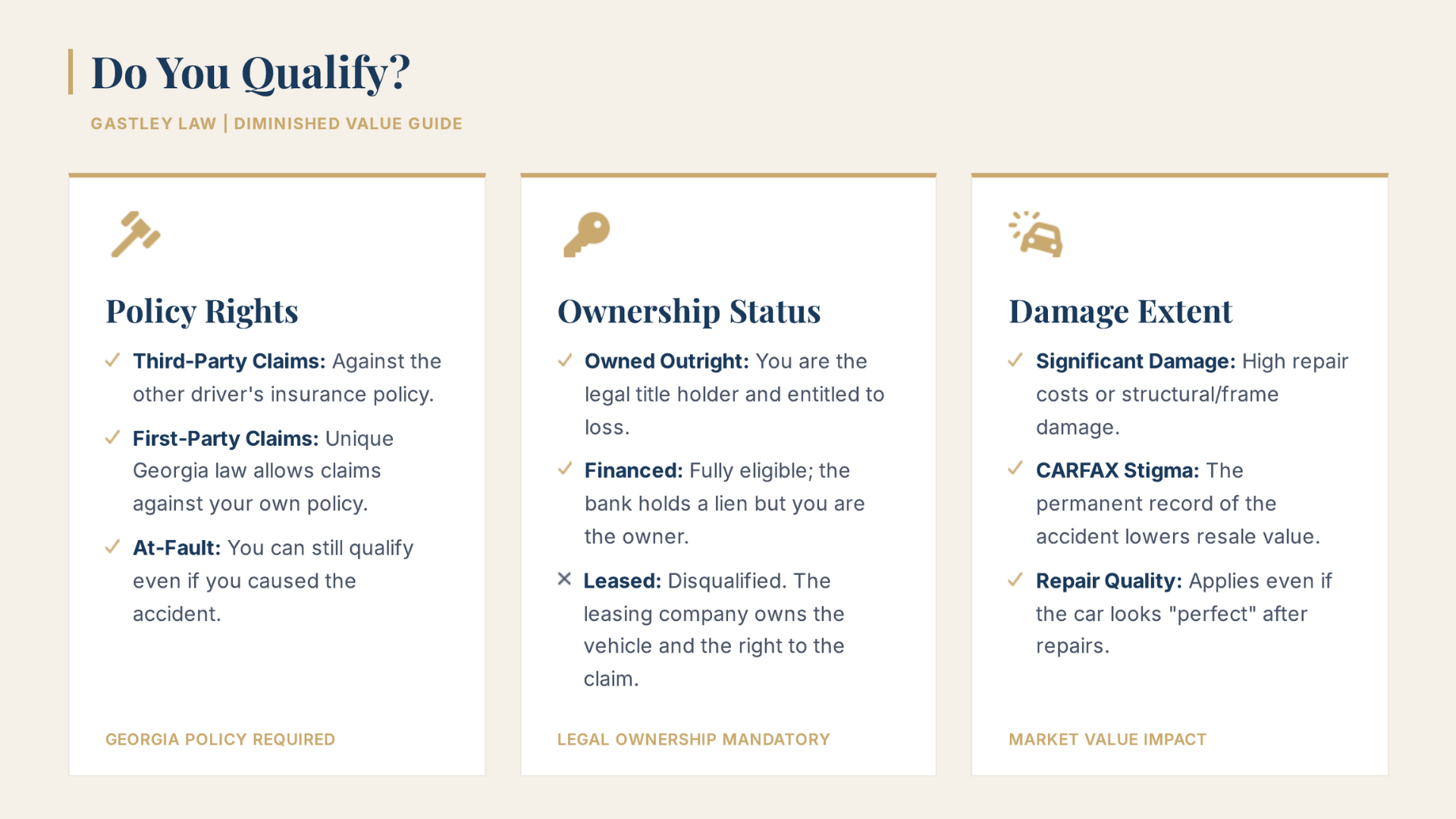
Filing a diminished value claim with State Farm involves meeting a few key requirements. Before you start the process, it’s important to confirm that your situation and your vehicle actually qualify. Understanding these rules upfront will save you time and help you build a stronger case from the very beginning. Let’s walk through the three main criteria State Farm will look at when you submit your claim.
In most states, you can only file a diminished value claim with State Farm if you were not the at-fault driver in the accident. However, Georgia is a unique exception to this rule. Here in Georgia, you have the right to file a first-party diminished value claim against your own insurance policy, even if the accident was your fault. This is a critical distinction that many drivers aren’t aware of. Understanding these state-specific insurance laws is a core part of our legal services and can make all the difference in getting the compensation you deserve.
To file a claim, you must be the legal owner of the vehicle, which means your name is on the title. If you are financing your car, you can absolutely still file a claim because you are considered the owner. The lienholder, like a bank or finance company, just has a security interest until the loan is paid off. The one situation where you cannot file is if you lease your vehicle. In a lease agreement, the leasing company is the legal owner of the car, not you. Therefore, they are the only party that could claim diminished value, though they rarely pursue it.
A diminished value claim is based on the simple fact that a car with an accident history is worth less than one without, even after perfect repairs. This loss in resale value is often called “CARFAX stigma,” because a documented accident report makes potential buyers hesitant. Your car will generally qualify if it has sustained significant damage, especially to the frame or structure, as this leads to a much greater loss of value than minor cosmetic issues. You can learn more about what diminished value is and how it’s calculated to see how this concept applies directly to your car’s situation.
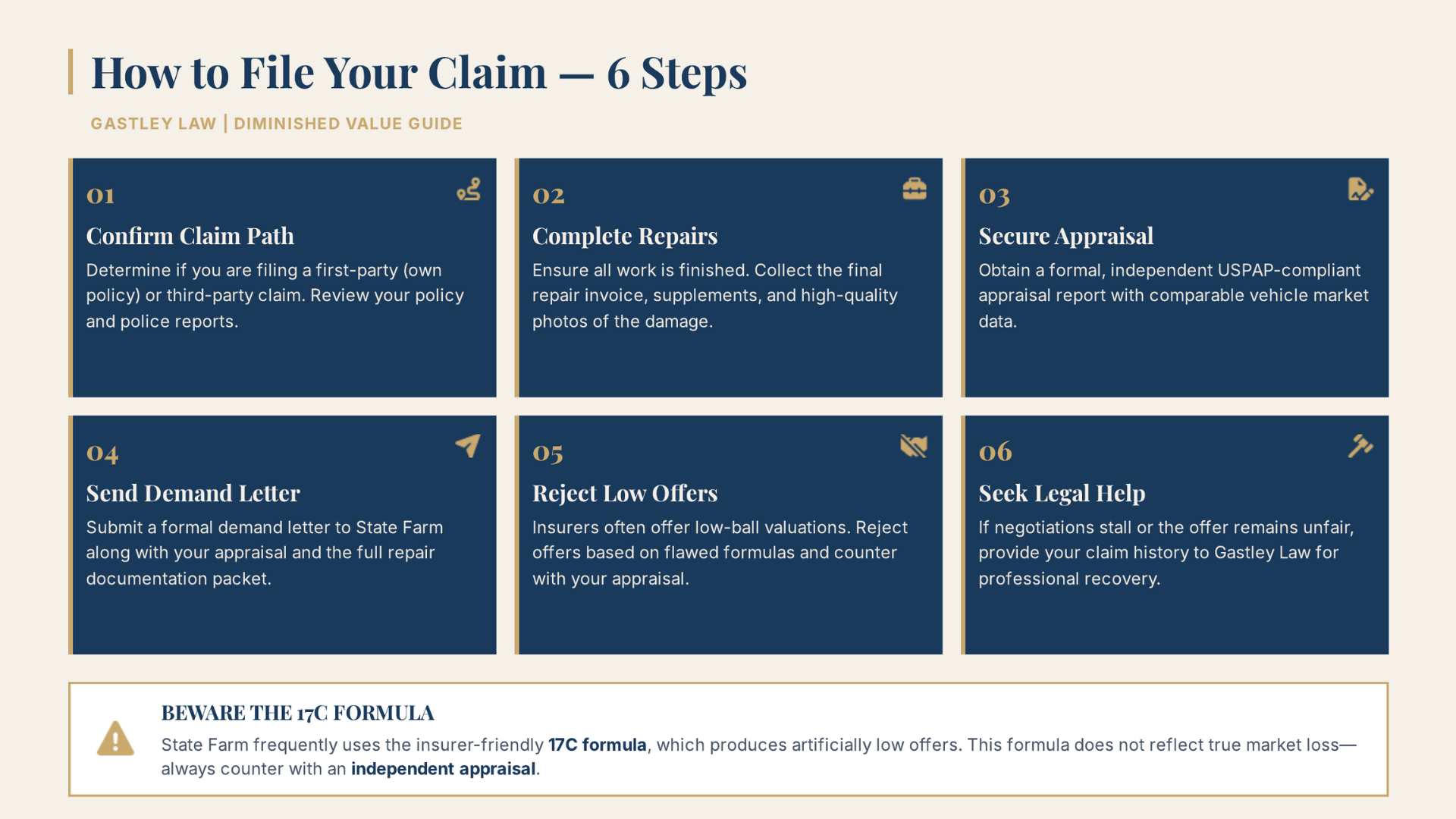
Filing a diminished value claim with State Farm can feel like a big undertaking, but you can manage it by breaking it down into a few clear steps. Think of this as your roadmap. The key is to be organized, persistent, and prepared for their tactics. By gathering the right evidence and presenting your case professionally, you put yourself in the best position to recover the money you’re owed. Let’s walk through exactly what you need to do to build a strong claim and get the settlement you deserve.
| Step | What to do | Documents/evidence | Why it matters |
|---|---|---|---|
| 1 | Confirm the claim path | Policy, claim number, police report, liability decision | Determines whether the claim is first-party or third-party and prevents fault confusion. |
| 2 | Finish repairs and collect records | Final repair invoice, supplements, photos, rental or tow records if relevant | Shows the severity of damage and supports the value-loss argument. |
| 3 | Get an independent appraisal | USPAP-compliant diminished value report, comparable vehicle data | Gives State Farm evidence beyond an online calculator or internal estimate. |
| 4 | Send a written demand | Demand letter, appraisal, repair packet, proof of ownership | Creates a clear record of the amount requested and supporting basis. |
| 5 | Respond to low offers | Adjuster emails, offer letter, valuation explanation | Helps identify whether State Farm relied on 17C or another low valuation method. |
| 6 | Get legal help if needed | Full claim packet and offer history | A Georgia diminished value attorney can handle negotiations and explain next steps. |
Start by confirming whether your claim is being made against another driver’s State Farm policy or under your own Georgia policy. Georgia drivers may have first-party diminished value rights under their own policy, even when fault is disputed or the accident was their fault. Gather the police report, claim number, liability decision, photos, ownership documents, and the State Farm adjuster’s contact information so your demand is organized from the beginning.
This is your most important piece of evidence. While online calculators might give you a quick estimate, insurance companies like State Farm don’t take them seriously. You need an independent, professional appraisal from a certified expert. A credible appraiser will conduct a thorough inspection and create a detailed report that follows the Uniform Standards of Professional Appraisal Practice (USPAP). This report provides an unbiased, expert opinion on exactly how much value your car has lost. It moves your claim from a simple opinion to a fact-based demand that is much harder for an adjuster to dismiss.
Once you have your professional appraisal, it’s time to formally submit your claim. You’ll do this by sending State Farm a demand letter. This isn’t just a simple email; it’s a formal document that officially requests payment for your car’s diminished value. Your letter should be clear and professional, outlining the facts of the accident and stating the specific amount you are demanding based on your appraisal report. Make sure to include a copy of the appraisal and any other supporting documents, like the police report. This letter formally kicks off the negotiation process and signals to State Farm that you have a well-supported claim.
Don’t be surprised if State Farm’s first offer is disappointingly low. This is a common negotiation tactic used by many insurance companies. The key is not to accept it right away. You have the right to reject their offer and present a counteroffer. Use your professional appraisal as leverage to justify why you deserve the full amount. If the adjuster refuses to offer a fair settlement, you can ask to speak with a supervisor to escalate the issue. If you continue to face resistance or feel overwhelmed by the process, it may be time to get professional legal help. An experienced attorney can handle the negotiations for you.
When you file a diminished value claim, the insurance adjuster won’t just take your word for it. You need to present a strong, evidence-backed case to show exactly how much value your car has lost. Think of yourself as building an argument, and every piece of paper and every report is a crucial part of your story. The more thorough you are, the harder it is for an insurer to deny or lowball your claim. Here are the key pieces of evidence you’ll need to gather.
While it might be tempting to plug your car’s details into a free online calculator, these estimates rarely hold up against an insurance company’s scrutiny. To build a credible claim, you need a professional, independent appraisal. This isn’t just any report; it should be prepared by a certified appraiser and comply with the Uniform Standards of Professional Appraisal Practice (USPAP). This formal standard ensures the valuation is objective and well-documented. An adjuster is far more likely to take a USPAP-compliant appraisal seriously than a generic online printout. Investing in a professional diminished value appraisal is one of the most important steps you can take to get the compensation you deserve.
Your repair documents are the foundation of your claim. They tell the story of what happened to your car and what it took to fix it. Be sure to collect everything: the initial estimate from the body shop, the final detailed invoice listing all parts and labor, and any supplemental reports for hidden damage discovered during repairs. These records provide concrete proof of the accident’s severity. They help demonstrate your car’s condition before the accident and establish a clear link between the collision and the permanent reduction in its market value. Keep these documents organized in one place so you can easily present them to the adjuster.
To prove your car lost value, you first need to establish what it was worth right before the accident. The insurance company might try to argue that your car had pre-existing issues, so you need evidence to show it was in great shape. Gather all your vehicle maintenance records, from regular oil changes to major services. If you have any photos of your car from before the crash, those are incredibly helpful too. This documentation paints a clear picture of a well-cared-for vehicle, making it much harder for the insurer to downplay the financial impact of the accident. Your goal is to create a strong “before” snapshot to contrast with the post-repair “after.”
Even if your car looks brand new after repairs, its market value has taken a hit simply because it now has an accident history. Potential buyers will pay less for a vehicle that’s been in a wreck, and you need to prove this. You can do this by gathering sales data for comparable vehicles, or “comps.” Look for listings of cars that are the same make, model, year, and condition as yours, but have a clean history. Then, find examples of similar cars that have a reported accident. The price difference between these two categories is a powerful illustration of your car’s diminished value. Compiling this market data can be challenging, so if you need help, don’t hesitate to contact a professional.
State Farm diminished value claims often turn on documentation, valuation method, and the adjuster’s explanation for a low offer. A denial or small offer does not always mean the claim has no value. It usually means you need clearer evidence, a better appraisal, or a written response that addresses the specific objection.
Many low diminished value offers are tied to the 17C formula or another internal valuation method. These calculations can produce numbers that do not reflect your vehicle’s actual market loss after an accident. If State Farm’s offer is based on a formula, ask for the valuation explanation and compare it with an independent appraisal supported by comparable vehicle data. Gastley Law also explains the 17C diminished value formula in more detail.
A repaired vehicle can still lose resale value because buyers, dealers, and vehicle-history reports treat an accident history as a pricing factor. Even quality repairs do not erase the record of structural damage, airbag deployment, frame work, or significant repair costs. Your claim should explain why the vehicle is worth less in the market after repair.
State Farm may question whether the other driver was responsible, whether you own the vehicle, or whether older damage caused part of the value loss. Georgia drivers may also need to explain whether the claim is first-party under their own policy or third-party against another driver’s insurer. Police reports, title or lien documents, repair records, photos, and pre-accident condition evidence help address those disputes.
Incomplete claim packets give an adjuster an easy reason to delay, discount, or deny the demand. Keep the final repair invoice, supplements, photos, appraisal, demand letter, ownership proof, claim correspondence, and every offer or valuation explanation in one file. Send important points in writing so there is a clear record of what you provided and what State Farm said in response.
State Farm offer lower than your appraisal? Gastley Law focuses on Georgia diminished value and property damage claims. The firm fronts accepted-case costs, handles insurer communication, and only takes a portion of the money recovered. Call 770-557-2838 or request a case evaluation to understand your options. This information is general and does not guarantee a result.
Georgia drivers may have first-party diminished value rights under their own auto policy, even when they caused the accident. Whether that applies depends on the policy, the facts of the loss, and the documentation available. If fault is unclear, keep the police report, claim number, and policy information together before responding to State Farm.
State Farm may pay diminished value when the claim is supported by evidence showing the vehicle lost market value after an accident. The offer can depend on the claim path, repair history, appraisal evidence, ownership proof, and the adjuster’s valuation method.
Useful documents include the policy or claim number, police report, final repair invoice, repair supplements, photos, proof of ownership, an independent diminished value appraisal, comparable vehicle data, the demand letter, and all offer or adjuster emails.
A low offer may come from the 17C formula, an internal valuation, missing appraisal evidence, disputes about prior damage, or a claim file that does not clearly show the vehicle’s market loss. Ask for the valuation explanation in writing and compare it with your independent appraisal.
You can file a claim yourself, but a Georgia diminished value attorney may help when State Farm denies the claim, makes a low offer, delays communication, disputes fault or ownership, or ignores appraisal evidence. Legal help should be evaluated based on the facts of the claim, not a guaranteed outcome.