
Diminished Value vs Depreciation Guide for Georgia Drivers
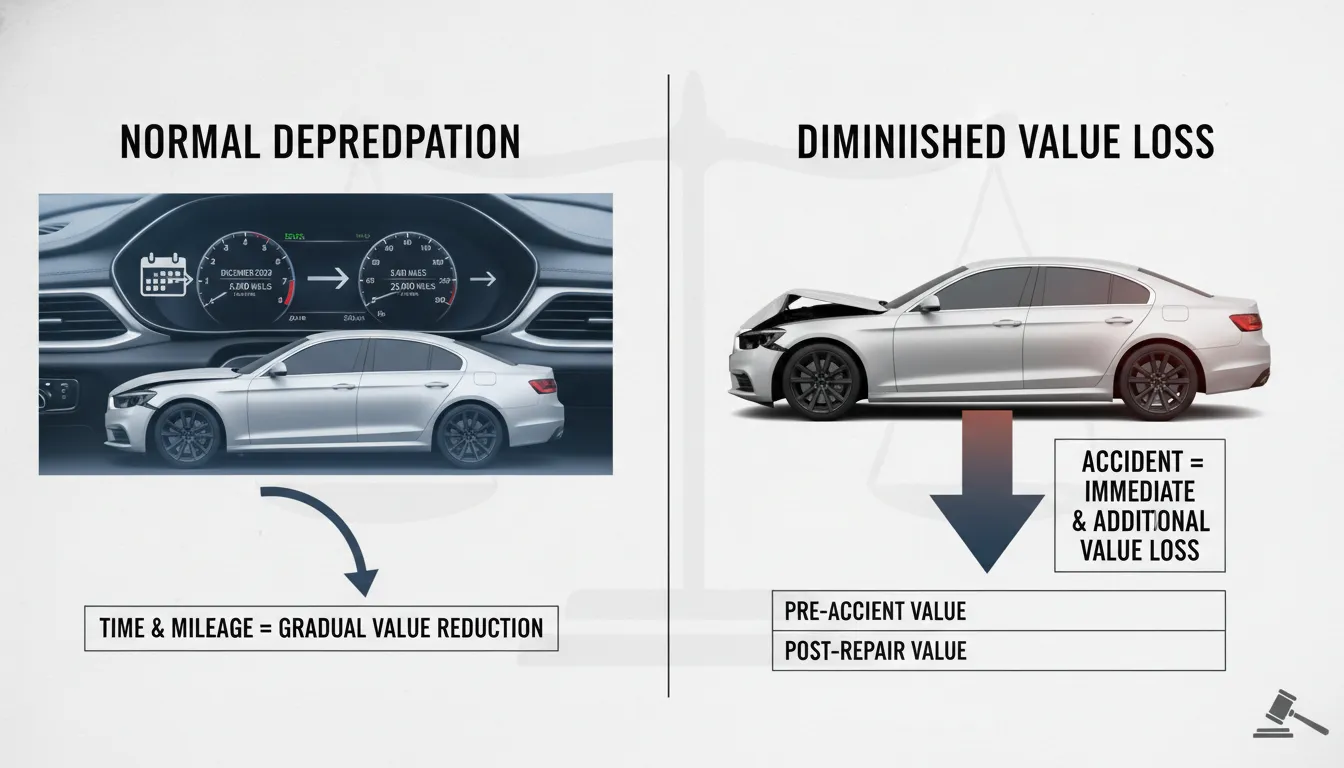
A perfect repair cannot fix the accident car label that follows your vehicle’s title. While every car loses value over time, a sudden crash creates a unique financial loss. Comparing diminished value vs depreciation shows how much money you might be leaving on the table.
For a free case evaluation with Gastley Law, call (770) 557-2838 today.
The main way diminished value vs depreciation differ is how the price drop starts and if your insurance company must pay for the loss. While depreciation is a slow and steady price drop from age and miles, diminished value is a sudden loss in worth after a car crash. According to the Insurance Information Institute, buyers almost always pay less for a car with a damage history. Most buyers will choose an identical vehicle that has never been hit or repaired instead of one with an accident report. Georgia drivers can claim this accident loss from an insurance company to get a fair check and recover the true market value of their car.
Insurance companies often mix up these terms to save money. To protect your wallet, you must know how a crash changes the market price of your car. Learning the answer to What Is Diminished Value? is the first step, and the path begins with…
Diminished Value Vs Depreciation: What Is Diminished Value?
Diminished value is the drop in a car’s market price after a crash and repairs. Even if a shop fixes your car well, it usually sells for less because it now has a crash history. Most buyers will not pay full price for a car that was in a wreck. In Georgia, you can often get back this lost value through a claim. Knowing what diminished value means for your vehicle is the first step toward getting fair pay for your loss.
The three types of loss
Loss in value happens in a few ways. The timing of the loss and the work quality both matter. The industry looks at three main types:
- Inherent diminished value: This is the most common type. It is the loss in price based just on the car’s crash history. Even with great repairs, the history stays with the car.
- Immediate diminished value: This is the drop in price right after the crash but before any work starts. It shows the value of the car in its damaged state.
- Repair-related diminished value: This happens when a shop does poor work. It includes things like bad paint or parts that do not fit right.
Most Georgia drivers focus on inherent diminished value when they talk to an insurer. This is because it is the hardest loss to avoid. No amount of work can erase a car’s history report.
A real world example
To see how this works, think about a car worth $20,000 before a crash. After a crash, a shop fixes the car well. But because the car now has a wreck on its record, a dealer might only offer $17,000 for it. In this case, your diminished value loss is $3,000. This is a real loss that you feel when you try to sell or trade in your car.
Insurance firms often try to ignore this loss. They might pay for the repair bill but skip the check for the lost price. But Georgia state rules say insurers must handle property claims fairly. This includes looking at the loss in value from the crash. If your car was worth less the moment the crash hit, you may have a valid claim for that loss.
Why crash history matters
When you sell a car, buyers use tools to check for past damage. A clean record is a big selling point. A record with a wreck makes people worry about hidden issues. Even if the car looks new, the risk of future problems stays in the buyer’s mind. This is why knowing the facts is so vital. It is not just about the cost of the parts. It is about the actual cash you lose when you move on to your next car.
What Is Vehicle Depreciation?
Every driver knows that a car loses value as soon as it leaves the lot. This process is called vehicle depreciation. It is a slow, steady drop in worth that happens to every car on the road. For Georgia drivers, knowing what diminished value means for your vehicle starts with a clear view of how normal wear and tear works. While both terms deal with a loss in value, they come from very different sources.
A loss from age and use
Depreciation is the natural drop in a car’s price due to its age and miles. It is a steady part of owning a car. As you drive your vehicle, its parts wear down and newer models come out. This makes your car worth less over time. According to the Insurance Information Institute, this loss is an expected cost of owning a vehicle. You cannot claim it on an insurance policy because it is not caused by a single event or a wreck.
Most cars lose a large chunk of their value very early on. Research shows that a new car can lose 20% to 30% of its value in just the first year. By the time a car is three years old, it may be worth only half of its first price. This drop happens whether the car is in a wreck or not. It is simply the market adjusting for the life left in the car.
Factors that drive the drop
Some key things decide how fast your car loses its value. Mileage is one of the biggest factors. A car with high miles will always be worth less than a car that was driven less. The make and model also play a huge role. Some luxury brands or trucks hold their value better than small cars. Market trends can shift prices as well. For example, when gas prices go up, large SUVs might see a faster drop in value than small cars.
Upkeep and condition are also key. A car that is well-kept and clean will lose value slower than one with stains or dents. Keeping good records of your oil changes and repairs can help slow this loss. But even a perfect car will still lose worth as it gets older. It is a set path that every gas or electric car follows through its life.
The line between wear and damage
The main thing to keep in mind is that depreciation is not a loss that an insurer pays for. You cannot ask a firm to pay you for the normal drop in your car’s price each year. This is a big point where people get confused. They see their car is worth less and think they can file a claim. But insurers only pay for losses caused by a set event, like a crash or a storm.
This is why filing a diminished value claim in Georgia is so different. While depreciation is a slow slide over years, diminished value is a sharp drop that happens in one second. One is a cost of life. The other is a loss caused by someone else. Knowing this line helps you see when you are truly owed money and when you are just facing the normal costs of driving a car in Georgia.
Diminished Value vs. Depreciation: Key Differences
Knowing the difference between diminished value and depreciation is key to your case. Both terms mean a car lost value, but they come from different places. Depreciation is a slow, steady loss that hits every car on the road. Diminished value is a sharp drop that happens only after a crash or other damage. Insurance firms often mix these terms up to lower your payout. You can use the table below to see how they differ.
| Feature | Diminished Value | Depreciation |
|---|---|---|
| Timing | Happens at once after a crash | Slow and steady over time |
| Cause | Starts with an accident or damage | Caused by age, miles, and wear |
| Claimability | May be paid by insurance in Georgia | Never paid by insurance policies |
| Predictability | Sudden and hard to guess | Predictable and steady loss |
| Affects Every Car | Only affects damaged cars | Affects every car on the road |
| Compensable | Yes, for most Georgia drivers | No, it is a cost of car ownership |
Why Insurers Mix These Terms
Insurance agents often use the word “depreciation” when they mean “diminished value.” They do this to make you think your loss is just a normal part of owning a car.
By calling your loss depreciation, they can claim that they do not owe you a dime. The Insurance Information Institute notes that most policies do not cover normal wear. But in Georgia, your crash-related loss is a real cost you can get back. Do not let them trick you into giving up your rights.
These firms want to hide the fact that your car’s history now has a “stigma” that lowers its price. Even if the car looks new after repairs, a buyer will pay less for it because of the crash. This is an extra loss on top of the value the car lost from old age. If you are disputing a low appraisal, you must show that these two types of loss are not the same. One is expected, but the other is a direct result of the crash.
The Problem With the 17c Formula
In Georgia, many insurers use a tool called the 17c formula to figure out your claim. This tool is bad because it caps your loss using the math of old age. It often assumes that a car can only lose a small part of its value in a crash. It then cuts that amount even more based on how many miles are on the car. This means the formula takes a real loss and turns it into a tiny check.
The 17c formula came from a court case, but it was never meant to be a hard rule for every claim. It fails to look at the real market price of your exact car. By using this math, insurers treat a rare crash like a normal day of driving. If you are filing a diminished value claim in Georgia, you do not have to accept this formula. You have the right to show the real loss in your car’s price with a better check of its value.
How Georgia Law Treats Diminished Value vs. Depreciation
Georgia law views car value loss in a way that helps owners. While normal depreciation is part of owning any car, Georgia courts see an accident as a separate loss. If you have been in a wreck, you should know how the law treats diminished value vs depreciation. This knowledge helps you get the money you are owed for your damaged vehicle.
Georgia’s Legal View of Value Loss
In Georgia, the law says that diminished value is a real loss. This means the drop in your car’s resale price is a cost your insurance should pay. Georgia is special because it lets you file this claim with your own insurance firm. This is true even if the crash was your fault. The law knows that a car with a crash history sells for less than a clean car.
You must follow Georgia’s legal requirements for diminished value claims to get paid. These rules let owners seek funds for the “stigma” a wreck leaves. Even if a shop fixes your car and it looks new, the market will pay less for it. Georgia law tries to fix this by covering that price gap.
The Six Year Time Limit
Georgia gives car owners a long time to act. You have up to six years from the date of the damage to file a claim. This is much longer than the time for injury claims. But waiting can make it hard to prove what your car was worth. It is best to start the process as soon as a shop fixes the car so the facts stay fresh.
According to the Georgia Judicial Branch, keeping good records of your car is key. If you wait too many years, you might lose those records. A fast claim helps stop the insurance firm from saying the loss was just from normal wear. You want to show the loss came from the wreck, not just old age.
How the 17c Formula Limits Your Pay
Insurance firms often use a math trick called the 17c formula to pay you less. This formula came from an old court case, but Georgia law does not force firms to use it. Insurers use it because it puts a low cap on what they pay. For example, it often cuts the pay to 10% of the car’s worth and then cuts more for high miles.
The 17c formula treats crash damage like normal wear, which is wrong. Car buyers do not use a math chart; they look at history reports. If a firm uses this trick to give you a low offer, you can fight it. A pro appraisal is often the best way to show the real loss that the 17c formula misses.
What Types of Diminished Value Claims Are Available in Georgia?
Georgia law gives car owners many ways to get back lost value after a crash. Most states limit what you can do. But in Georgia, you can often get paid by your own insurer or by the other driver’s policy. The type of claim you file depends on the crash and who was at fault.
First party claims for Georgia owners
A first-party claim is one you file with your own insurance company. Georgia is a rare state where insurers must pay for lost value to their own clients. This rule stays in place even if you caused the crash. If you have collision coverage, your firm may owe you for the drop in price that repairs cannot fix.
Some drivers fear that filing a diminished value claim in Georgia will fail if they were at fault. Yet, Georgia courts say that firms must pay their clients for the full loss. This helps keep diminished value vs depreciation as a clear split. The crash causes a fast loss that normal wear does not.
Third party claims against at fault drivers
You file a third-party claim with the insurance of the person who hit you. If another driver caused the crash, their policy should pay for repairs and lost resale value. This is the main path for drivers who are not at fault. The law says the insurer must put you back in the same spot you were in before the crash.
Getting a fair deal from a third-party firm can be hard. These firms often try to use low estimates to save cash. If you think the insurance offer is too low, you can push back. You have the right to ask for full pay for your loss.
Rights after your car is fixed
One common myth is that you lose your right to claim lost value once your car is fixed. This is not true. You can file a claim even after you take a check for physical repairs. Per the Insurance Information Institute, these are two separate losses. One check covers parts and work. The other covers the drop in what the car is worth to a buyer.
You usually have six years from the date of the crash to file in Georgia. Both at-fault and not-at-fault drivers may have a case for a claim. It is key to act fast to show how the crash hurt your car’s price. You want to prove how it ranks next to a car with a clean history.
How an Attorney Helps Separate Diminished Value from Depreciation
Insurance companies in Georgia often try to mix up lost value and normal wear. They do this to save money and offer you a smaller check after a car wreck. While wear is a normal loss that happens as a car gets older, diminished value is a specific drop in worth caused by a crash. An expert lawyer helps you prove the difference so you can get the full payment you need.
Disputing Low Appraisals and the 17c Formula
Most insurance companies use a math tool called the 17c formula to figure out what they owe you. This tool often puts a cap on what they will pay for your car’s loss in value. It uses old rules that may not show the real market price. At Gastley Law, we know how to fight these tricks by showing the real loss in what your car is worth.
We help by disputing a low appraisal through a private and expert review. A strong appraisal is the best way to show an insurance company that their offer is too low. In the last year, our firm has recovered $2.4 million in property damage claims for our clients by using this clear proof.
The Gastley Law Seven-Step Recovery Process
Getting a fair check from an insurance company takes a clear and simple plan. We use a seven-step process to help our clients across Georgia. This path starts with good records and a free review of your claim. We then send a formal request to the insurance company for the money you are owed.
If the company sends a low offer or says no, we use a smart rejection to keep the claim moving forward. Our process also includes a private appraisal and hard talks with the adjuster. Most claims we handle reach an end within 30 to 90 days. This plan is key to negotiating a fair insurance settlement that covers your actual losses.
Court Case Trust and No Upfront Cost Help
Many insurance adjusters will only pay a fair amount if they know a law firm is ready to go to court. Gastley Law has a history of taking cases to small claims court when insurance companies refuse to be fair. This history of winning in court helps us push for better results during the talk phase of your claim. We do not just talk about fair deals; we fight for them in front of a judge if we must.
We make this process easy for you by using a no-win, no-fee model. This means there is no upfront cost to start your case. We pay for all the costs of the claim, including the appraisal fees which can cost between $200 and $1,500. You only pay us if we win money for you. This allows you to fight for your car’s value without any risk to your own bank account. Knowing your rights under Georgia law is the best way to handle a loss after a crash.
Frequently Asked Questions
How do I calculate my diminished value?
To find your car’s diminished value, you must look at its market worth before the wreck. You then compare that to its value after repairs. Insurance firms often use low quotes. You should get a certified appraisal to show the true loss. This report acts as strong proof when you ask for a fair payout. A clear look at local sales for similar cars helps find the right amount.
Can I claim diminished value if I was at fault?
Yes. Georgia is one of the few states where you can file a claim even if you caused the wreck. This is known as a first-party claim. You must have a valid plan that includes this loss. Based on Georgia’s legal rules, both at-fault and not-at-fault drivers can seek these funds. You should check your insurance papers to see your specific rights.
What is the 17c formula for diminished value?
The 17c formula is a tool that many insurance firms use to cap payouts. It applies a set of limits based on the age of your car and how bad the damage was. This method often results in a very low offer. It treats accident losses like normal wear. Most drivers need to fight these low numbers to get what they truly owe. You may need to dispute a low appraisal if the firm uses this formula.
How long do I have to file a diminished value claim in Georgia?
You have up to six years from the date of the wreck to file your claim in Georgia. This is a longer window than many other states provide. You should start the process early while repair records are fresh. Waiting too long can make it harder to find old market data. You can learn more about filing a diminished value claim in Georgia to ensure you meet all local rules.
Does insurance cover both depreciation and diminished value?
Insurance does not cover normal depreciation because it happens to every car over time. However, many plans in Georgia do cover diminished value after a wreck. This is a loss that goes beyond normal wear and tear. You must show that the wreck caused a specific drop in what your car is worth. A fair settlement should include funds for this lost value.
Are you ready to recover the money your car lost after a wreck?
Waiting to start your claim can cost you thousands of dollars. Every day makes it harder to prove your car’s true value loss. Insurance agents may try to say your car just lost value from normal use, but an expert can show the real cost of the wreck.
Ready to schedule a free case evaluation? Call (770) 557-2838 to talk to a diminished value expert today. Find out exactly how much your car is worth right now. Our team will help you fight for the fair payment you need. Do not leave money on the table after your accident. Start your claim today to get your check faster.