After a car accident, the insurance company starts using a lot of confusing terms, and “total loss threshold” is one you can’t afford to ignore. This isn’t just jargon; it’s the specific rule that dictates whether you get your car back from the shop or a check to replace it. It’s a tipping point, set by state law, that forces an insurer to declare a car totaled if repair costs exceed a certain percentage of its value. Because these rules are not universal, understanding the total loss threshold by state is critical. What qualifies as a total loss in Georgia might be considered repairable just across the state line, and that difference can completely change the outcome of your claim. This guide will break down what that threshold means for you and how to make sure the insurance company’s math adds up.
After a car accident, you’ll hear a lot of insurance jargon, and “total loss threshold” is one of the most important terms to understand. Simply put, a total loss threshold is the point at which an insurance company is legally required to declare your car a “total loss.” Instead of paying to fix your car, they will pay you for its value.
Think of it as a tipping point set by state law. Each state has its own rules that dictate this process, but they usually involve a specific percentage. If the estimated cost to repair your car exceeds this percentage of its pre-accident value, the insurer must write it off as totaled. For example, here in Georgia, the threshold is 75%. This means if your car was worth $20,000 before the crash, and the repairs are estimated at $15,000 or more, it’s officially a total loss.
This threshold is critical because it determines whether you get your repaired car back or a check to replace it. It also protects you from being forced to drive a vehicle with extensive damage that might not be safe, even after repairs. Understanding your state’s specific threshold is the first step in making sure the insurance company handles your property damage claim fairly and you get what you’re owed.
The total loss threshold directly impacts the outcome of your insurance claim. When repair costs meet or exceed your state’s percentage, the insurance company’s path is clear: they must declare the car a total loss. This means they stop the repair process and instead calculate a payout based on your car’s actual cash value (ACV) right before the accident.
This number is the dividing line between two very different results. If the repair estimate is below the threshold, the insurer will pay the body shop to fix your car. If it’s above the threshold, you’ll receive a settlement check. This is why the initial repair estimate and the valuation of your car are so critical. An inaccurate estimate or a lowball valuation can completely change the outcome, potentially leaving you with a poorly repaired car or not enough money to buy a new one.
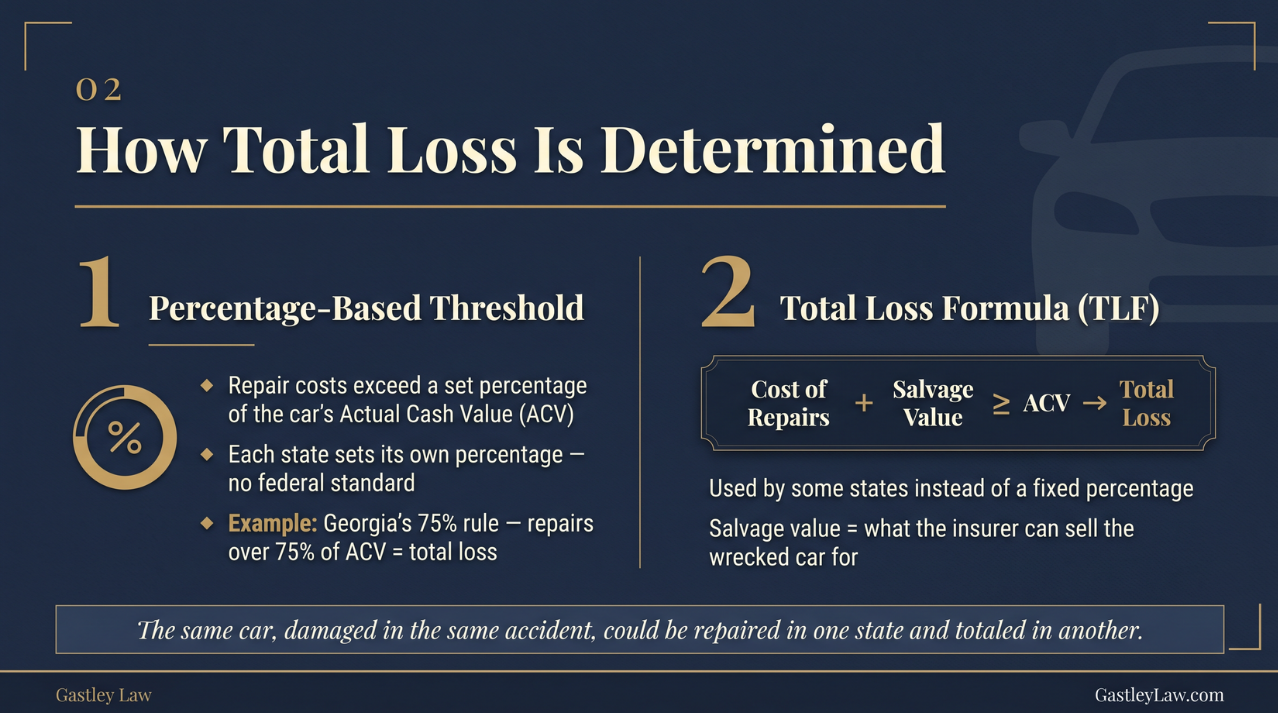
Insurance companies generally use one of two methods to determine if your car is a total loss, and the one they use depends on state law. The most common method is a straightforward percentage-based threshold. In these states, the insurer compares the estimated repair cost to the car’s actual cash value (ACV). If the repair cost is, for example, 75% or more of the ACV, the car is totaled.
Other states use a “Total Loss Formula” (TLF). This calculation is a bit different: the insurer adds the cost of repairs to the car’s potential salvage value (what they could sell the wrecked car for). If that total is equal to or greater than the car’s pre-accident ACV, it’s declared a total loss. If you feel an insurer is using the wrong numbers or their math doesn’t add up, it might be time to get some help.
The short answer is no. When an insurance company decides if your car is a total loss, the rules they follow depend entirely on the state where your car is registered. A vehicle that would be considered a total loss in Georgia might be deemed repairable just across the state line in Florida or Alabama. This is because each state has its own “total loss threshold,” which is the point where the damage is considered too severe to justify repairs.
Insurers generally use one of two methods to make this call: the Percentage-Based Threshold or the Total Loss Formula (TLF). The specific method and the numbers involved can vary significantly from one state to another. Understanding which rule applies to your situation is a critical first step in the claims process. It directly impacts whether you’ll be getting a check for your car’s value or getting it sent to the repair shop. This patchwork of regulations means you need to be aware of your local laws to ensure you’re being treated fairly by the insurance company. You can find a complete list of the total loss threshold by state to see how the rules differ across the country. Because these rules are set at the state level, there’s no single federal standard, which often causes confusion for car owners. What you learned from a previous accident in another state might not apply to your current situation, making it essential to check the specific regulations for your area.
This is the most common method states use, and it’s pretty straightforward. A state sets a specific percentage, and if the estimated cost to repair your car exceeds that percentage of its pre-accident value (its Actual Cash Value or ACV), it’s declared a total loss. For example, Georgia uses a 75% threshold. If your car was worth $20,000 before the crash, it would be considered a total loss if the repair estimate is $15,000 or more (75% of $20,000). This method creates a clear line for insurers and car owners, removing some of the guesswork from the decision.
Some states use a different calculation called the Total Loss Formula (TLF). Instead of a simple percentage, this formula considers the car’s salvage value, which is the amount the insurance company can get by selling the damaged vehicle for parts or scrap. The formula looks like this: Cost of Repairs + Salvage Value ≥ Actual Cash Value. If the sum of the repair costs and the salvage value is equal to or greater than your car’s pre-accident value, the insurer will declare it a total loss. This method gives insurers a bit more financial leeway in their decision-making, but it can also make the process less transparent for you. Understanding these calculations is key to any property damage claim.
You might be wondering why there isn’t one standard rule for the whole country. The main reason for the variation comes down to public safety. States with stricter thresholds (meaning a lower percentage) are often trying to keep dangerously damaged vehicles off the road. A car that has suffered major structural damage might not be safe to drive, even after extensive repairs. These rules also account for the possibility of hidden damage that isn’t found in the initial estimate. By setting a threshold, states create a buffer to prevent cars with unforeseen problems from being patched up and returned to service, protecting both the owner and other drivers on the road.

The total loss threshold is a key factor in your property damage claim, but it isn’t the same everywhere. Each state sets its own rules, which can make a huge difference in whether your car is repaired or declared a total loss. An insurer in one state might decide to repair a vehicle, while an insurer in another would total the exact same car with the same amount of damage. Understanding where your state stands can help you set realistic expectations and prepare for your conversation with the insurance adjuster. Let’s look at how these thresholds vary across the country.
In some states, your car has to be severely damaged before an insurer will write it off. States with high thresholds require the repair costs to be a very large percentage of the car’s actual cash value (ACV). For example, Colorado and Texas use a 100% threshold, meaning the repair estimate must equal or exceed the car’s value. If your car is worth $15,000, the repairs would need to cost at least $15,000 to be totaled. Other states like Florida and Missouri have a slightly lower but still high threshold of 80%. A high threshold often means you’re more likely to have your car repaired, even if the damage is extensive.
The most common total loss threshold falls in the 70% to 79% range. A large number of states, including New York, North Carolina, and Tennessee, use a 75% rule. This means a car is declared a total loss if repair costs meet or exceed 75% of its pre-accident value. So, for a car worth $10,000, damage estimated at $7,500 would be enough to total it. This middle ground is where many drivers find themselves, and it’s where disputes over repair estimates and vehicle valuations often happen.
If you live in a state with a low threshold, your car is more likely to be totaled with less damage. Oklahoma has the lowest percentage in the country at just 60%. This means a car valued at $10,000 could be totaled with only $6,000 in estimated repairs. Nevada is another state with a lower threshold, setting its limit at 65%. While this might seem like a bad thing, it can sometimes protect you from being forced to drive a vehicle with significant structural repairs. It’s a trade-off that varies depending on your specific situation and the quality of the proposed repairs.
Here in Georgia, we operate on a 75% threshold. If your car is worth $20,000 before the accident, an insurance company will declare it a total loss if the repair estimate is $15,000 or more. But there’s another important detail in Georgia law: a car can also be considered a total loss if it needs two or more major component parts replaced. This rule can be a game-changer, especially in accidents involving significant frame or structural damage. Understanding these nuances is critical when you’re filing a property damage claim, as it gives you more ground to stand on when negotiating with the insurance company.
While your state’s total loss threshold provides the main guideline, it’s not the only thing an insurance adjuster considers. The final decision comes down to a specific financial calculation that weighs the cost of fixing your car against its pre-accident worth. Several key factors go into this equation, including the initial repair estimates, the possibility of hidden damage, and what the insurer could get for your car if they sold it for scrap.
At its core, a total loss decision is a comparison between two numbers: the estimated cost to repair your vehicle and its Actual Cash Value (ACV). The ACV is what your car was worth in the moments right before the accident. An insurance adjuster will look at the repair estimate and see if it exceeds the total loss threshold for your state. For example, in Georgia, if the repairs cost 75% or more of your car’s ACV, it will be declared a total loss. This is why the insurer’s valuation of your car is so important. If they assign a low ACV to your vehicle, it’s much more likely to be totaled. Understanding your car’s pre-accident diminished value is a critical part of this process.
The first repair estimate you see isn’t always the final number. Body shops often discover more extensive damage once they start disassembling the vehicle, like a bent frame or compromised wiring that wasn’t visible at first. Insurance adjusters know this and factor a buffer for potential hidden damages into their calculations. State laws also set thresholds to ensure that severely damaged cars, especially those with potential safety issues, are permanently taken off the road. Modern vehicles are filled with complex sensors and safety systems that are expensive to replace and must be perfectly calibrated to work correctly. The high cost of repairing these systems can easily push a vehicle over the total loss threshold.
The final piece of the puzzle is your car’s salvage value. This is the amount of money the insurance company can get by selling your damaged vehicle to a salvage yard for parts or scrap metal. The insurer makes a simple business decision: is it cheaper to pay for the repairs, or is it cheaper to write you a check for the car’s ACV and then sell the wreck to get some of that money back? If the cost of repairs is more than the car’s ACV minus its salvage value, the insurer will almost always declare it a total loss. This calculation is one of the key areas where having an expert review your property damage claim can make a significant difference.
Hearing that your car is a “total loss” can feel like a final blow after an already stressful accident. But this declaration is just the beginning of the insurance claim process. It’s a moment filled with questions: How much will they pay me? What happens to my car loan? What does a “salvage title” even mean? Understanding these next steps is key to making sure you get a fair outcome. The insurance company has its process for handling totaled vehicles, and knowing what to expect can help you protect your financial interests.
This part of the journey involves understanding how the insurer calculates your payout, dealing with any outstanding loans, and deciding what to do with the vehicle itself. Each step has its own set of rules and potential pitfalls. Let’s break down what happens after your car is declared a total loss so you can feel more prepared for the conversations ahead.
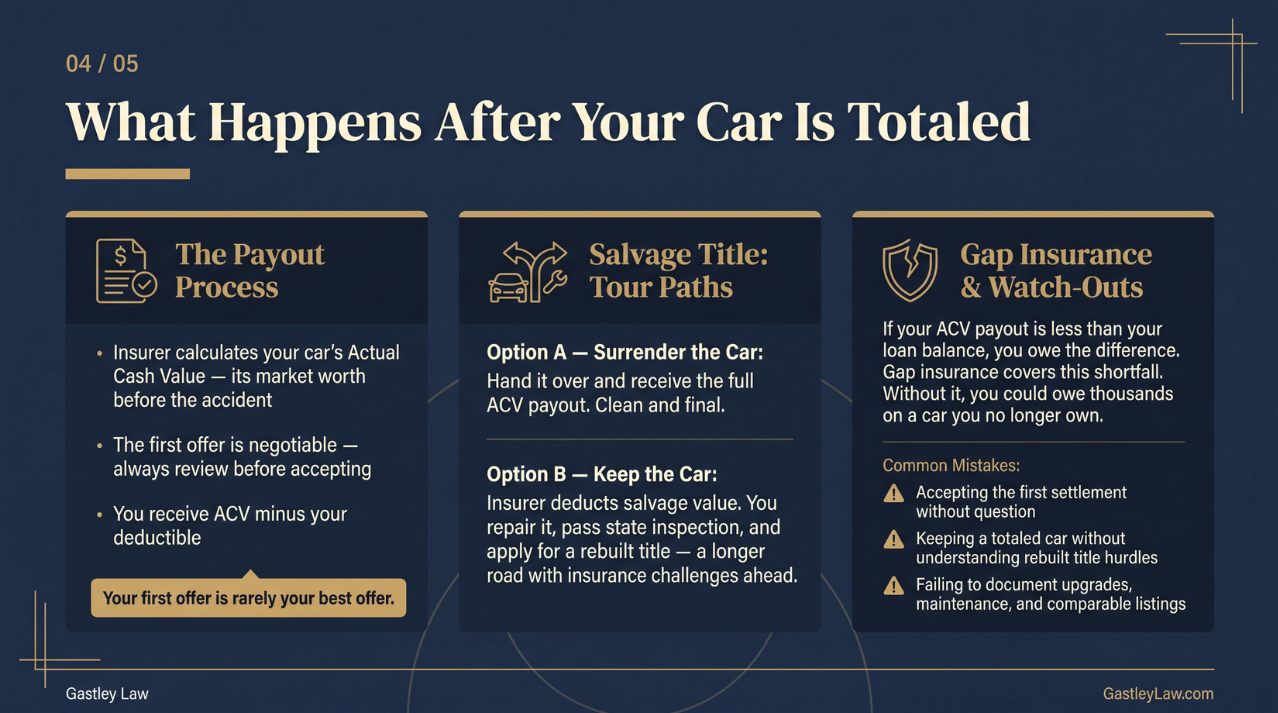
When an insurance company declares your car a total loss, its main job is to figure out how much to pay you. They do this by calculating your car’s “actual cash value,” or ACV, which is what your vehicle was worth the moment before the accident happened. This isn’t what you paid for it or what a new one would cost; it’s the market value considering its age, mileage, and condition. The insurer compares this ACV to the estimated repair costs. If the repairs exceed a certain percentage of the car’s value, as defined by state law, it’s deemed totaled. It’s important to remember that their initial ACV offer is often just a starting point, not the final word on your car’s diminished value.
One of the toughest situations after a total loss is discovering that the insurance payout is less than what you still owe on your car loan. This can happen if your car depreciated faster than you paid down the loan. You are still responsible for paying off the entire loan balance, even without a car to show for it. This is where gap insurance comes in. If you have it, this optional coverage helps pay the difference between the insurance company’s ACV payout and your remaining loan amount. It’s a good idea to check your auto loan and insurance documents to see if you purchased this coverage when you bought your car.
Once a car is declared a total loss, its clean title is replaced with a “salvage title.” This new title is a permanent brand on the vehicle’s record, indicating it has sustained major damage. A car with a salvage title cannot be legally registered or driven on public roads. You typically have two options: surrender the car to the insurance company in exchange for the full ACV payout, or choose to keep it. If you keep the car, the insurer will deduct its salvage value (what they could sell it for) from your settlement. To drive it again, you’d have to get it repaired, pass a state inspection, and apply for a “rebuilt” title. If you’re facing a complex situation with your vehicle’s title, it’s wise to contact us for guidance.
Receiving the insurance company’s decision can feel like the final word, especially when you’re already dealing with the stress of a car accident. But their initial assessment, whether it’s a low repair estimate or a total loss declaration, is just that: an initial offer. It’s not a final verdict, and you have every right to question it. Insurance adjusters are trained to protect their company’s bottom line, which often means paying out as little as possible. If their offer seems unfair or doesn’t cover the full extent of your losses, it’s time to push back.
Challenging their decision isn’t about being difficult; it’s about advocating for yourself and getting the fair compensation you deserve. The key is to approach the dispute with a clear strategy and solid evidence. You can counter their assessment by showing them exactly why your vehicle was worth more than they claim or why their repair estimate falls short. Many people accept the first offer without realizing they have options. By taking a few proactive steps, you can build a strong case that forces the insurer to reconsider their position. It starts with knowing when their assessment is off, getting an expert opinion, and gathering the right documents to prove your point.
Trust your instincts. If the insurance company’s offer feels too low, it probably is. A major red flag is when they declare your car a total loss even when the damage seems repairable. Insurers sometimes do this if they decide repairs are not “economically feasible” for them, a calculation that serves their interests, not yours. You should also be skeptical if the adjuster was rushed during their inspection or relied solely on photos without seeing the vehicle in person. Any offer that doesn’t account for your car’s specific condition, recent upgrades, or low mileage is a clear sign that you need to dispute their assessment.
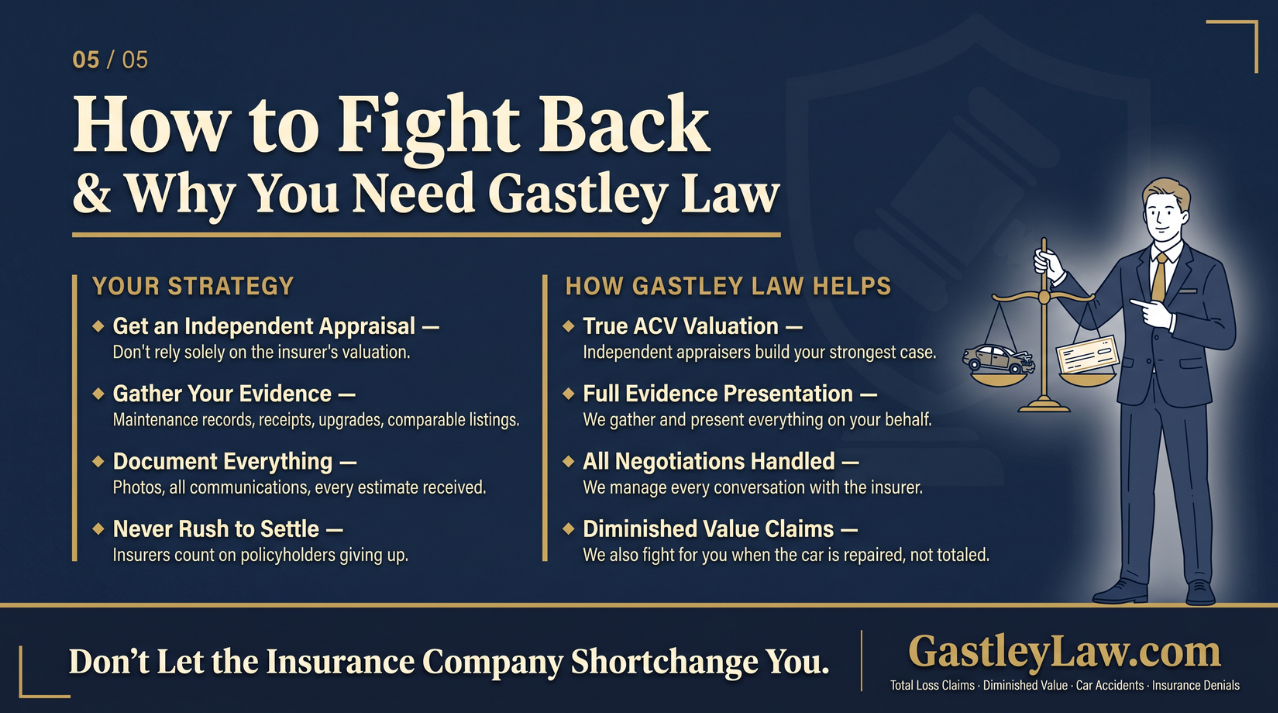
One of the most powerful steps you can take is to get an independent appraisal. This means hiring a qualified, unbiased professional to evaluate your vehicle’s pre-accident value and the full cost of repairs. Unlike the insurance company’s adjuster, an independent appraiser works for you. They will conduct a thorough inspection and create a detailed report that you can use as leverage in negotiations. This professional review provides concrete evidence to counter the insurer’s lowball offer. Presenting a well-documented appraisal shows the insurance company that you are serious about getting a fair settlement and have the facts to back up your claim.
Your car is more than just a number in a valuation guide. To prove its true worth, you need to collect documents that tell its story. Start by gathering all your maintenance records to show the vehicle was well-cared for. Did you recently buy new tires, replace the battery, or install a new stereo system? Find those receipts. Any upgrades or special features add to its value. This paperwork helps you build a case for a higher payout by demonstrating that your car was in better-than-average condition before the accident. This documentation is also crucial for establishing your vehicle’s diminished value, which is the loss in market value even after it’s been repaired.
When an insurance company declares your car a total loss, it can feel like the final word. But it doesn’t have to be. The insurer’s first offer is just that: an offer. You have the power to negotiate for a settlement that truly reflects what your car was worth. Getting the maximum payout requires you to be prepared, proactive, and aware of your rights. It’s about making sure you have the resources you need to get back on the road in a comparable vehicle, not just accepting the first number the adjuster gives you.
The moments after an accident are chaotic, but the actions you take can significantly impact your claim’s outcome. First, document everything. Take photos of the damage from every angle, the accident scene, and any injuries. Keep a detailed record of all communication with the insurance company, including the adjuster’s name, the date, and what was discussed. Don’t rush to accept the initial settlement offer. If you think the insurance company’s offer for your totaled car isn’t fair, you can get a professional review of your claim. An experienced attorney can assess the offer and help you determine the true value of your vehicle to ensure you get a better payout.
One of the biggest mistakes you can make is accepting the first offer without question. Insurance companies are businesses, and their initial offer is often lower than what you’re actually owed. If you believe the insurer has valued your car too low, you have the right to argue for a higher amount. Another common pitfall is deciding to keep the totaled car. While it might seem like a way to salvage some value, it’s usually not worth it. The repair costs are often astronomical, getting a rebuilt title is a difficult process, and you’ll face major challenges trying to insure it afterward. Focus your energy on getting a fair cash settlement instead.
Understanding your rights is your best defense against a lowball offer. As a policyholder, you are entitled to a fair settlement based on your car’s actual cash value right before the accident. You also have options. For instance, you might be allowed to keep a car that’s been declared a total loss, but your insurance payout will be reduced by the car’s salvage value. If you own your car outright with no loan, you can sometimes buy it back from the insurance company for that salvage price. Knowing these details gives you more leverage in negotiations. If you’re unsure about your options or feel the insurer isn’t treating you fairly, don’t hesitate to contact us for guidance.
Dealing with a totaled car is stressful enough without the added pressure of haggling with an insurance company. While many claims can be handled on your own, there are times when the insurer’s offer is simply not fair. Insurance companies are businesses, and their goal is to pay out as little as possible. When their interests conflict with yours, having a legal professional on your side can make all the difference.
An experienced attorney understands the tactics insurers use and knows how to counter them. They work to ensure the settlement reflects your car’s true value, not just the lowest number the insurance company can justify. If you feel like you’re being taken advantage of or the process has become overwhelming, it’s probably a good time to consider getting help. A lawyer can manage the communications, present a solid case on your behalf, and fight for the full compensation you deserve.
Trust your instincts. If the insurance company’s settlement offer feels wrong, it probably is. Watch out for a few key warning signs that indicate you need professional support. The first and most obvious red flag is a lowball offer that won’t even cover your outstanding car loan or the cost of a comparable replacement vehicle. Also, be wary if the adjuster is pressuring you to accept a check immediately. This is often a tactic to get you to settle for less before you’ve had time to assess the offer. If you’ve provided evidence of recent upgrades or a strong maintenance history and they’ve ignored it, it’s time to get help. Don’t let them wear you down; contact us for a case evaluation.
When you hire an attorney, they take over the fight for you. Their first step is to build a case proving your vehicle’s actual pre-accident value. This often involves bringing in an independent appraiser to get an unbiased valuation, which can be much higher than the insurer’s assessment. Your lawyer will also help you gather all the necessary paperwork, including maintenance records, receipts for new tires or parts, and listings for similar vehicles in your area. Armed with this evidence, they will handle all negotiations with the insurance company, using their knowledge of Georgia law to argue for a fair payout. This lets you focus on getting back on your feet while a professional handles the back-and-forth.
Insurance companies have a lot of leeway in their decisions. For instance, they might declare your car a total loss even if the repair costs fall below the official state threshold, simply because it’s cheaper for them. It’s also crucial to understand your own policy. If your car is totaled and the insurance payout is less than what you owe on your loan, you’ll be responsible for the difference unless you have gap insurance. An attorney can review your policy and the settlement offer to protect you from these financial pitfalls. They ensure you understand exactly what you’re owed, including compensation for things like diminished value if your car is repaired instead of totaled.
You absolutely have the right to challenge their number. The insurance company’s initial offer is based on their own valuation, which often uses generic data that might not account for your car’s excellent condition, low mileage, or recent upgrades. To counter their offer, you should gather your own evidence. Collect maintenance records, receipts for new tires or other parts, and find listings for comparable vehicles for sale in your area to prove your car was worth more before the accident.
Yes, it can happen. While the 75% threshold is the primary rule, an insurer might still decide to total your car if they believe it’s the most cost-effective option for them. They might factor in the potential for hidden damages or the high cost of a rental car during a lengthy repair process. Georgia law also allows a car to be totaled if it needs two or more major component parts replaced, which can sometimes occur even if the total repair cost is under that 75% mark.
This is a tough situation, and unfortunately, you are still responsible for paying off the entire loan balance, even if the insurance payout doesn’t cover it. The gap between the insurance check and your loan amount is your responsibility. This is precisely what gap insurance is designed for. If you have this coverage, it will pay that difference for you. If not, you will have to work out a payment plan with your lender.
No, you don’t have to surrender the vehicle. You have the option to keep your car, but it’s a decision you should consider carefully. If you choose to keep it, the insurance company will deduct the car’s salvage value (what they could have sold it for) from your settlement check. The car will be issued a salvage title, meaning you cannot legally drive it until it’s repaired, passes a rigorous state inspection, and is issued a “rebuilt” title.
If you feel the insurance company is being unfair, a lawyer can be a powerful advocate. You should consider getting legal help if the insurer gives you a lowball offer that won’t make you whole, ignores the evidence you provide, or pressures you into a quick settlement. An attorney can manage the entire negotiation process, build a strong case for your car’s true value, and ensure the insurance company treats you fairly according to Georgia law.