
How to Sue an Insurance Company in Small Claims Court
That lowball offer from the insurance company isn’t just frustrating; it’s real money they’re trying to keep from you. Whether it’s for incomplete repairs or the diminished value of your vehicle, every dollar they refuse to pay comes directly out of your pocket. You might feel like fighting back requires expensive legal fees that make it not worth the effort, but that isn’t always the case. For many people in Georgia, the most practical and cost-effective solution is to sue insurance company small claims. This process is specifically designed for recovering amounts under $15,000, and this guide will explain exactly how to do it.
Key Takeaways
- Know your venue: Georgia’s small claims court is a powerful tool for disputes up to $15,000, making it ideal for many property damage and diminished value claims without the cost of a major lawsuit.
- Preparation is everything: Your success hinges on strong evidence and proper procedure. Before filing, send a formal demand letter and gather all documentation, including repair estimates, photos, and correspondence, to build an undeniable case.
- Assess your need for a professional: While you can represent yourself, consider hiring an attorney for complex cases, claims exceeding the $15,000 limit, or when you want an expert to fight the insurer’s lawyers on your behalf.
What Is Small Claims Court?
If you’re in a dispute over money, small claims court offers a faster, more straightforward path to resolving it than traditional court. Think of it as a simplified legal process designed to handle smaller monetary claims without the formal, and often expensive, procedures of a major lawsuit. The main goal here is to get compensation for damages you’ve suffered, not to enforce other actions like restraining orders. This makes it an ideal venue for clear-cut cases where the facts are easy to present.
When you’re dealing with an uncooperative insurance company after a car accident, small claims court can be a powerful tool. It’s a place where you can directly challenge an insurer’s decision without getting tangled in a complex legal battle that drags on for years. Because the process is less formal, many people feel comfortable representing themselves. However, going up against an insurance company’s legal team can still be intimidating. Understanding your options and the strength of your case is the first step, and sometimes, getting professional advice on our services can make all the difference in your approach.
How It Works
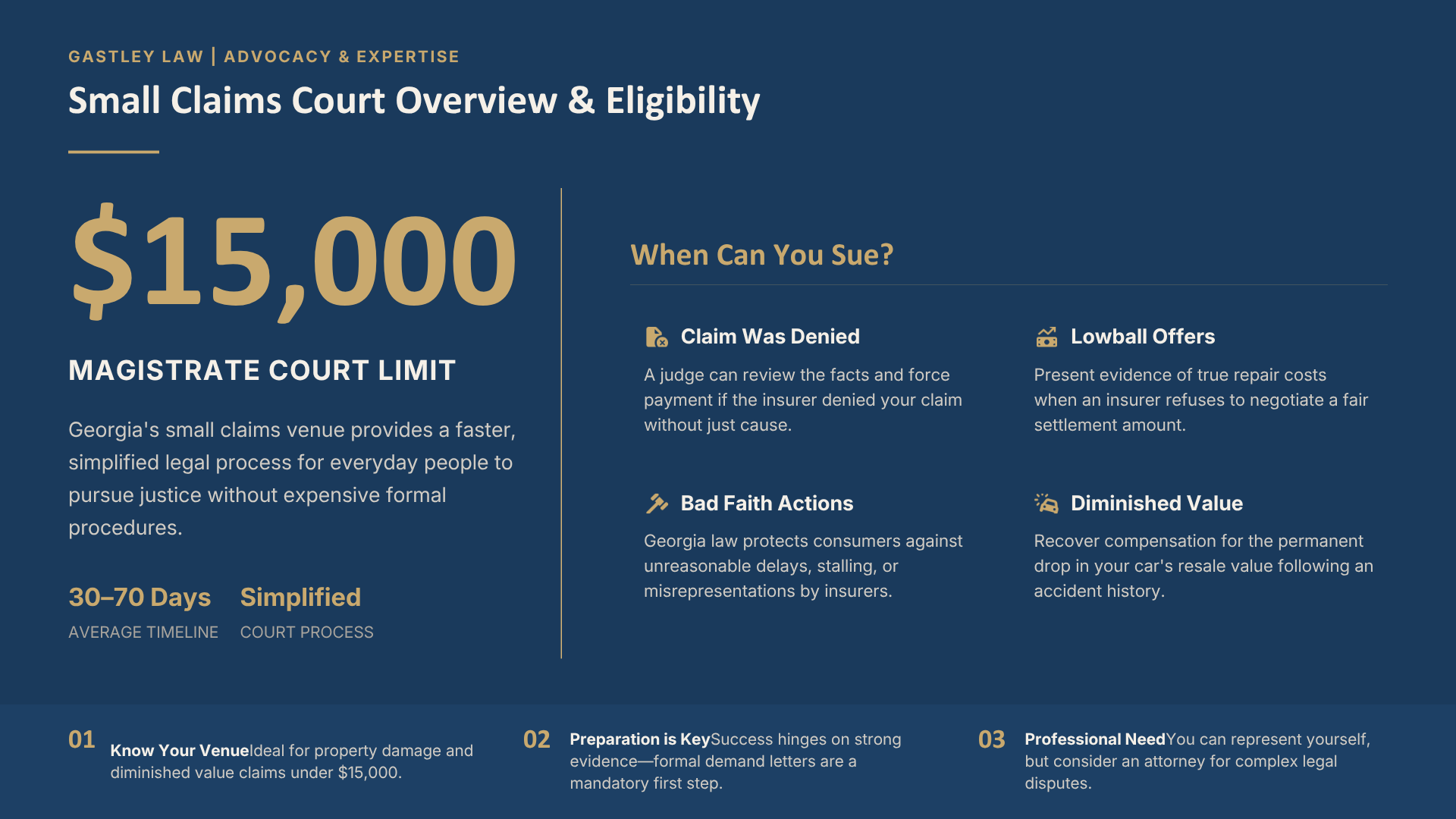
The small claims process is designed to be accessible. You have the right to sue an insurance company if you believe it has unfairly denied your claim or isn’t following the rules. The system is built for speed; you can often get a hearing within 30 to 70 days, which is much faster than a typical lawsuit. The filing fees are also lower, and you don’t need to hire an attorney to represent you. This allows you to present your case directly to a judge and seek a fair outcome for a smaller amount of money without investing a fortune in legal fees. If you’re unsure whether your situation fits the small claims model or if you need help preparing your argument, you can always contact us for guidance.
Georgia’s Small Claims Limits
In Georgia, you can use small claims court, also known as Magistrate Court, to sue for amounts up to $15,000. This is great news for people with significant property damage or diminished value claims that fall under this threshold. If the insurance company’s lowball offer is thousands of dollars less than what you’re owed, but your total claim is still under $15,000, you can file a case to recover the difference. The court is structured to be user-friendly, empowering you to resolve your dispute efficiently. Knowing this limit helps you decide if small claims court is the right path for your specific case.
When Can You Sue an Insurance Company in Small Claims?
Dealing with an insurance company after an accident can be incredibly frustrating, especially when you feel like you’re not being treated fairly. The good news is that you have options. Small claims court can be a powerful tool for individuals to hold insurance companies accountable without the cost and complexity of a major lawsuit. If you find yourself in a standoff with an insurer, it’s helpful to know which situations might justify taking that next step. Here are a few common scenarios where suing in small claims court might be the right move for you.
Your Claim Was Denied
It’s a sinking feeling: you’ve paid your premiums and followed all the rules, only to have your legitimate claim denied. Insurance companies are required to provide a valid reason for a denial, but sometimes their reasoning doesn’t hold up. If you believe your claim was denied without a just cause, you don’t have to accept it as the final word. Filing a suit in small claims court allows a judge to review the facts of your case and the insurer’s decision. This process can force the company to pay a claim they wrongfully rejected. Our firm specializes in these types of property damage claims and can help you fight back.
You Received a Lowball Offer
Insurance adjusters are often trained to minimize payouts to save their company money. This can result in a settlement offer that doesn’t come close to covering your actual repair costs or other losses. You are never obligated to accept an offer that you feel is too low. If the insurance company refuses to negotiate in good faith or present a fair number, small claims court is a practical next step. It gives you the opportunity to present your own evidence, like repair estimates and receipts, to show the true cost of your damages and demand the full amount you are rightfully owed.
The Insurer Acted in Bad Faith
Insurance companies have a legal duty to act in “good faith,” which means they must treat you honestly and fairly. When they fail to do so, it’s known as acting in bad faith. This can include things like unreasonably delaying your claim, failing to conduct a proper investigation, or misrepresenting the terms of your policy. While proving bad faith can be complicated, it’s a serious breach of their responsibility to you as a policyholder. Georgia law provides protections for consumers against these practices, and filing a lawsuit can hold the insurer accountable for their unfair actions.
You’re Claiming Diminished Value
Even after your car is perfectly repaired, its resale value has likely dropped simply because it now has an accident history. This loss in market value is called diminished value, and you are entitled to be compensated for it. Unfortunately, insurance companies are often reluctant to pay these claims and may deny them outright or make an insultingly low offer. If an insurer refuses to fairly compensate you for your vehicle’s lost value, small claims court is an excellent venue to pursue your case. You can present evidence to prove the diminished value and recover the money you deserve.
How to Sue an Insurance Company in Small Claims: A Step-by-Step Guide
Taking on an insurance company can feel like a huge undertaking, but small claims court is designed to be a more accessible legal path for individuals. It’s a place where you can represent yourself and have your case heard without the complexities of a larger lawsuit. If you’re feeling stuck after a denied claim or a lowball offer, this process might be the right next step for you. Let’s walk through exactly what you need to do to prepare and file your case in Georgia.
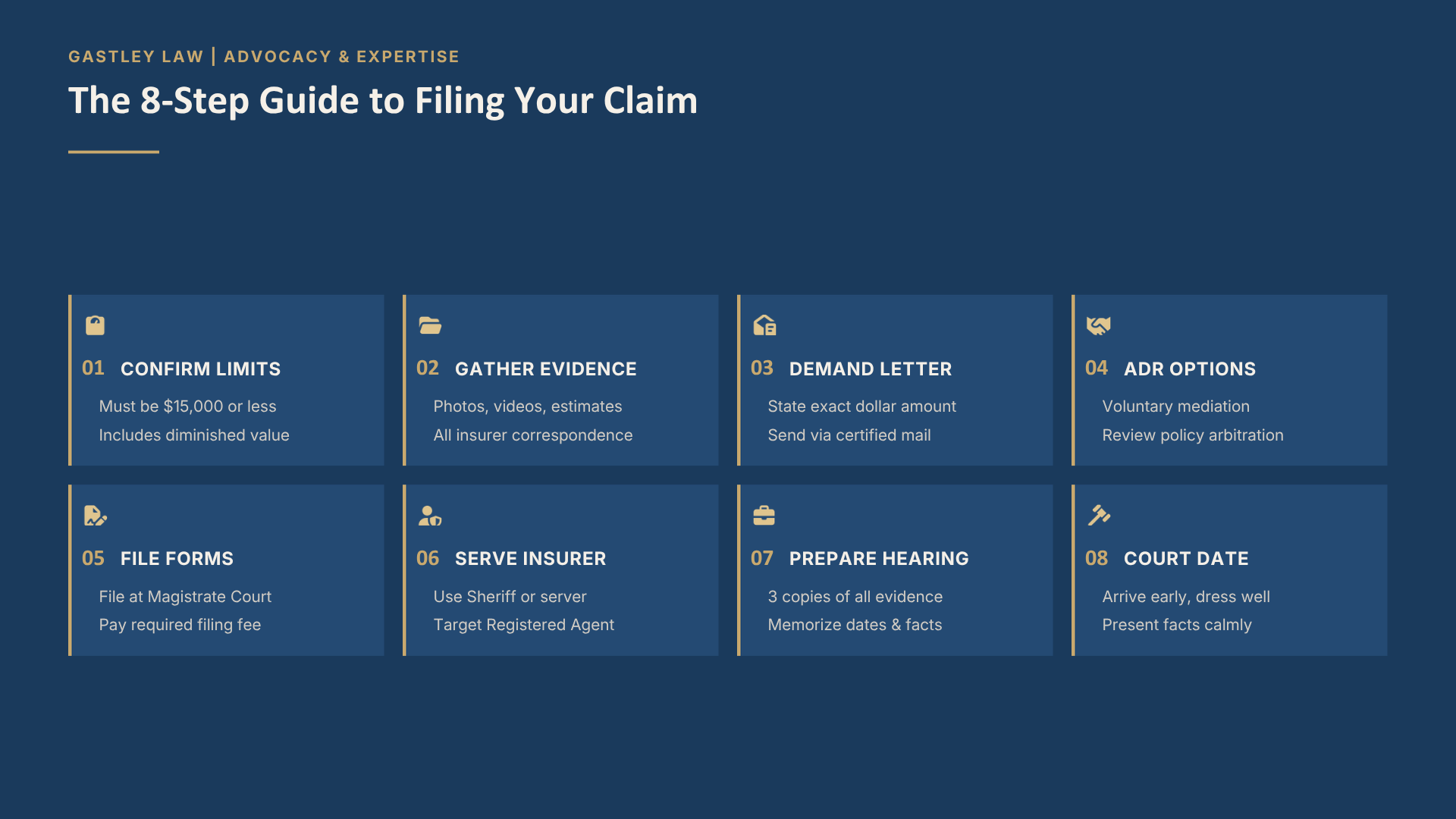
Step 1: Confirm Your Claim Meets Georgia’s Limits
Before you begin, you need to make sure your case is a good fit for small claims court. In Georgia, the primary rule involves the amount of money you’re seeking. The maximum you can sue for in small claims court is $15,000. So, take a moment to calculate the total damages you’re claiming, including repair costs, diminished value, and any other related expenses. If your total is $15,000 or less, you’re in the right place. If it’s more, you may need to consider a different legal route, but for many property damage and diminished value claims, small claims is a perfect fit.
Step 2: Gather Your Evidence
This is where you build the foundation of your case. Your goal is to collect everything that proves what happened and what you’re owed. Strong evidence is your most powerful tool. Start by gathering photos and videos of the vehicle damage from multiple angles. Compile all repair estimates, your final repair bill, and any receipts for out-of-pocket expenses like a rental car. It’s also helpful to include your written correspondence with the insurance company. According to some legal experts, you should collect everything that supports your case, including statements from anyone who saw what happened. The more documentation you have, the clearer your story will be to the judge.
Step 3: Send a Demand Letter
Before you officially file a lawsuit, it’s a good practice to send a formal demand letter to the insurance company. This letter clearly states your case, the facts of the accident, the damages you’ve incurred, and the specific amount you are demanding. It shows the court you made a final, good-faith effort to resolve the issue before taking legal action. A formal letter asking for payment can sometimes be enough to bring the insurer back to the negotiating table with a better offer. Be professional, stick to the facts, and give them a firm deadline to respond, such as 14 or 30 days.
Step 4: Consider Alternative Dispute Resolution
If your demand letter doesn’t lead to a resolution, there’s still another option to consider before heading to the courtroom. Alternative dispute resolution (ADR) includes processes like mediation or arbitration. In mediation, a neutral third party helps you and the insurance company try to reach a mutual agreement. It’s less formal than court and non-binding, meaning you don’t have to accept the outcome. Arbitration is a bit more formal, where an arbitrator hears both sides and makes a decision. Many legal guides suggest you consider mediation or arbitration as a way to potentially save time and money.
Step 5: File Your Small Claims Forms
If you’ve tried the previous steps with no luck, it’s time to officially start the legal process. You’ll need to fill out and file the necessary court forms, which are typically called a complaint or a statement of claim. You can usually find these forms on your local magistrate court’s website. Be prepared to provide the insurance company’s full legal name and address for their registered agent, which you can find on the Georgia Secretary of State’s website. Fill out the forms carefully and concisely, explaining why you are suing and how much you are seeking. Once completed, you’ll file all the necessary court forms with the court clerk and pay a filing fee.
Step 6: Serve the Insurance Company
After filing your lawsuit, you must formally notify the insurance company that you are suing them. This legal notification process is called “service of process.” You can’t just mail the forms yourself; the law requires an impartial third party to do it. In Georgia, you can typically have the papers delivered by the sheriff’s office or a professional process server for a fee. This step is critical because it proves the insurance company was properly notified of the lawsuit. You must make sure the other party officially receives the court papers, as the case cannot move forward until service is complete.
Step 7: Prepare for Your Hearing
Once a court date is set, it’s time to organize your case for the judge. Go back to the evidence you gathered in Step 2 and arrange it in a clear, logical order. Make copies of everything: one for you, one for the judge, and one for the insurance company’s representative. Practice explaining your side of the story out loud so you can present it confidently and concisely. Remember, having good evidence is key, so bring your photos, receipts, the demand letter, and any other documents that support your claim. Being organized and prepared will make a huge difference on your court day.
Step 8: Go to Your Court Date
On the day of your hearing, arrive at the courthouse early to find your courtroom and get settled. Dress professionally, as you would for a job interview. When it’s your turn, present your case to the judge calmly and clearly. Stick to the facts and show your evidence. The insurance company will have a lawyer or representative there who will get to ask you questions, so be prepared to answer them honestly. It’s important to attend all court meetings and always be respectful to the judge and the opposing side. After hearing from both parties, the judge will make a decision, which may be announced that day or mailed to you later.
What Kind of Damages Can You Claim?
When you sue an insurance company, you’re asking the court to award you money for the harm you’ve suffered. In legal terms, this money is called “damages.” Understanding the different types of damages you can ask for is a key part of building your case. The goal is to clearly show the court what you’ve lost and why the insurance company should be responsible for paying for it.
In most small claims cases involving insurance disputes, you’ll focus on recovering your direct financial losses. However, in some rare situations, you might be able to claim additional damages. Let’s break down the two main categories you should know about.
Compensatory Damages
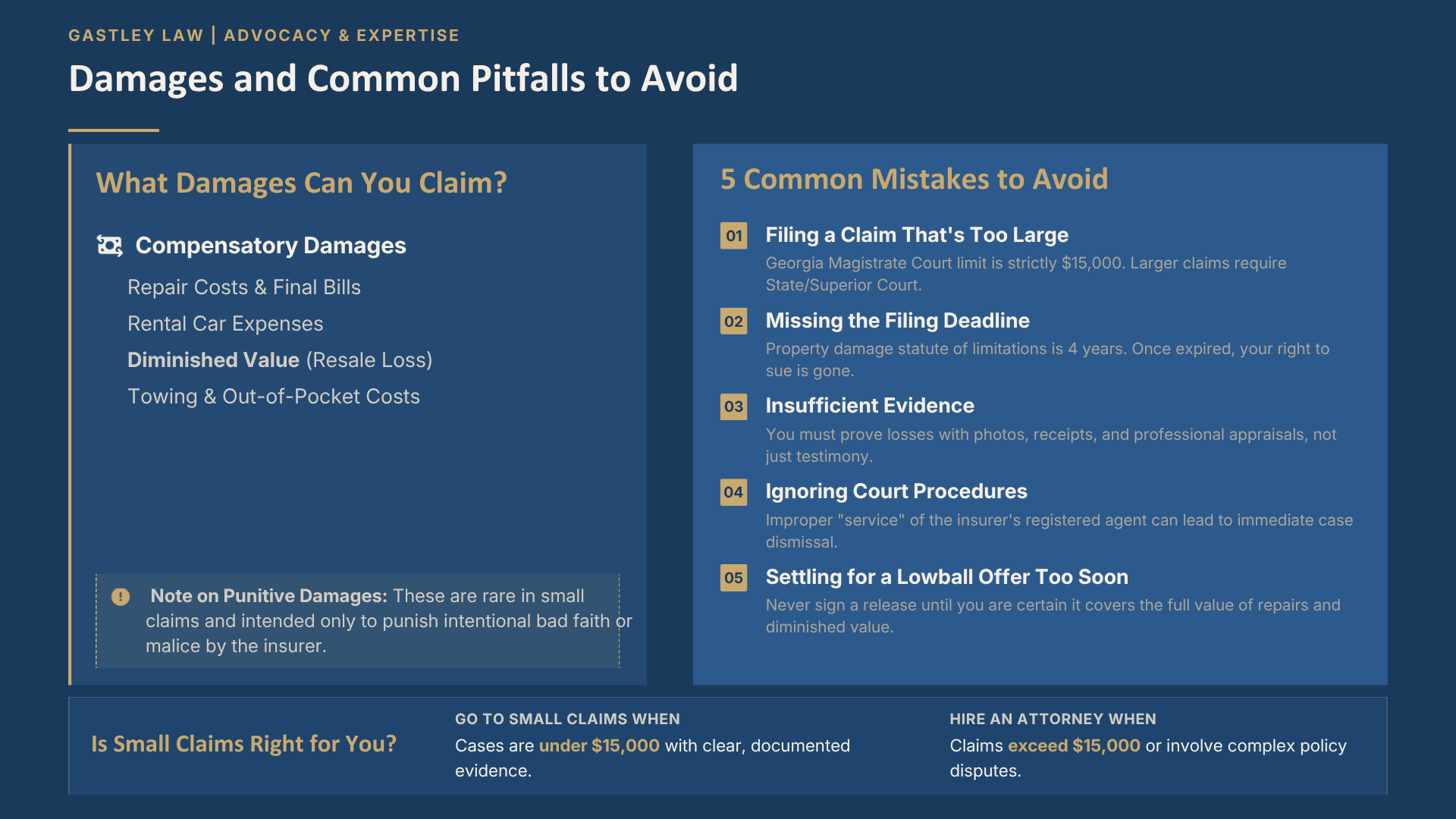
This is the most common type of damages and will likely be the core of your small claims case. Compensatory damages are meant to do exactly what they sound like: compensate you for your actual, out-of-pocket losses. The idea is to restore you to the financial position you were in before the accident or the insurer’s bad decision.
Think about all the costs you’ve had to cover. This includes the obvious ones, like the bill for your car repairs or the cost of a rental car while yours was in the shop. It also includes the loss in your car’s resale value even after it’s been perfectly repaired, which is known as diminished value. Be sure to keep detailed records and receipts for every expense, as you’ll need them to prove your claim.
Punitive Damages
Punitive damages are very different from compensatory damages. They aren’t meant to cover your losses. Instead, they are designed to punish the insurance company for particularly bad behavior and discourage other insurers from acting the same way. To get punitive damages, you have to prove the insurer didn’t just make a mistake; they acted in bad faith, with malice, or with a reckless disregard for your rights.
Frankly, winning punitive damages is rare, especially in small claims court, because the standard of proof is very high. You would need to show that the insurer intentionally did something wrong, like knowingly using a false reason to deny your claim. Because these claims are so complex, they often require the help of an experienced attorney to demonstrate the insurer’s misconduct. Our firm provides a range of legal services to help clients hold insurance companies accountable.
Common Mistakes to Avoid When Suing an Insurer
Taking on an insurance company can feel like a big step, but you can set yourself up for success by avoiding a few common missteps. Knowing what to watch out for will help you build a stronger case and feel more confident as you move forward. From filing deadlines to evidence, let’s walk through the mistakes you’ll want to steer clear of.
Filing a Claim That’s Too Large for Small Claims
Before you file, you need to be sure your claim fits within the monetary limits of small claims court. In Georgia, you can sue for up to $15,000. If your total damages, including repair costs and your car’s diminished value, add up to more than this amount, small claims court isn’t the right venue for your case. You would need to file in a higher court, which has more complex rules and procedures. It’s essential to accurately calculate your losses to ensure you start your legal action in the correct place.
Missing the Filing Deadline
In the legal world, timing is everything. Every state has a “statute of limitations,” which is a strict deadline for filing a lawsuit. In Georgia, you generally have four years from the date of the accident to file a claim for property damage. If you miss this window, the court will likely dismiss your case, even if you have a valid reason to sue. Don’t wait until the last minute. Start the process as soon as possible to protect your right to seek compensation for your damages.
Not Bringing Enough Evidence
A strong case is built on strong evidence. You can’t just tell the judge you’re owed money; you have to prove it. Without clear proof of your damages and what it costs to fix them, a judge may not award you what you deserve. You’ll need to gather all your documentation, including the police report, repair estimates, photos of the damage, and any correspondence with the insurer. For a diminished value claim, an expert appraisal report is a critical piece of evidence to show how much value your car has lost.
Ignoring Court Procedures
While small claims court is designed to be more straightforward than higher courts, it still has rules and procedures you must follow. Legal processes can be complex, and it’s easy to miss an important step or make a mistake if you aren’t familiar with them. For example, you must properly “serve” the insurance company with the lawsuit, which means formally notifying them. Make sure you read the instructions provided by the court carefully and follow them to the letter to prevent your case from being delayed or dismissed on a technicality.
Settling for a Lowball Offer Too Soon
After an accident, it’s tempting to accept the first settlement offer you receive just to get it over with. Insurance companies know this and often make a low offer right away, hoping you’ll take it without asking questions. They might be trying to settle quickly to avoid the costs of going to court. Don’t feel pressured to say yes immediately. It’s important to evaluate any offer carefully to ensure it fully covers all of your losses. If you feel an offer is unfair, you have the right to negotiate or proceed with your claim.
Is Small Claims Court Right for You?
Deciding whether to take an insurance company to small claims court or hire an attorney is a big step. Both paths have their merits, and the right choice depends on the specifics of your case, like the amount of money involved and how complex the situation is. Think of small claims court as the DIY route; it’s faster and less formal, but you’re in the driver’s seat. Hiring an attorney means bringing in a professional to handle the fight for you. Let’s walk through when each option makes the most sense.
When to Go to Small Claims Court
Small claims court is a great option if your case is straightforward and the amount you’re seeking is relatively small. In Georgia, this court (officially called Magistrate Court) handles disputes up to $15,000. If your diminished value claim or repair costs fall within this limit, you can represent yourself without needing a lawyer. The process is designed to be quicker and less formal than traditional court. It’s an effective way to get a resolution when an insurance company has denied a valid claim or given you a lowball offer, and you have clear evidence to back up your side of the story.
When to Hire an Attorney Instead
If your claim is for more than $15,000, you’ll need to file in a different court, and you’ll definitely want an attorney. It’s also wise to hire legal help if your case is complicated. For instance, if the insurance company is arguing complex legal points or claiming your policy doesn’t cover the damage, an experienced lawyer can cut through the jargon and fight back effectively. An attorney understands the insurance company’s tactics and can often negotiate a much better settlement than you could on your own. Think of it as bringing a professional to a professional fight. Our team is experienced in handling these exact types of property damage claims.
What to Expect When Facing the Insurance Company’s Lawyers
Don’t make the mistake of thinking the insurance company will go easy on you in small claims court. They will have skilled lawyers whose only job is to protect the company’s bottom line by paying out as little as possible. They will come prepared to challenge your evidence and question every part of your claim. Without your own legal expert, you could be at a significant disadvantage. If you choose to represent yourself, you must be meticulously prepared with all your documents, photos, and repair estimates in perfect order. A judge can’t award you money for damages you can’t prove.
How Gastley Law Can Help
Going up against an insurance company can feel like an uphill battle, even in small claims court. While it’s possible to sue an insurer without a lawyer, the process is often difficult and full of challenges. Insurance companies have teams of attorneys whose job is to protect the company’s bottom line, which can leave you feeling overwhelmed and outmatched. They understand the system inside and out, and they often count on you not knowing your rights or the full value of your claim.
This is where we come in. At Gastley Law, we level the playing field. Our firm focuses specifically on property damage and diminished value claims, so we know exactly what tactics insurers use to deny claims or make lowball offers. We handle the complex legal procedures and communications for you, allowing you to focus on getting your life back to normal. We believe you shouldn’t have to become a legal expert just to get the fair compensation you’re owed after an accident.
A successful claim depends on strong evidence, and we know what it takes to build a powerful case. We meticulously gather all the necessary documentation, from police reports and repair invoices to expert appraisals that accurately calculate your vehicle’s loss in value. Our team provides the specialized legal representation needed to challenge the insurance company’s arguments effectively. We are prepared to negotiate aggressively on your behalf or take your fight to court. If you’re ready to stop fighting the insurance company alone, contact us to see how we can help.
Related Articles
- Insurance Claim Denials in Georgia | Fight Back with Gastley Law
- Car Insurance Claim Denied? Here’s What to Do Next
- How to Fight a Car Insurance Denial in Georgia
- How to File a Third Party claim in Georgia
- How to Sue an Insurer for Property Damage
Frequently Asked Questions
Do I really need a lawyer for small claims court?
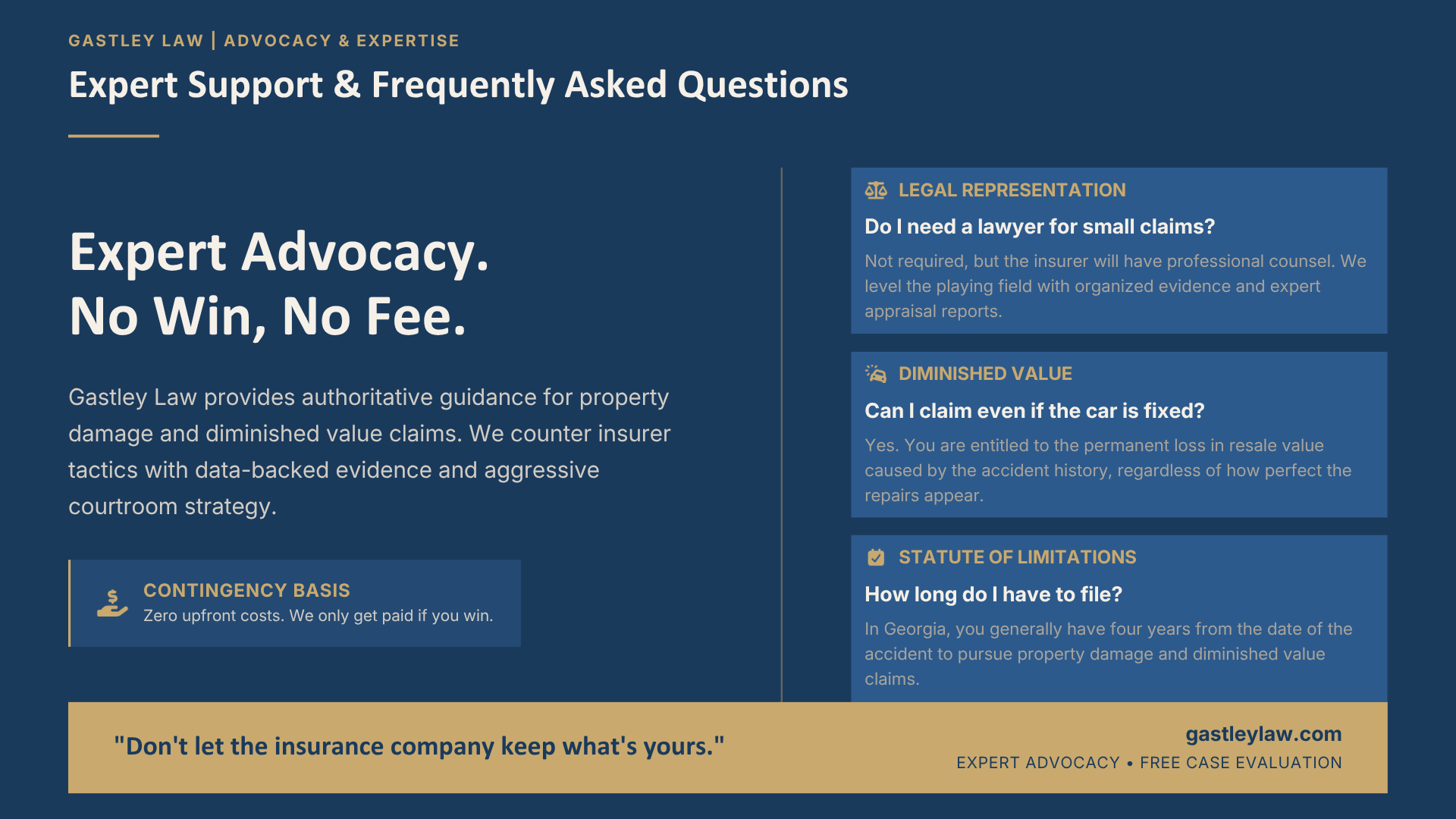
You are not required to have a lawyer in small claims court, and many people successfully represent themselves. However, it’s important to remember that the insurance company will almost certainly have legal representation. Their lawyer’s job is to minimize the payout, so you need to be extremely prepared with your evidence and arguments. If your case involves complex issues or you feel intimidated by the process, getting professional legal advice can give you a significant advantage.
What happens if my damages are more than the $15,000 small claims limit?
If your total claim for repairs and diminished value exceeds $15,000, you cannot use small claims court in Georgia. Instead, you would need to file your lawsuit in a higher court, such as State or Superior Court. These courts have more formal rules and complex procedures, and navigating them without legal representation is very difficult. For claims of this size, working with an attorney is almost always the best course of action.
Can I still claim diminished value if the repairs made my car look perfect?
Yes, absolutely. Diminished value is not about the quality of the repairs; it’s about the loss in your car’s market value simply because it now has an accident history. Even if a car is repaired perfectly, a potential buyer will pay less for it compared to an identical car that has never been in a wreck. You have a right to be compensated for that financial loss, regardless of how good the car looks after being fixed.
What is the single most important thing I need to win my case?
The most critical element of your case is strong, organized evidence. A judge cannot award you money based on your word alone; you must prove your losses. This means you need to present clear documentation, such as photos of the damage, multiple repair estimates, the final repair invoice, and an expert report calculating your car’s diminished value. The more thorough and well-organized your proof is, the stronger your position will be in court.
How long do I have to file a lawsuit for property damage in Georgia?
In Georgia, the law that sets a deadline for filing a lawsuit is called the statute of limitations. For property damage claims, including damage to your vehicle, you generally have four years from the date of the accident to file your case. This is a strict deadline. If you try to file a lawsuit after this period has passed, the court will almost certainly dismiss your case, so it is very important to act promptly.