
Ohio Diminished Value Claim: A Step-by-Step Guide

Let’s say you’re shopping for a used car. You find two identical models with the same mileage and features, but one has been in an accident. You would naturally expect to pay less for the one with the accident history, right? That price difference is its diminished value. Even with perfect repairs, the simple fact of an accident permanently lowers your car’s resale price. In Ohio, the law allows you to recover this financial loss from the at-fault driver’s insurance. This article breaks down exactly what an Ohio diminished value claim is and how you can successfully prove your case.
Key Takeaways
- Know your rights and your deadline: In Ohio, you can file a claim against the at-fault driver’s insurance as long as you’re not primarily responsible for the accident, but you must act within the strict two-year statute of limitations.
- Your opinion isn’t enough, get an expert: The most powerful tool for your claim is a professional appraisal report. This independent valuation provides the credible evidence needed to prove your car’s loss in value and counter lowball offers.
- Don’t take no for an answer: Expect the insurance company to challenge your claim or offer a low settlement. A denial isn’t the end, so be prepared with all your documentation and consider seeking legal advice to fight for the compensation you deserve.
What is a diminished value claim in Ohio?
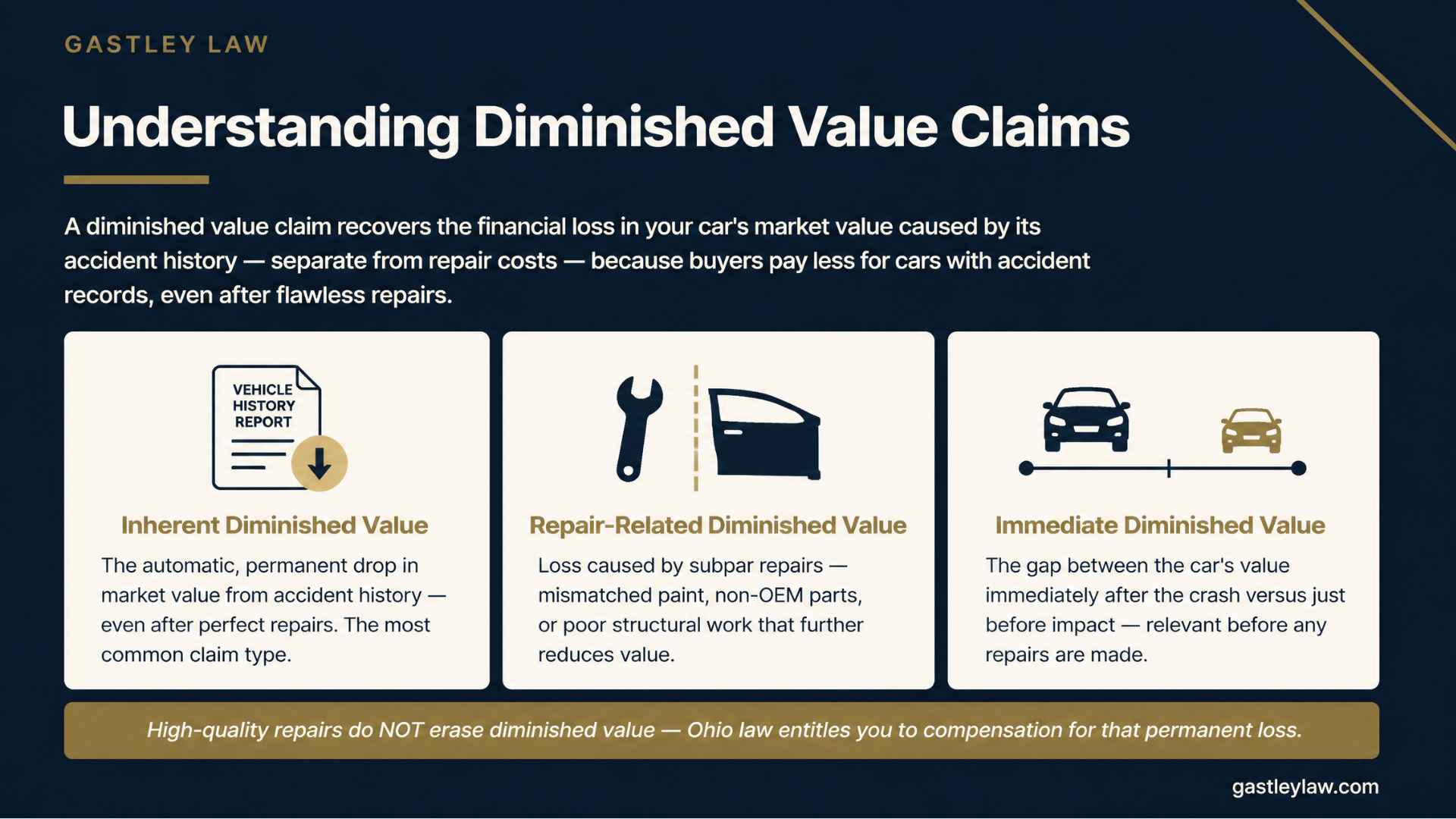
Even after your car has been perfectly repaired following an accident, it’s worth less than it was before. Why? Because it now has an accident history. A diminished value claim is how you can recover that financial loss. Think of it this way: if you were buying a used car and had to choose between two identical models, but one had been in a wreck, you’d expect to pay less for the one with the accident history. That price difference is its diminished value.
In Ohio, a diminished value claim lets you seek compensation for this exact loss in market value. It acknowledges that the simple fact of an accident makes a vehicle less desirable to future buyers, permanently lowering its resale price. This claim is separate from the money you receive for repairs; it specifically covers the drop in your car’s inherent worth. It’s about making you whole again by addressing the value that even the best body shop can’t restore.
The different types of diminished value
When you hear people talk about diminished value, they are usually referring to one of three types. Understanding the difference can help you figure out what your claim should cover.
- Inherent Diminished Value: This is the most common type of claim. It’s the automatic loss in value your car suffers just by having an accident on its record, even if the repairs are flawless.
- Repair-Related Diminished Value: This applies when the repairs themselves are subpar. Maybe the new paint doesn’t quite match the original, or there are noticeable signs of the work done. This type of diminished value is due to the quality of the repair, not just the accident history.
- Immediate Diminished Value: This is the difference in the car’s value right after the accident, before any repairs have been made.
For most people, the focus will be on inherent diminished value, as it’s the most predictable and widely accepted loss.
Understanding Ohio’s diminished value laws
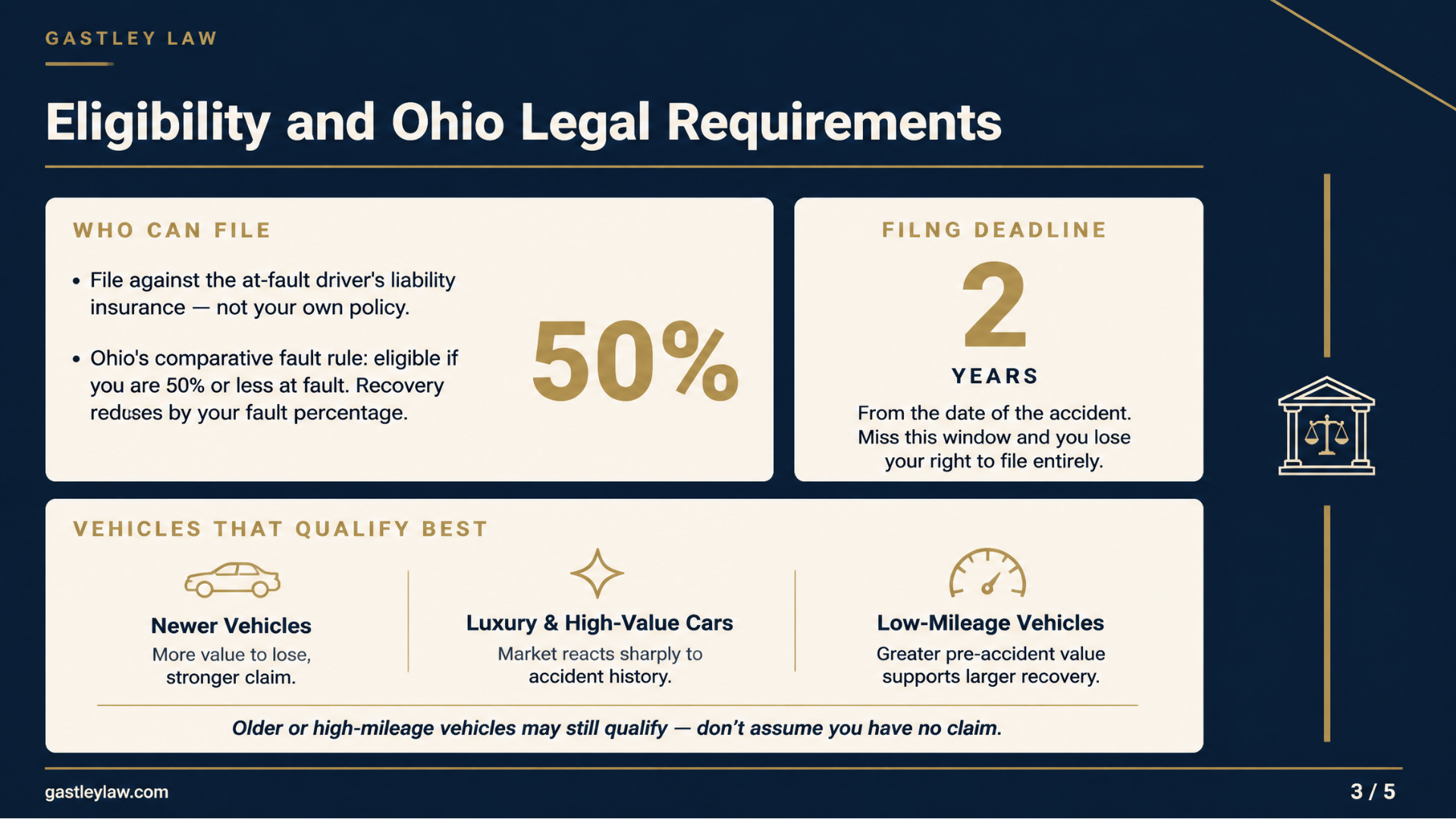
Navigating the rules for a diminished value claim in Ohio is straightforward once you know the basics. First, you can only file a claim against the at-fault driver’s insurance company, not your own. This means you must not have been the one who caused the accident. However, Ohio law is flexible. Thanks to its comparative fault rule, you can still file a claim as long as you are found to be 50% or less at fault for the collision.
The clock is ticking from the day of the accident. You have a two-year statute of limitations to file your claim, so it’s important to act promptly. To build a successful claim, you’ll need to provide solid proof of your vehicle’s reduced value. This is typically done by getting a report from a credible, independent appraiser who can accurately calculate the loss.
Can you file a diminished value claim in Ohio?
If you’ve been in a car accident in Ohio, getting your car repaired is just the first step. Even after it’s fixed, your vehicle now has an accident history, which can significantly lower its resale value. The good news is that you may be able to recover that lost value through a diminished value claim. Ohio law allows you to file a claim against the at-fault driver’s insurance company, but there are a few key requirements you’ll need to meet first. Understanding these rules is the first step toward getting the full compensation you deserve.
Who is eligible to file?
The most important rule for filing a diminished value claim in Ohio is that you cannot have been at fault for the accident. This type of claim is filed with the other driver’s insurance company, not your own. So, if another driver was responsible for the collision, you are eligible to pursue a claim for your car’s loss in value. If the accident was your fault, or if you’re in a situation where fault is shared, you generally won’t be able to file this specific type of claim. It’s a straightforward but critical distinction that determines whether you can move forward.
Does your vehicle qualify?
Not every car that has been in an accident will have a strong diminished value claim. Insurance companies look at several factors to determine if a payout is warranted. A key element is your vehicle’s pre-accident value. Newer cars, luxury models, and vehicles with low mileage tend to suffer a more significant drop in value after an accident, making their claims more substantial. Conversely, an older car with high mileage and pre-existing damage might not have a strong case. Understanding exactly what diminished value is and how it applies to your specific vehicle is crucial before you begin the filing process.
The two-year filing deadline you can’t miss
In Ohio, you have a limited window to take action. The statute of limitations for filing a diminished value claim is two years from the date of the accident. This is a strict deadline, and if you miss it, you lose your right to pursue compensation for your vehicle’s lost value. While two years might sound like a long time, it can pass quickly. Gathering evidence, getting a professional appraisal, and negotiating with the insurance company all take time. It’s always best to start the process as soon as possible after your vehicle has been repaired to ensure you don’t miss this critical cutoff.
How to file your diminished value claim in Ohio
Filing a diminished value claim might seem complicated, but it boils down to a clear, manageable process. Think of it as building a case for the value your car has lost. It requires careful preparation, solid evidence, and a bit of persistence. By following the right steps, you can confidently present your claim to the insurance company and argue for the compensation you deserve. We’ll walk through exactly what you need to do, from gathering your paperwork to formally submitting your claim. Let’s get started.
Gather the right documents and evidence
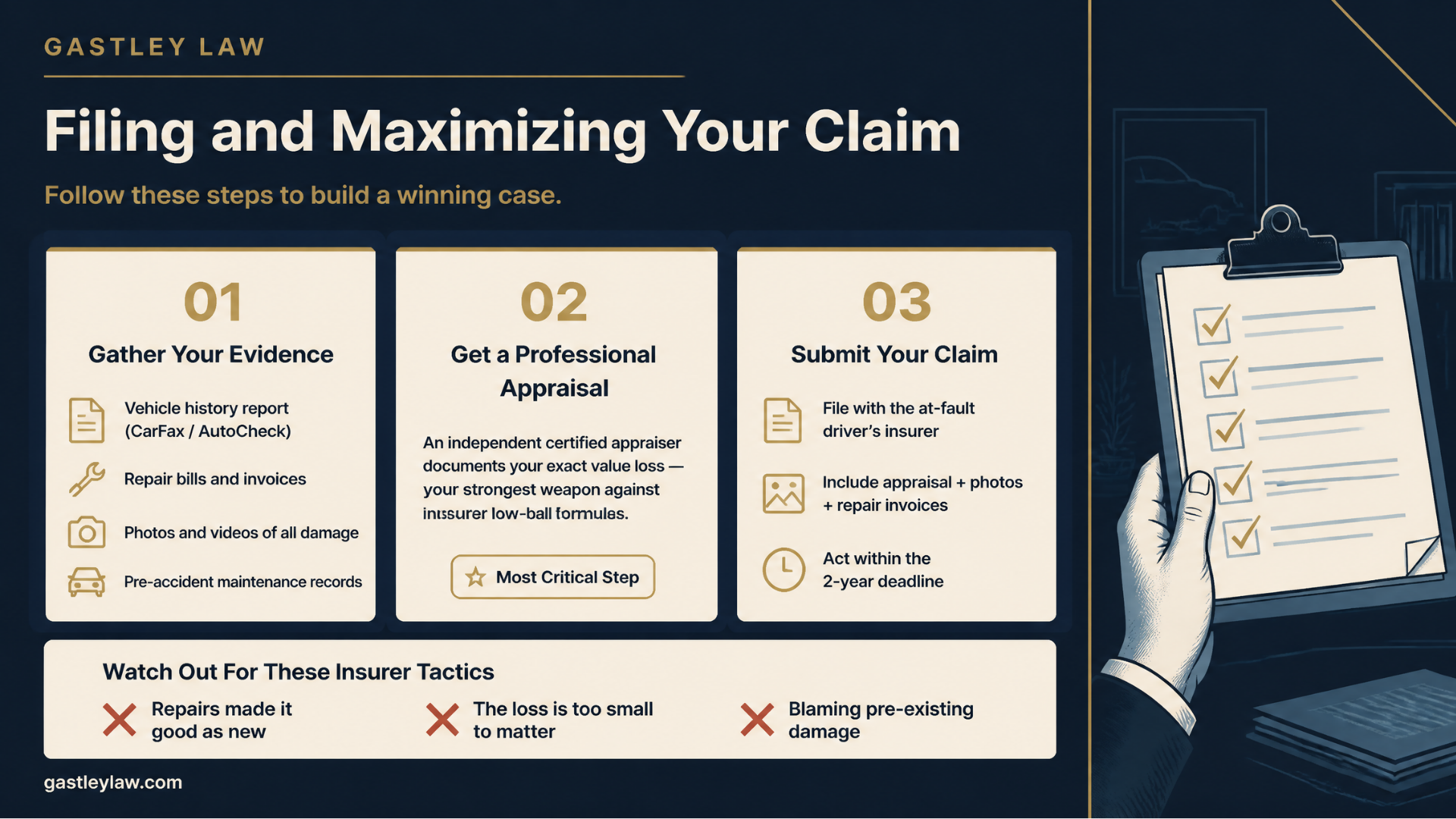
A strong claim is built on strong evidence. Your first step is to collect every piece of paper and every photo related to the accident and your vehicle. Start with a vehicle history report from a service like CarFax or AutoCheck to show the accident is now on your car’s record. You’ll also need detailed repair bills that list every part and service. Don’t forget to include any photos you took at the scene and during the repair process. The more documentation you have, the harder it is for an insurance company to dispute the facts. Having all your evidence organized makes the entire process smoother and shows the insurer you mean business.
Get a professional appraisal
This is the most important piece of your puzzle. A Diminished Value Appraisal Report from a certified professional is the expert testimony that proves your car’s loss in value. An appraiser will look at your vehicle’s condition before the accident, the extent of the damage, the quality of the repairs, and the current market for similar cars in Ohio. This isn’t just a guess; it’s a calculated assessment that gives your claim credibility. Without a professional appraisal, you’re just giving the insurance company a number. With one, you’re presenting them with an expert valuation they have to take seriously.
Follow this step-by-step filing process
Once your evidence is compiled and you have your appraisal report, it’s time to file. In Ohio, you must file your claim within two years of the accident, so don’t wait. It’s also important to know that you can only file a diminished value claim against the at-fault driver’s insurance company; you can’t file one if you were responsible for the crash. Be prepared for the insurer to push back. They often argue that repairs made the car “good as new” or that your vehicle had prior issues. If you find yourself facing these tactics, it might be time to get some help to ensure your claim is handled fairly.
Common challenges you’ll face with your claim
Filing a diminished value claim sounds straightforward, but you’ll likely hit a few bumps along the way. Insurance companies are businesses, and their goal is often to pay out as little as possible. It’s common for them to push back, hoping you’ll simply give up and accept their initial assessment.
You might hear adjusters say that the repairs made your car “as good as new,” so there’s no loss in value to claim. They may also argue that the diminished value is too small to matter or even try to blame pre-existing issues with your vehicle. These are standard tactics designed to protect their bottom line, not yours. Knowing what to expect is the first step in preparing a strong response and standing up for the compensation you deserve.
How to handle insurance company tactics
When you’re up against an insurance company, preparation is your best defense. They have teams of experts working for them, so you need to counter with solid evidence. Start by gathering every piece of documentation related to the accident and repairs. This includes a detailed, itemized repair bill, clear photos of the damage before and after repairs, and any records of your car’s value before the crash.
Because insurance companies can be so tough, having an expert in your corner can make all the difference. A lawyer who specializes in property damage claims can protect your rights and ensure your evidence is presented effectively. They know the tactics adjusters use and can build a case that’s difficult to dispute, taking the pressure off you.
Don’t fall for these common myths
One of the biggest myths you’ll hear is that high-quality repairs restore your car to its pre-accident condition, erasing any loss in value. This is simply not true. Even with perfect repairs, a vehicle with an accident history is worth less to a potential buyer than one without. The accident report is a permanent part of your car’s record, and that history alone diminishes its market value.
Another common misconception is that a previous accident automatically disqualifies your vehicle from a diminished value claim. While a prior accident can make the calculation more complex, it doesn’t necessarily mean you can’t file. As long as you can prove the most recent accident caused a new, distinct loss in value, you may still have a valid claim.
Proving your vehicle’s loss in value
To successfully prove your claim, you need to show concrete evidence of what diminished value is and how it applies to your car. Your opinion alone won’t be enough; you need documentation that clearly demonstrates the financial loss. Start by getting a vehicle history report from a service like CarFax or AutoCheck, which will officially record the accident.
From there, gather your detailed repair bills and photos. The most critical piece of evidence is an independent appraisal from a certified expert who specializes in diminished value. This report will provide a credible, unbiased assessment of your car’s value before the accident and its reduced value after repairs. This expert analysis is the foundation of a strong claim and gives the insurance company a specific, documented number to work with.
How to get the most from your diminished value claim
Getting the full compensation you deserve after an accident isn’t always straightforward. Insurance companies are businesses, and their goal is often to pay out as little as possible. To get the most from your diminished value claim, you need to approach the process with a solid strategy. This means doing more than just submitting a form; it involves building a powerful argument backed by credible evidence. By taking a few key steps, you can significantly strengthen your position and show the insurer that you’re serious about receiving a fair settlement for your vehicle’s loss in value.
The key is to be prepared. Having your documentation in order, getting an expert opinion on your car’s value, and understanding how to handle negotiations will put you in control. Let’s walk through how you can build a strong claim from the ground up.
Build a bulletproof case
The foundation of any successful diminished value claim is solid proof. You can’t just say your car is worth less; you have to prove it with clear documentation. Start by gathering every piece of paper related to the accident and your vehicle. This includes the accident report, detailed repair invoices, and photos of the damage both before and after the repairs. You should also get a vehicle history report from a service like CarFax or AutoCheck, which will officially record the accident. This report is crucial because it’s what future buyers will see, proving the what is diminished value is a real, tangible loss. Think of it as creating a complete story of your car’s journey, with every detail accounted for.
Work with a professional appraiser
While your own documentation is important, an independent appraisal is your most powerful tool. An insurance company will perform its own assessment, which will almost certainly undervalue your claim. To counter this, you need an unbiased, expert opinion. Hire a professional appraiser who specializes in diminished value. They will conduct a thorough inspection and create a detailed report that calculates your vehicle’s specific loss in value after the accident and repairs. This professional report gives your claim immediate credibility and provides a concrete number to use in negotiations, making it much harder for the insurance company to justify a lowball offer.
Negotiate effectively with the insurance adjuster
Once you submit your claim and appraisal, the negotiation begins. Be prepared for the insurance adjuster to push back. They might argue that the repairs restored your car to its pre-accident condition or that your vehicle had prior issues. These are common tactics used to minimize payouts. This is where having an expert on your side can make all the difference. An attorney who specializes in property damage claims understands these strategies and knows how to counter them effectively. They can handle the back-and-forth with the adjuster, present your evidence persuasively, and fight to ensure you receive the full amount you’re owed. If you feel overwhelmed, don’t hesitate to contact us for help.
What to do if your claim gets denied

Getting a denial letter from an insurance company is incredibly frustrating, but it’s not the final word. Insurance companies often deny claims initially, hoping you’ll simply give up. Think of a denial as the start of a negotiation, not the end of the road. You have several options for pushing back and fighting for the compensation you deserve. The key is to be persistent and methodical in your approach.
Don’t let a denial discourage you. With the right strategy, you can challenge the insurance company’s decision and continue to pursue your claim. It’s important to understand the steps you can take, from simple follow-ups to getting professional help. Knowing your options will empower you to handle the situation effectively and increase your chances of a successful outcome. Remember, you are your own best advocate, and taking these next steps can make all the difference.
The appeals process
Your first move after a denial should be to appeal the decision directly with the insurance company. This often involves resubmitting your original paperwork along with a formal letter of appeal. It’s a good idea to call the adjuster to discuss the denial and ask for a specific reason in writing. Sometimes, a claim is denied due to a simple clerical error or a misunderstanding. This follow-up gives you a chance to provide any missing information or clarify details that may have been overlooked. This simple act of persistence shows the insurer you’re serious about your claim and won’t be easily dismissed.
When to call a lawyer
If your appeal is denied or the insurance company refuses to negotiate in good faith, it’s time to bring in a professional. A lawyer who specializes in diminished value claims understands the tactics insurance companies use and knows how to counter them. They can handle all communication, manage the complex legal procedures, and apply pressure on the insurer to offer a fair settlement. When the insurance company sees you have legal representation, they often take your claim more seriously. An attorney can ensure your rights are protected and fight for the full amount you are owed.
Exploring your other options
A denied claim doesn’t change the fact that your vehicle lost value because of an accident that wasn’t your fault. If the insurance company won’t budge, you still have options. An attorney can help you evaluate the strength of your case and decide if filing a lawsuit is the right next step. Pursuing legal action can be a powerful way to hold the at-fault party’s insurance company accountable. If you’re feeling stuck or unsure what to do next, a free case evaluation can provide clarity. You can contact us to discuss the specifics of your situation and get expert advice on how to proceed.
Related Articles
- Diminished Value Claims | Gastley Law
- Your 5-Step Third Party Diminished Value Claim Process
- Diminished Value Claims in Georgia | Gastley Law
- Florida Diminished Value Claim: A Step-by-Step Guide
- How to Win Your California Diminished Value Claim
Frequently Asked Questions
Can I file a diminished value claim if the accident was partially my fault?
Yes, you might be able to. Ohio follows a comparative fault rule, which means you can still seek compensation as long as you are found to be 50% or less responsible for the accident. The amount you can recover would be reduced by your percentage of fault. For example, if you were found to be 20% at fault, you could still claim 80% of your car’s diminished value from the other driver’s insurance.
Do I really need to hire a professional appraiser for my claim?
While you can file a claim without one, a professional appraisal is the single most important piece of evidence you can have. An insurance company will have its own methods for calculating value, which are designed to save them money. An independent, certified appraisal provides an unbiased, expert valuation that is difficult for an insurer to ignore. It transforms your claim from a simple request into a documented, credible demand.
Is it worth filing a claim if my car is older or has high mileage?
It depends, but you shouldn’t automatically assume it isn’t worth it. While newer, low-mileage, and luxury vehicles typically see the largest drop in value, any car with a clean history can suffer a financial loss after an accident. The key is whether the loss in value is significant enough to justify the claims process. A professional appraiser can help you determine the potential value of your claim before you invest too much time and effort.
Why can’t I file a diminished value claim with my own insurance company?
In Ohio, your own auto insurance policy is designed to cover the cost of repairs to restore your vehicle’s function and appearance, not to compensate for its loss in market value. Diminished value is considered a financial loss caused by the negligence of another driver. Therefore, the claim must be made against the at-fault driver’s liability insurance, which is responsible for covering the damages they caused.
What if the at-fault driver’s insurance company offers me a quick, small settlement?
You should be very cautious. A quick offer is often a tactic used by insurance companies to settle a claim for a fraction of its true worth before you have time to get a professional appraisal. They are hoping you will take the easy money and close the case. It’s always best to politely decline any initial offers until you have a certified appraisal report that shows the true, documented loss in your vehicle’s value.