
Negotiating With an Insurance Adjuster: A Simple Guide
It’s surprisingly easy to hurt your own car accident claim without even realizing it. A simple “I’m sorry” at the scene or accepting the first settlement offer can cost you thousands. Insurance adjusters are trained to use these common mistakes to their advantage, justifying a lower payout for your vehicle’s damage and diminished value. Before you even pick up the phone, knowing what not to do is just as important as knowing what to do. This guide is your roadmap for avoiding the costly pitfalls of negotiating with an insurance adjuster. We’ll cover the most frequent errors people make and provide smart, straightforward strategies to protect your claim.
Key Takeaways
- Understand the adjuster’s role: Remember that the insurance adjuster’s primary goal is to protect their company’s finances by settling your claim for the lowest possible amount. This isn’t personal; it’s a business negotiation.
- Preparation is your best tool: Before you even speak to an adjuster, build a strong case by gathering all your documents, getting independent repair estimates, and securing a diminished value report. This evidence is the foundation of your negotiation.
- Counter common tactics strategically: Always reject the first low offer with an evidence-based counteroffer, politely refuse recorded statements, and document every conversation. If the adjuster uses delays or pressure, recognize these as signs that you may need legal support to get a fair outcome.
What’s an Insurance Adjuster’s Goal?
After a car accident, one of the first people you’ll speak with is an insurance adjuster. It’s easy to assume they’re on your side, there to help you get back on your feet. But it’s important to remember who they work for: the insurance company. Their primary role is to protect the company’s financial interests, which means settling your claim for the lowest amount possible.
Understanding their objective is the first step in protecting your own interests. The adjuster is a trained negotiator whose job is to investigate your claim and determine how much the insurance company should pay. While they may be friendly and seem helpful, their goal is fundamentally at odds with yours. You want to receive full and fair compensation for your property damage and losses, while they are tasked with minimizing that payout. This doesn’t make them bad people; it just means you’re in a business negotiation, and you need to be prepared.
What Insurance Adjusters Do
An insurance adjuster’s official job is to investigate claims on behalf of their company. This involves gathering facts about the accident, reviewing police reports, looking at photos of the damage, and speaking with everyone involved. After their investigation, they determine who was at fault and assess the extent of the damages.
From there, their main function is to negotiate a settlement with you. They will make an offer to cover the costs of repairs or the value of your car if it’s a total loss. This negotiation is a standard part of the process. Their job is to close your claim quickly and for as little money as possible. Knowing this helps you approach the conversation with the right mindset.
How Adjusters Evaluate Claims
Adjusters use a specific process to put a dollar value on your claim. They’ll look at the cost of repairs from their network of approved body shops and compare it to your car’s actual cash value (ACV) right before the accident. If the repair costs exceed the car’s value, they will declare it a total loss. They also review your statements and any medical reports to assess the scope of the claim.
A key part of their evaluation is looking for reasons to reduce the payout. They will listen carefully to everything you say, and any casual comment like “I’m fine” can be used to downplay your claim later. They also calculate the diminished value of your vehicle, which is the loss in resale value your car suffers after being in an accident, but their initial calculation is often far lower than what you’re truly owed.
Why Adjusters Offer Low Settlements
Insurance companies are businesses, and their profitability depends on paying out less in claims than they collect in premiums. Because of this, adjusters are trained to start with a low settlement offer. They know many people are stressed after an accident and just want to get the process over with. They hope you’ll accept the first offer without question.
This initial offer is a starting point for negotiation, not a final decision. The insurance company is testing the waters to see if you understand the actual value of your claim. They are counting on you not having all the evidence or expertise to challenge their assessment. This is why it’s so critical to never accept the first offer and to be ready to present a counteroffer backed by solid proof of your losses. If you feel overwhelmed, it might be time to contact us for support.
How to Prepare for Your Negotiation
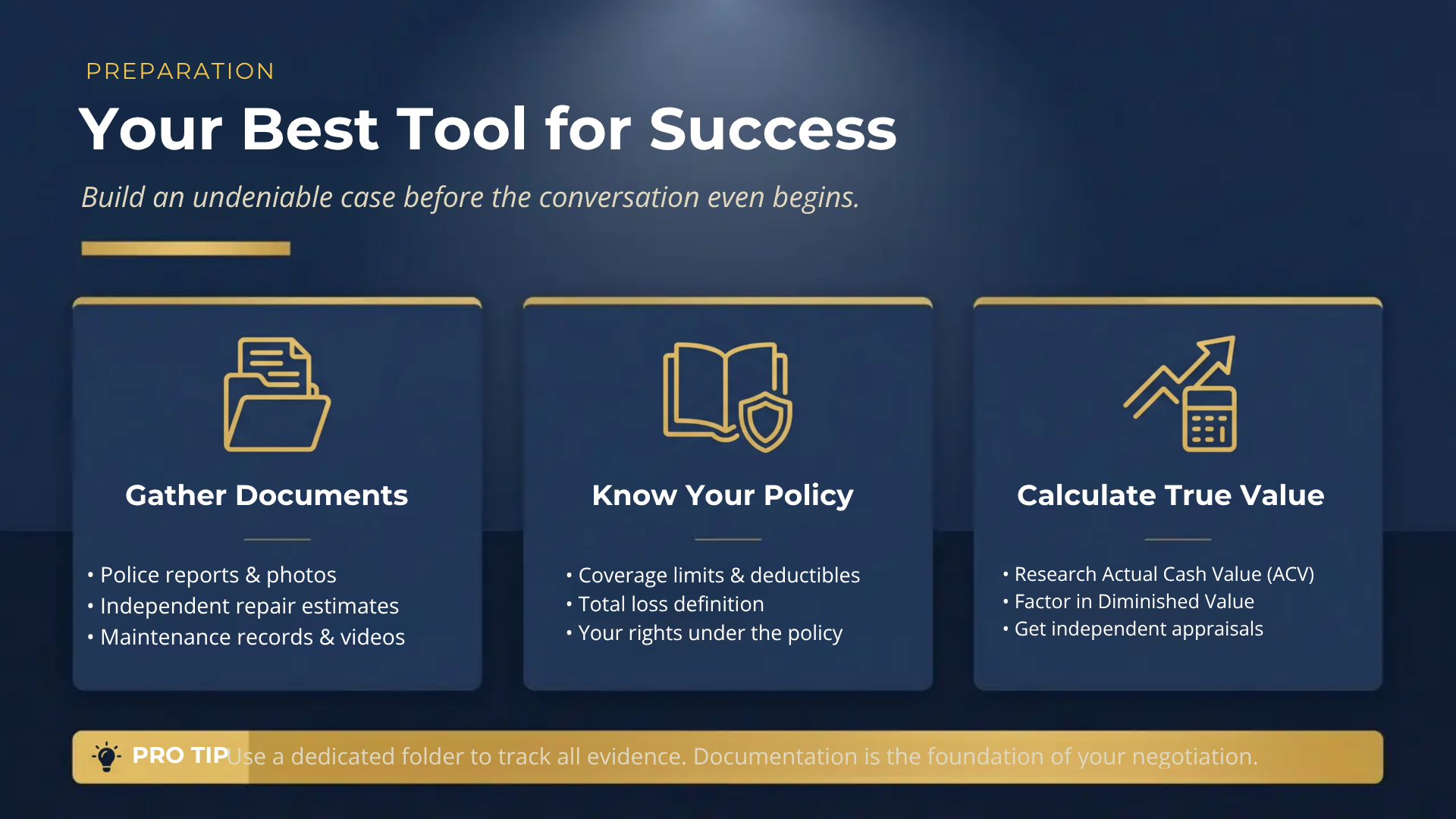
Walking into a negotiation with an insurance adjuster unprepared is like taking a test you didn’t study for. You’re putting yourself at a major disadvantage from the start. The adjuster handles claims like yours every single day; they have a refined process and a clear goal, which is to settle your claim for the lowest amount possible to protect their company’s bottom line. Your best defense is solid preparation. By taking the time to get organized, you shift the power dynamic. Instead of just reacting to their offer, you can lead the conversation with facts, figures, and evidence that support your position.
Being prepared shows the adjuster you’re serious and won’t be easily pushed around or intimidated by industry jargon. It means gathering all your paperwork, understanding the fine print of your insurance policy, and coming up with a clear, justified number for what you believe your claim is worth. This isn’t about being aggressive; it’s about being thorough and professional. When you have everything you need at your fingertips, you can confidently and calmly state your case, making it much harder for them to dismiss your claim. Let’s break down exactly what you need to do to get ready.
Gather Your Documents
Think of yourself as a detective building a case. Your goal is to collect undeniable proof of your car’s value and the damages it sustained. The more evidence you have, the harder it is for an adjuster to justify a lowball offer. Start by creating a dedicated folder (physical or digital) for everything related to the accident. This includes the police report, photos and videos of the accident scene and vehicle damage, and repair estimates from trusted body shops. You should also gather your car’s title, maintenance records, and any recent appraisals to establish its pre-accident condition and value. This documentation is the foundation of your claim for diminished value and property damage.
Know Your Insurance Policy
Your insurance policy is a contract, and it’s essential to know what it says before you talk to an adjuster. Don’t just rely on your memory or what an agent told you when you signed up. Pull out the actual document and read the sections related to property damage and total loss. Understand your coverage limits and your deductible. Pay close attention to how your policy defines a “total loss,” which is typically when the cost of repairs exceeds a certain percentage of the car’s actual cash value. Knowing these details helps you understand the adjuster’s obligations and ensures you can counter any misinterpretations of your coverage. Our team can help you understand the specifics of your policy as part of our services.
Calculate Your Claim’s True Value
The insurance adjuster will have a number in mind, but you should never accept it as the final word. You need to calculate your own independent figure for what your claim is truly worth. This starts with determining your vehicle’s actual cash value (ACV) before the crash by researching comparable vehicles for sale in your area. Next, add the cost of repairs from your independent estimates. Most importantly, you must factor in the diminished value, which is the loss in your car’s resale value now that it has an accident history. This is a real loss that you are entitled to recover. Tallying up these figures gives you a target settlement amount to work toward. If you need help getting an accurate number, don’t hesitate to contact us for a case evaluation.
What to Expect From the First Call
The first phone call from an insurance adjuster can feel intimidating, but knowing what to expect puts you in a much stronger position. Their job is to settle your claim for the lowest amount possible, so this initial conversation is their first chance to gather information that could limit your payout. Think of this call not as a friendly check-in, but as the opening round of a negotiation. Being prepared will help you protect your rights and set the stage for a fair settlement.
The Adjuster’s Opening Move
The first thing to remember is that the adjuster’s initial offer is rarely their best one. It’s a starting point, and it’s almost always low. Insurance companies use this tactic to see if you understand the true value of your claim. Don’t be discouraged or offended when you hear a number that seems unfair. Simply view it as the beginning of the conversation. You don’t have to accept, reject, or even respond to it right away. Your goal is to gather information, not to agree to a settlement on the spot. Understanding the full extent of your car’s diminished value takes time, and you shouldn’t feel rushed.
Information They’ll Ask For
The adjuster will ask for some basic details, and it’s fine to provide them. You can confirm your full name, address, and phone number. However, when the questions turn to the specifics of the accident or the damage to your vehicle, it’s best to be brief. You are not obligated to provide a detailed account of what happened on this first call. You can politely say that you are still processing the details and aren’t prepared to give a full statement. This isn’t about being difficult; it’s about ensuring you provide accurate and complete information once you have it all together. If you feel pressured, it might be a good time to contact a professional for guidance.
What Not to Say to an Insurance Adjuster
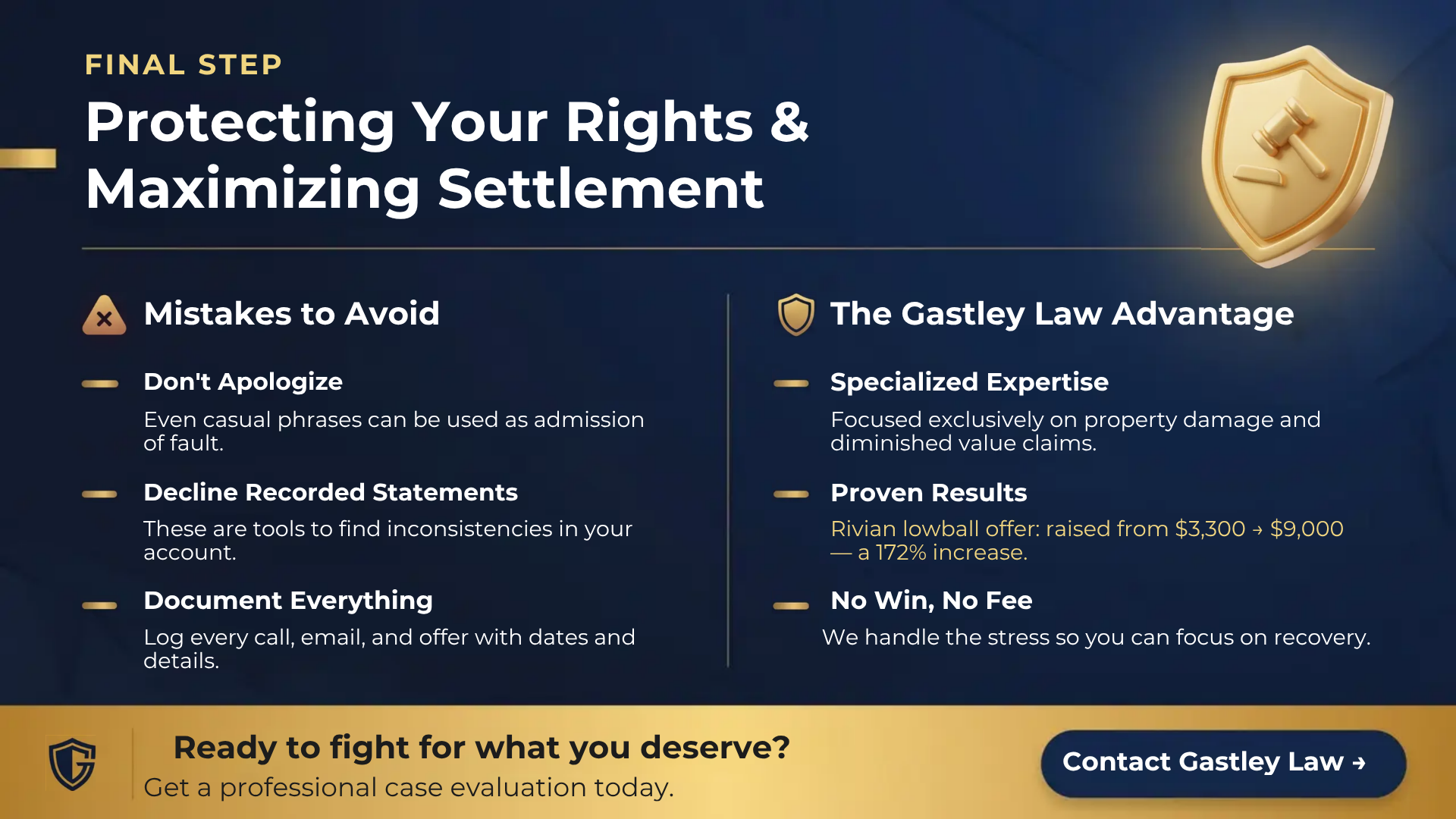
What you don’t say is just as important as what you do say. Be mindful of your words, as they can be recorded and used to weaken your claim. First, never apologize or admit any fault for the accident. Even a simple “I’m sorry” can be interpreted as an admission of guilt. Second, avoid downplaying the damage to your car. Phrases like “it’s not that bad” or “it seems okay” can be used later to justify a lower settlement offer. Stick to the facts you know for sure. Finally, politely decline any request to give a recorded statement until you’ve had a chance to speak with an attorney. Protecting your claim starts with controlling the narrative, and our team can help you handle all communication with the insurer.
Smart Strategies for a Successful Negotiation
Once you’ve had that first call and know what you’re up against, it’s time to shift into negotiation mode. This isn’t about arguing; it’s about presenting a clear, logical case for why you deserve the full value of your claim. The key is to be prepared, confident, and strategic. With the right approach, you can steer the conversation toward a fair settlement that covers all your losses, from property damage to the diminished value of your vehicle. Let’s walk through the tactics that will help you get there.
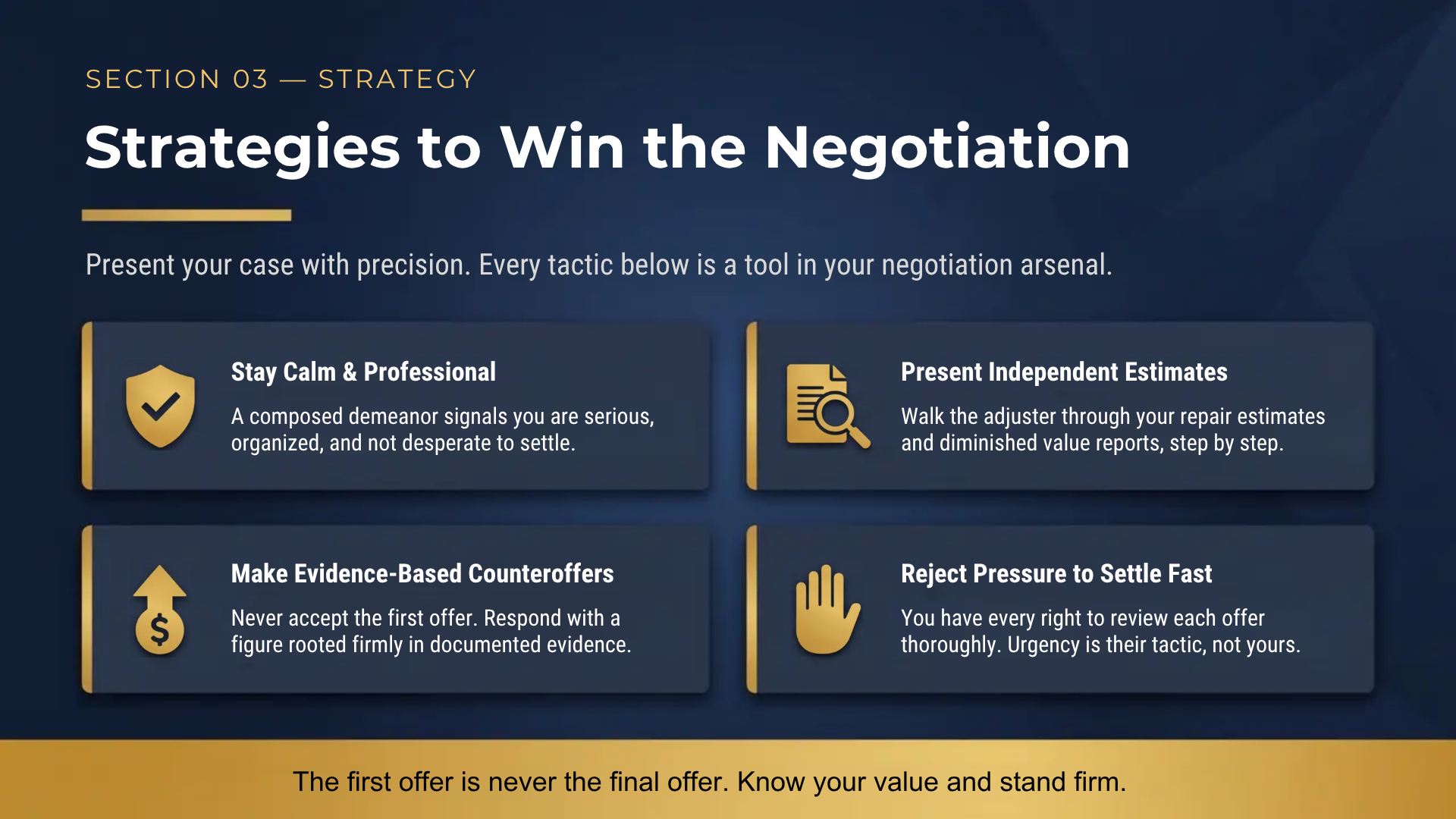
Stay Calm and Professional
It’s completely understandable to feel frustrated or angry after an accident, but letting those emotions drive your conversation with the adjuster won’t help your case. Your goal is to be firm and clear, not confrontational. A calm, professional demeanor shows the adjuster you are serious and in control. Remember, they handle calls all day, and being polite and organized can make your claim stand out for the right reasons. Think of it as a business transaction. You are presenting a case, and your professionalism is part of your presentation. This approach helps keep the lines of communication open and encourages a smoother, more productive negotiation process.
Present Your Evidence Clearly
This is where your preparation pays off. Don’t just tell the adjuster what you’re owed; show them. Organize all your documents, including the police report, photos of the damage, multiple repair estimates, and most importantly, your independent diminished value report. When you present your claim, walk the adjuster through your evidence step by step. For example, you can say, “As you can see from the attached estimate from ABC Body Shop, the repair cost is X, and according to the independent appraisal, the post-repair diminished value is Y.” A well-documented claim is difficult to dispute and signals to the insurer that you have a strong, fact-based case.
Make a Strategic Counteroffer
The insurance adjuster’s first offer will almost always be low. Don’t be discouraged, and definitely don’t accept it. This is just their opening move. Instead, respond with a thoughtful counteroffer. This shouldn’t be a random number; it should be based on the total you calculated from your repair estimates and diminished value report. When you present your counteroffer, explain exactly how you arrived at that figure. Break it down for them, referencing the evidence you’ve already provided. By grounding your request in facts, you shift the conversation from a simple back-and-forth to a discussion about the actual costs you’ve incurred.
Know When to Mention Legal Action
If the adjuster refuses to offer a fair settlement despite your evidence and calm persistence, it may be time to mention that you’re prepared to seek legal counsel. This isn’t a threat but a statement of intent. You can say something like, “If we can’t reach a fair agreement, I’m prepared to consult with an attorney to protect my interests.” Often, the possibility of legal action is what it takes for an insurer to take your claim seriously. They know that litigation is expensive and time-consuming. If you find yourself at this point, it’s a clear sign that you need professional help. Don’t hesitate to contact an expert who can take over the fight for you.
How to Counter Common Adjuster Tactics
Insurance adjusters are skilled negotiators, and they have a set of tactics they often use to protect their company’s bottom line. Their goal is to settle your claim for the lowest amount possible. But when you know what to expect, you can stand your ground and protect your interests. Think of it as learning their playbook so you can come prepared with your own.
Understanding these common strategies is the first step to countering them effectively. It’s not about being confrontational; it’s about being informed, prepared, and firm in your position. Let’s walk through some of the most frequent tactics you’ll encounter and how you can handle each one with confidence.
Respond to Lowball Offers
It’s almost a guarantee that the adjuster’s first offer will be low, sometimes shockingly so. Don’t let this discourage you or make you feel like your claim isn’t valid. This is a standard opening move designed to see if you understand the true value of your claim. They are testing the waters to see if you’ll accept a quick, cheap payout.
Instead of getting offended, see this as the starting point of the negotiation. The best response is a calm and professional counteroffer. Politely reject their initial number and present your own, making sure to back it up with the documentation you’ve gathered, like repair estimates and your diminished value report. This shows the adjuster you’ve done your homework and are serious about receiving fair compensation.
Handle Pressure to Settle Quickly
An adjuster might push you to accept an offer right away, sometimes even during the first phone call. They might create a sense of urgency, suggesting the offer is only good for a limited time. This tactic is designed to get you to settle before you realize the full extent of your vehicle’s damages and its loss in value. A quick check might seem convenient, but accepting it means you forfeit your right to ask for more money later if other issues arise.
Don’t fall for it. You have the right to take your time to review any offer. Simply tell the adjuster you need time to consider it and review your documents. Never agree to a settlement until all your damages have been assessed and you are confident the amount is fair.
Decline a Recorded Statement
Early in the process, the adjuster for the other party’s insurance company will likely ask you to provide a recorded statement about the accident. They’ll frame it as a standard procedure, but you are not obligated to agree to it. These recordings are often used to find inconsistencies in your story or get you to say something that could hurt your claim later. Even a simple, innocent comment can be twisted to imply fault or downplay your damages.
Your best move is to politely decline. You can say something like, “I’m not comfortable providing a recorded statement at this time.” You can provide the basic facts of the accident without agreeing to be recorded. If they insist, it’s a clear sign that you should consult with an attorney before proceeding.
Deal with Delays and Manipulation
If an adjuster isn’t pressuring you for a quick settlement, they might use the opposite tactic: dragging the process out. They might ignore your calls, delay responding to emails, or bury you in repetitive paperwork requests. This is a strategy of attrition. The goal is to frustrate you to the point where you’ll accept a low offer just to be done with the hassle. It’s also a way for them to test your resolve and see if you’re willing to fight for what you’re owed.
The key here is persistence and documentation. Keep a detailed log of every interaction and follow up on your conversations in writing. If you feel the adjuster is intentionally stalling, it may be a sign of bad faith. This is often the point where having a lawyer step in can make all the difference, as it signals to the insurer that these tactics won’t work.
How to Write a Demand Letter That Works
After you’ve gathered your evidence and calculated your claim’s value, it’s time to formally present your case to the insurance company. This is done with a demand letter. Think of it as the official start of the negotiation process. It’s a detailed letter that outlines the facts of the accident, explains how you arrived at your settlement figure, and includes all your supporting documents.
A well-crafted demand letter sets a professional and serious tone. It shows the adjuster that you’ve done your homework and are prepared to stand by your claim. This isn’t just a simple note; it’s a strategic document that frames the entire negotiation. A strong letter can prevent the adjuster from starting with an extremely low offer because it demonstrates you have a solid foundation for your request. It forces them to take your claim seriously from the very beginning. Writing a clear, organized, and evidence-backed letter is one of the most effective steps you can take to secure a fair settlement.
Key Components of a Strong Demand Letter
Your demand letter should be clear, concise, and easy for the adjuster to follow. Start with the basics: your name, the claim number, and the date of the accident. Then, lay out a factual summary of what happened, sticking to the objective details of the incident. The core of your letter is the demand itself. State the specific dollar amount you are seeking for your property damage and diminished value. It’s crucial to break down how you calculated this number, referencing repair estimates, your diminished value report, and any other costs you incurred. By presenting a logical and well-supported argument, you make it harder for the adjuster to dismiss your claim.
Support Your Claim with Evidence
A demand without proof is just an opinion. To get the insurance company to agree to your settlement amount, you need to back it up with solid evidence. Your demand letter should act as a cover letter for all the documentation you’ve collected. Attach copies (never the originals) of everything that supports your case. This includes the police report, photos of the damage, repair estimates from multiple body shops, your diminished value appraisal, and receipts for any related expenses like a rental car. The more compelling proof you can provide for your claim, the stronger your negotiating position will be. This evidence shows you aren’t just picking a number out of thin air; you’re demonstrating the true financial loss you suffered.
Highlight the Full Impact of the Accident
Your claim isn’t just about bent metal and repair bills. The accident had a real impact on your life, and your demand letter should reflect that. While keeping a professional tone, don’t be afraid to explain the full extent of the inconvenience and frustration the accident caused. Did you miss work? Did the loss of your vehicle disrupt your family’s routine? Mention the time you spent dealing with body shops, rental car agencies, and the insurance company itself. Highlighting these strong points and the emotional stress of the situation helps the adjuster see you as a person, not just a claim number. If you’re finding it difficult to put these frustrations into words, it might be time to contact a professional who can help you frame your case effectively.
Common Negotiation Mistakes to Avoid
When you’re trying to get fair compensation for your vehicle, it’s easy to make a misstep that can cost you. Insurance adjusters handle these conversations every day; they have a script and a goal to pay out as little as possible. Knowing the common mistakes people make can help you protect your claim and stand your ground. Think of it as learning their playbook so you can write your own. By avoiding these simple but costly errors, you put yourself in a much stronger position to get the money you’re actually owed for your property damage and diminished value.
Accepting the First Offer
It can be tempting to take the first offer an insurance company throws your way. You want to get your car fixed and move on. But here’s a little secret: that first offer is almost always a lowball. Insurance companies often start with a very low number to see if you understand what your claim is really worth. Accepting it without a second thought is like leaving money on the table. Instead, view that initial offer as the starting point of a conversation, not the end. Take a deep breath, thank the adjuster for the offer, and tell them you need time to review it. Compare it to your own repair estimates and your vehicle’s diminished value to see how far apart you really are.
Sharing Too Much Information
In the early stages of your claim, less is more. When you first speak with an adjuster, stick to the basics: your name, contact information, and the type of claim you’re filing. There’s no need to give a detailed, moment-by-moment account of the accident or speculate on what happened. Adjusters are trained to listen for any information they can use to reduce your claim’s value. Volunteering extra details or agreeing to a recorded statement can backfire. Keep your answers direct and factual. You are in control of the information you provide, so don’t feel pressured to share every detail before you’re ready. If you feel overwhelmed or unsure what to say, it might be time to get some advice.
Admitting Fault or Apologizing
It’s natural to be polite, but after an accident, even a simple “I’m sorry” can be twisted into an admission of fault. Insurance adjusters can use an apology against you to argue that you were responsible for the accident, which could seriously reduce your settlement or get your claim denied entirely. When discussing the incident, stick to the facts of what happened without expressing guilt or regret. You can be cooperative and professional without apologizing. Let the evidence and the police report speak for themselves. Your focus should be on clearly communicating the facts of your claim, not on assigning blame to yourself or anyone else.
Rushing the Process
Patience is your best friend during a negotiation. Adjusters may pressure you to settle quickly, sometimes making an offer seem like it’s only available for a limited time. This is often a tactic to get you to agree to a low amount before you realize the full extent of your damages. Don’t accept a quick settlement without understanding all your losses, from repair costs to the significant drop in your car’s resale value. Take the time you need to get multiple repair quotes and a proper diminished value appraisal. Rushing only benefits the insurance company. A fair settlement is worth waiting for, and a reputable law firm can help you evaluate your losses to ensure you’re getting what you deserve from their services.
Document Everything
When you’re negotiating with an insurance adjuster, your memory is not enough. Creating a detailed paper trail is one of the most powerful things you can do to protect your claim. Think of it as building a file on your own case. Every conversation, every offer, and every piece of paper adds to the strength of your position. This record-keeping isn’t just for your own reference; it’s your proof. If the adjuster tries to change their story, deny something they said, or delay your claim unfairly, your documentation becomes your best defense.
This habit of documenting everything keeps both you and the adjuster accountable. It shows the insurance company that you are organized, serious, and paying close attention to every detail. It also makes it much easier to hand your case over to an attorney if things get complicated. A well-documented file gives a legal professional everything they need to get up to speed quickly and fight effectively on your behalf. Start a dedicated folder on your computer or a physical notebook right now. From this point forward, make it a rule to write everything down.
Record All Communications
From your very first call with the adjuster, keep a log of every single interaction. For phone calls, note the date, time, the adjuster’s name, and a summary of what you discussed. What you say can significantly impact your claim’s outcome, so it’s vital to have an accurate record. Adjusters are trained to listen for anything that could minimize your claim, like an admission of fault or downplaying the damage.
To make things easier and create an automatic paper trail, try to communicate through email as much as possible. This gives you a written, time-stamped record of your entire conversation, leaving no room for misinterpretation. If you do have a phone call, you can send a follow-up email summarizing the key points: “Hi [Adjuster’s Name], just to confirm our conversation today, we discussed…” This simple step ensures you’re both on the same page. If you feel like your words are being twisted, it might be time to contact a professional to handle communications for you.
Track All Offers and Responses
Insurance companies almost always start with a low settlement offer to see if you understand the true value of your claim. Don’t be discouraged, and definitely don’t accept it right away. Instead, start a running list of every offer the insurance company makes and every counteroffer you propose. Note the date and the amount for each entry.
This log is more than just a list of numbers. It tells the story of your negotiation and demonstrates a pattern. Keeping track helps you stay organized and strategic in your responses. It also serves as crucial evidence if you need to prove the insurer wasn’t negotiating in good faith. Having a clear history of lowball offers can be a powerful tool, especially when you’re fighting for the full diminished value of your vehicle.
Get Every Agreement in Writing
A verbal agreement over the phone means very little until it’s in writing. Once you and the adjuster finally agree on a settlement amount, your job isn’t quite done. You need to solidify that agreement immediately to prevent any “misunderstandings” later on.
The best way to do this is by sending a confirmation letter or email right after your conversation. In it, clearly state the settlement amount you both agreed upon, what damages it covers (like repairs, rental car costs, and diminished value), and when you expect to receive the official paperwork and payment. This simple action protects you from the adjuster changing the terms or claiming the conversation went differently. It creates a clear record of the final agreement, which is essential for ensuring you get paid fairly and promptly. If you need help finalizing a settlement, our team is here to review the legal services we offer.
When Should You Call a Lawyer?
While you can handle many negotiations on your own, there are times when bringing in a professional is the smartest move. Think of it like a home repair project: you can fix a leaky faucet, but you’d call a plumber for a burst pipe. Knowing when to ask for help can protect you from being taken advantage of and ensure you get the compensation you deserve. An attorney can step in to manage the process, giving you the space to focus on your recovery.
Signs You Need Professional Help
If the insurance company isn’t taking your claim seriously, it’s a major red flag. This can look like weeks of unreturned phone calls, an outright denial of a valid claim, or pressure to accept an offer that doesn’t even cover your basic repair costs. If you’ve suffered serious injuries, you should also seek legal advice immediately. An experienced lawyer understands the long-term costs associated with medical care and can build a case that reflects your true needs. Our firm offers a range of legal services designed to handle these exact situations.
When Your Case Gets Complicated
Things can get complicated fast. Maybe the other driver is disputing fault, or the adjuster is questioning the severity of your vehicle’s damage. Insurance companies often start with a very low offer, hoping you don’t know what your claim is really worth. If you’re dealing with a significant diminished value claim, the calculations can be complex and are often challenged by insurers. When adjusters see you’re only talking about suing without taking action, they may not take your claim seriously. This is when a lawyer can make a real difference.
How Gastley Law Can Maximize Your Settlement
Hiring an attorney sends a clear message to the insurance company: you will not be pushed around. It’s always best to get legal advice before you agree to a recorded statement or sign any documents. We take over all communication with the adjuster, so you don’t have to worry about saying the wrong thing. We’ll gather all the necessary evidence, from repair estimates to expert appraisals, to build the strongest case possible. Our goal is to challenge lowball offers and fight for the full amount you’re owed. If you feel stuck, contact us for a case evaluation.
Red Flags of Bad Faith Insurance Practices
You pay your insurance premiums with the understanding that your provider will be there for you when you need them. When an insurance company fails to honor its contractual obligations without a reasonable basis, it’s known as acting in “bad faith.” While it can be tough to prove, recognizing the warning signs is the first step in protecting your rights. If your adjuster’s behavior feels more like an obstacle course than a helping hand, pay close attention. These tactics are often designed to frustrate you into accepting less than you deserve for your property damage claims.
Unreasonable Delays
Patience is a virtue, but it can also be a weapon used against you. If your adjuster is consistently slow to return calls, misses deadlines, or seems to be dragging the process out for weeks or months without a good reason, it might be a deliberate strategy. Insurance companies know that the longer a claim drags on, the more likely you are to get frustrated and accept a low offer just to be done with it. While claims take time to process, a pattern of unresponsiveness or unexplained delays is a major red flag that they aren’t treating your claim fairly.
Excessive Paperwork Demands
It’s normal to provide documents to support your claim, but some adjusters take it to an extreme. They might ask for irrelevant information, request documents you’ve already sent, or bury you in complicated forms. This is often a tactic to overwhelm you and create reasons to deny or delay your claim. Be especially wary of requests for a recorded statement right away. Adjusters are trained to ask questions that can get you to say something that hurts your case later. You have the right to take your time and even consult with an attorney before agreeing to be recorded.
Misrepresenting Your Policy
An adjuster might try to convince you that certain damages aren’t covered under your policy, even when they are. They may use confusing jargon or quote sections of your policy out of context to justify a lowball offer or a denial. Remember, the adjuster works for the insurance company, not for you. It’s their job to minimize the payout. Don’t just take their word for it. Always review your policy yourself, and if their interpretation doesn’t seem right, it’s a clear sign you may need a professional to step in and advocate for what you’re truly owed.
Related Articles
- How to File a Third Party Claim: A Step-by-Step Guide
- Third Party Insurance Claim Guide: Tips & FAQs | Gastley Law
- How to File a Third Party claim in Georgia | Gastley
- Navigating an At-Fault Driver Insurance Claim Settlement
Frequently Asked Questions
Why can’t I just trust the insurance adjuster to be fair?
It’s not that adjusters are bad people; it’s that they have a different job than you might think. Their primary responsibility is to the insurance company’s financial health, which means their goal is to settle your claim for the lowest amount possible. While they may be friendly and polite, you are in a business negotiation where your goal (full compensation) is directly opposite theirs (minimal payout).
What is “diminished value” and why won’t the adjuster’s offer include enough for it?
Diminished value is the loss in your car’s resale value after it has been in an accident, even if it’s perfectly repaired. A car with an accident history is simply worth less than one without. Insurance companies often undervalue this loss or hope you don’t know you’re entitled to claim it. Their initial calculations are typically based on formulas that benefit them, not on a real-world market analysis of your vehicle’s lost value.
Is it really a big deal if I give a recorded statement?
Yes, it can be a very big deal. The other party’s insurer will ask for a recorded statement to find information they can use to weaken your claim. They are trained to ask questions that might lead you to unintentionally say something that implies fault or downplays the damage. It is best to politely decline until you have had a chance to organize your thoughts or speak with an attorney.
My adjuster is taking forever to get back to me. What should I do?
Intentional delays can be a tactic to frustrate you into accepting a low offer just to end the process. The best way to handle this is with persistent, professional follow-up. Keep a detailed log of your calls and send emails to create a paper trail. If a pattern of unresponsiveness continues, it’s a strong signal that the insurer may be acting in bad faith and it’s time to consider getting legal help.
What if I don’t feel confident negotiating on my own?
That’s completely understandable. This is a complex process, and insurance adjusters are trained professionals. If you feel overwhelmed, pressured, or that the offers are consistently unfair, it is a wise decision to seek legal counsel. An experienced attorney can take over the negotiation for you, handle all communications, and build a strong, evidence-based case to ensure you receive the full compensation you are owed.