When a Georgia driver is dealing with an insurer after a crash, a clear insurance claim demand letter can organize the vehicle property-damage claim and explain the amount requested. Repair costs, rental or towing charges, and diminished value may need separate documentation. The goal is a factual, supported request, not a promise of payment.
Request a free case evaluation with Gastley Law or call (770) 557-2838.
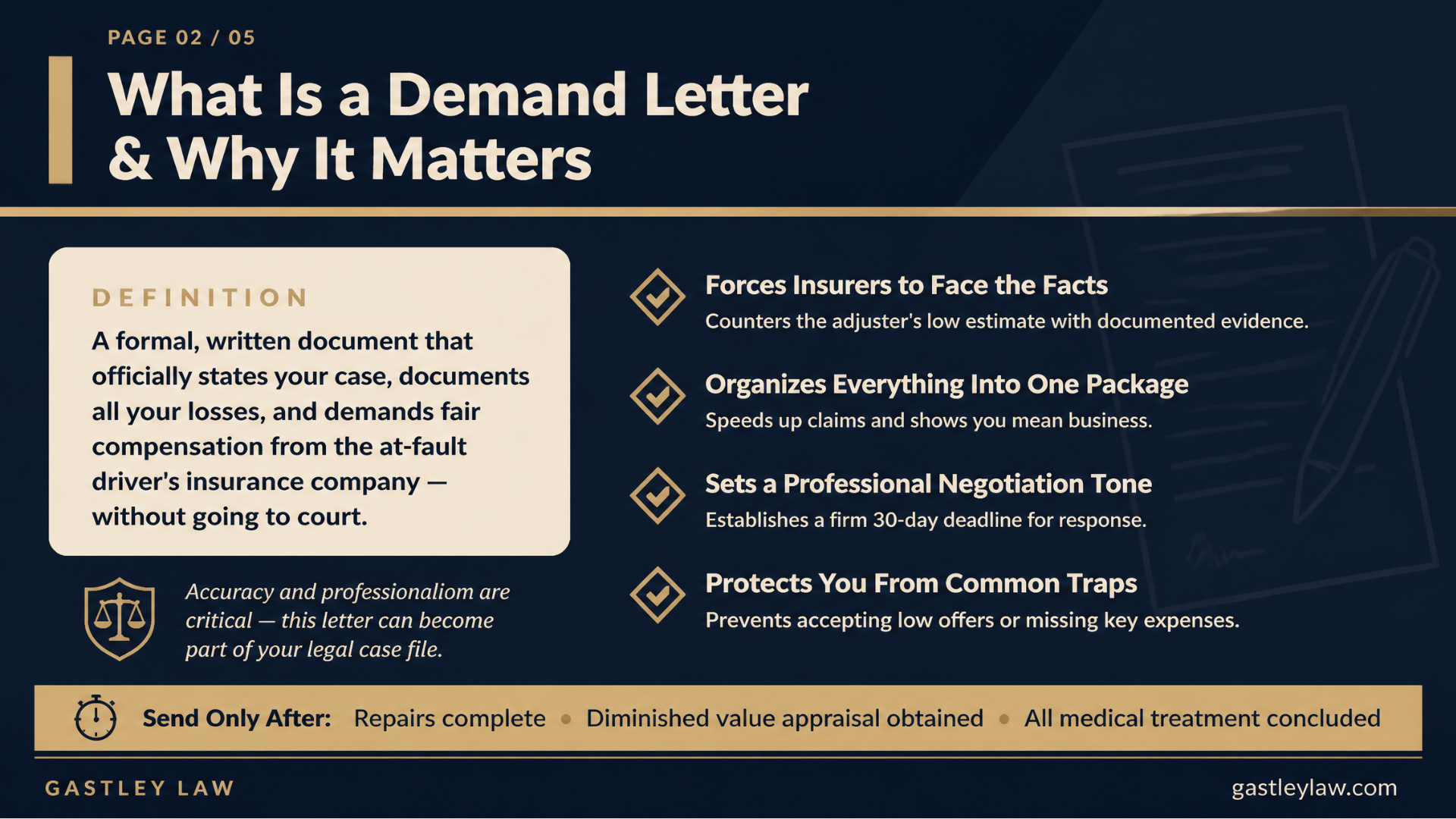
An insurance claim demand letter is a written request that explains a vehicle claim, identifies the damage and documented losses, and states the amount the owner wants the insurer to consider. For a Georgia car claim, it can organize repair evidence and a separate diminished-value analysis while creating a clear record of the requested resolution.
A demand letter is more than a short message asking an adjuster to pay. It should give the reader a concise account of the incident, identify the claim, summarize the vehicle condition, and point to the attached proof. Keep the letter limited to facts you can support. If a policy, appraisal, repair document, or claim instruction calls for a particular format, follow that instruction rather than assuming one format works for every claim.
A written demand gives the adjuster a single reference point for the facts, documents, and calculations you want reviewed. It can also help you track what you requested and when you sent it. A call may be useful for confirming receipt, but a call alone does not present the same organized explanation of repair costs, rental or towing expenses, and diminished value.
Keep the tone firm, accurate, and courteous. Avoid describing an insurer’s position in stronger terms than the correspondence supports. If the other driver, coverage, or amount is disputed, describe the dispute as a dispute. A lawyer can help evaluate wording when the facts or coverage questions are difficult.
Send the letter when you can explain the vehicle damage and support the amount requested. That often means collecting the relevant repair estimate or final invoice, photographs, receipts, claim correspondence, and any diminished-value report before sending a complete package. If damage is still being investigated, state what remains open instead of presenting an incomplete total.
A requested response date is a business date you are asking the insurer to use for its review. It is not automatically a legal deadline. Check the policy, claim instructions, and current facts for requirements that may apply to your situation. Do not use the letter to create a deadline you cannot support.
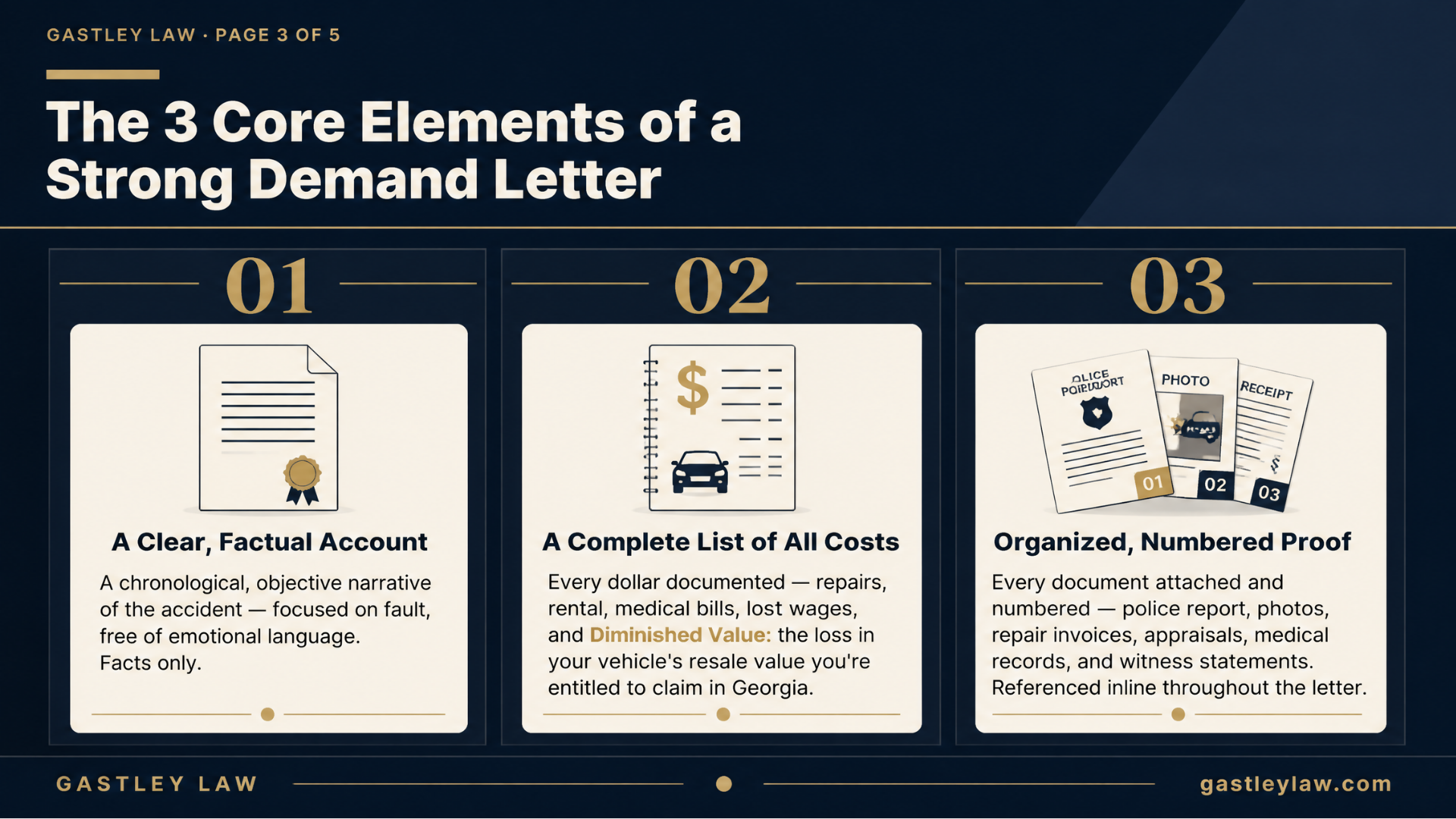
A strong vehicle insurance demand letter identifies the claim, gives a concise accident and damage summary, lists each documented loss, and explains the requested total. For a Georgia vehicle claim, include repair documentation and any separate diminished-value support, then attach an indexed proof packet. The letter should let an adjuster verify each material statement without guessing.
Before drafting, create a simple table with the loss category, amount, supporting document, and page number in the attachments. That small step reduces omissions and makes the request easier to review. Use the insurer’s claim number and the adjuster’s preferred delivery method when available.
Start with the date, location, vehicles involved, claim number, and a short factual description of the collision. Explain what you observed and what the available records show. Identify the vehicle by year, make, model, and identification details that are appropriate for the claim. If a point is uncertain or disputed, label it rather than stating it as settled fact.
Do not turn the opening into an argument about every disagreement. The adjuster needs a readable timeline and enough detail to match the narrative to the claim file. Refer to a police report, photographs, witness statement, repair estimate, or other attachment by name so the reader can find it quickly.
Match every important statement to a document. Useful proof can include photographs of the vehicle and scene, the repair estimate or invoice, parts and labor details, towing and storage receipts, rental-car receipts, inspection records, claim correspondence, and a diminished-value report when one is being requested. Keep the files legible and use consistent names or page numbers.
Send only documents relevant to the vehicle claim and protect personal information that is not needed for review. If an attachment is unavailable, say so and explain when it may be provided. Do not describe an estimate as a final cost or a preliminary analysis as a completed appraisal.
Break the requested amount into categories instead of presenting one unexplained number. List supported repair costs, reasonable rental or towing charges, storage or other property-related expenses when documented, and the separately calculated diminished value amount if applicable. Show subtotals and identify the attachment supporting each subtotal.
Do not count the same invoice twice. Compare the repair estimate with the final invoice and note any difference. If an insurer has already paid a portion, show the payment and calculate the remaining amount you are asking the insurer to review. Avoid adding a cushion that you cannot explain.
State a total and show how you reached it. A simple calculation might identify the supported repair balance, documented property-related expenses, and a separate diminished-value figure, then show any payments or credits. The number should be tied to evidence, not to a target chosen without an explanation.
Explain whether the amount is intended to resolve the vehicle property-damage claim based on the documents enclosed or whether a component remains subject to review. Use qualified wording where the facts are not final. A clear calculation gives the adjuster something concrete to evaluate and gives you a basis for discussing a counteroffer.
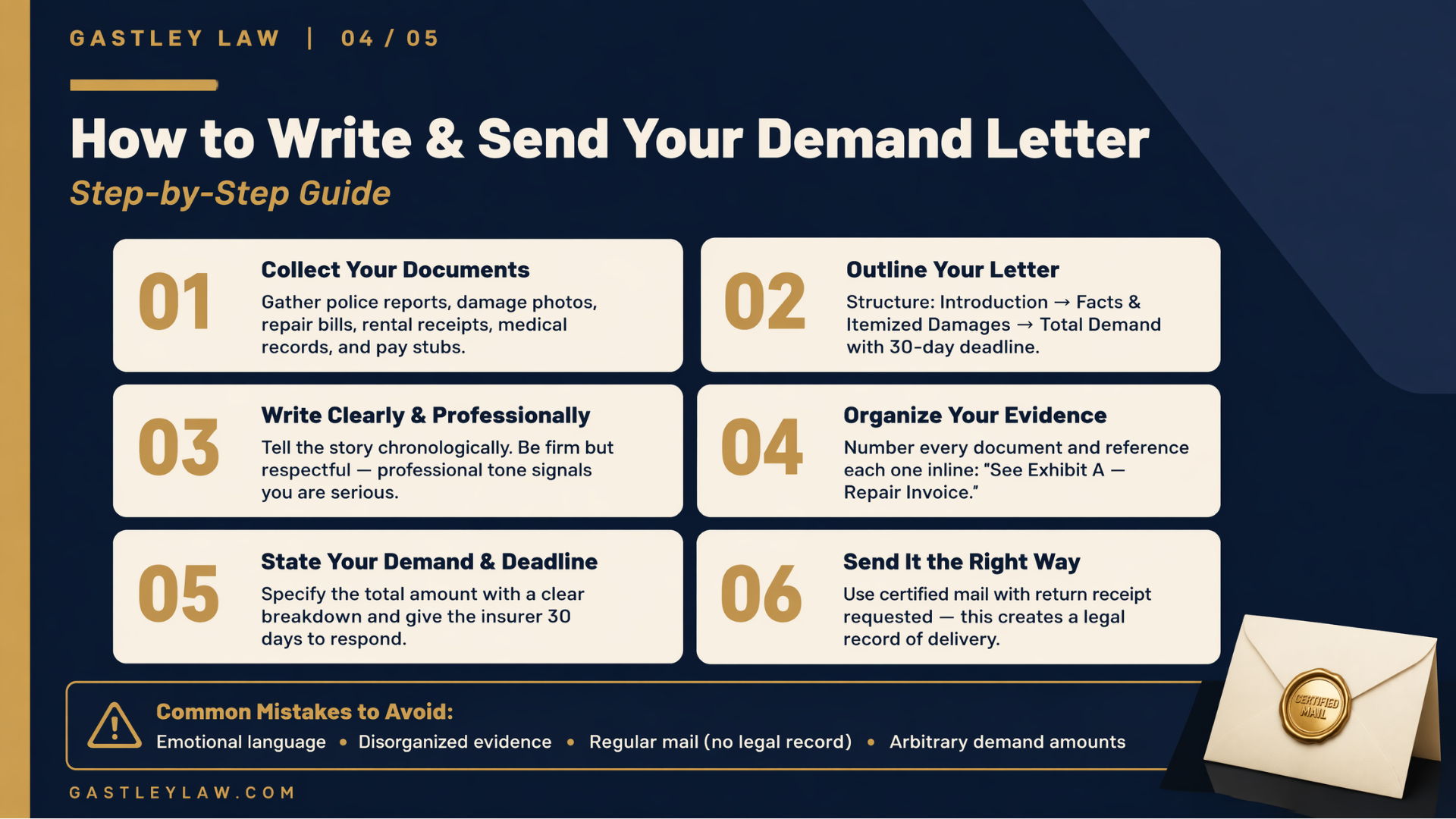
Write the letter as a short, organized claim package: identify the Georgia vehicle claim, explain the supported facts, itemize repair and related property losses, and address diminished value separately when applicable. Use a professional tone, attach proof, and ask for a response by a requested business date without calling it an automatic legal deadline.
Draft in a separate document first, proofread every amount, and compare the final version with the attachments. The following steps keep the process focused and provide a structure you can customize to the actual claim.
Gather the claim number, policy or claim correspondence, incident report, photographs, repair estimate, final invoice if available, inspection records, towing or rental receipts, payment records, and any diminished-value report. Put the documents in a logical order and keep an untouched copy of the original files. If an amount is not documented, leave it out or identify it as pending.
Review the insurer’s communications for requested forms, delivery instructions, and questions that still need an answer. A demand letter does not replace a policy form or claim document the insurer specifically requests. Use the exact claim details from the file instead of relying on memory.
Use headings that make the letter easy to scan: claim identification, accident and vehicle facts, damage and repair history, itemized losses, diminished value if requested, total demand, attachments, and response request. An outline also helps you remove repeated explanations. Every paragraph should either explain a fact, point to proof, or clarify the calculation.
Use a chronological account and plain language. Explain what happened without insults, speculation, or unsupported conclusions. Distinguish what you personally observed from what a report or document says. If liability, coverage, causation, or valuation is disputed, describe the issue accurately and avoid presenting a disputed point as a guaranteed result.
Number or name the attachments and refer to them in the letter. For example, identify the final repair invoice, photograph set, towing receipt, or diminished-value report by the same label used in the packet. Check that each file opens, each page is readable, and sensitive information that is not needed for the vehicle claim is not unnecessarily included.
Show the calculation, state the amount requested, and ask for a written response by a reasonable business date. Phrase the date as a request for review, not as an automatic legal deadline. Keep a copy of the sent letter, attachments, delivery confirmation, and any response. Use a delivery method that gives you a reliable record.
Use this copy-and-customize starting point only after checking every fact, amount, attachment, and contact detail against the claim file:
[DATE]
Via [DELIVERY METHOD]
[INSURER NAME]
[ADJUSTER NAME]
[INSURER ADDRESS OR EMAIL]
Re: Vehicle property-damage claim for [CLAIMANT NAME]
Claim number: [CLAIM NUMBER]
Date of incident: [DATE OF INCIDENT]
Vehicle: [YEAR, MAKE, MODEL, VIN OR OTHER IDENTIFIER]
Dear [ADJUSTER NAME OR CLAIMS DEPARTMENT]:
I am writing about the vehicle property-damage claim identified above. On [DATE OF INCIDENT], at or near [LOCATION], [DESCRIBE THE ACCIDENT FACTS THAT ARE SUPPORTED BY YOUR RECORDS]. The information in this paragraph is based on [POLICE OR INCIDENT REPORT, PHOTOGRAPHS, WITNESS INFORMATION, OR OTHER SUPPORTING DOCUMENTS]. Any disputed point is identified as disputed in the attached materials.
After the incident, the vehicle was inspected or repaired by [REPAIR FACILITY OR INSPECTOR]. The supported repair cost is [REPAIR COST], shown in [ATTACHMENT NAME OR NUMBER]. The vehicle also incurred [RENTAL, TOWING, STORAGE, OR OTHER DOCUMENTED PROPERTY-RELATED COSTS] totaling [AMOUNT], shown in [ATTACHMENT NAME OR NUMBER].
I am also requesting consideration of diminished value in the amount of [DIMINISHED-VALUE AMOUNT], based on [APPRAISAL, MARKET ANALYSIS, OR OTHER SUPPORTING DOCUMENT] attached as [ATTACHMENT NAME OR NUMBER]. This amount is stated separately from repair costs so the claim file can evaluate each component on its own support.
The total amount requested is [TOTAL DEMAND]. The calculation is: repair cost [AMOUNT], diminished value [AMOUNT], documented rental, towing, storage, or other property-related costs [AMOUNT], less payments or credits already received [AMOUNT], for a remaining requested amount of [TOTAL DEMAND].
Attached are: [LIST EACH ATTACHMENT, INCLUDING CLAIM CORRESPONDENCE, REPORTS, PHOTOGRAPHS, ESTIMATES, INVOICES, RECEIPTS, PAYMENT RECORDS, AND DIMINISHED-VALUE SUPPORT]. Please review the attached materials and provide a written response by [REQUESTED RESPONSE DATE, STATED AS A BUSINESS DATE]. This is a requested review date, not automatically a legal deadline.
Please send the response to [MAILING ADDRESS] and [EMAIL ADDRESS], or contact me at [PHONE NUMBER]. I can provide additional claim information that is reasonably available and relevant to the vehicle property-damage request.
Sincerely,
[CLAIMANT NAME]
[CONTACT INFORMATION]
Customize every bracketed item before using this template. Submit only statements and amounts that the claim file supports, do not copy facts from an unrelated sample, and confirm that every attachment is included. This is an educational starting point, not legal advice, and it does not guarantee payment or a particular remedy. Obtain attorney review when the claim, coverage, valuation, or legal issue is disputed.
Evidence makes the requested amount reviewable. Keep the packet focused on the vehicle claim and arrange it in the same order used in the letter. A short index can save time for both you and the adjuster. If a document conflicts with another document, explain the discrepancy instead of hiding it.
For a vehicle property-damage request, prioritize the records that show the condition of the car and the cost of addressing it: inspection notes, repair estimates, invoices, photographs, parts and labor details, and any valuation analysis. A medical record is outside the scope of this vehicle property-damage template. Keep injury-related issues separate and obtain appropriate legal guidance if they are part of the claim.
An incident or police report may provide useful facts about the date, location, vehicles, and reported circumstances. Witness information can help clarify what was observed. Use these records accurately and identify the document that supports the statement. Do not state that a report conclusively resolves a disputed issue when the report itself is incomplete or the parties disagree.
Use invoices and receipts to support the dollars in the demand. Examples include repair charges, towing, storage, rental transportation, and other documented vehicle-related expenses. Show whether each item has been paid, remains outstanding, or was reimbursed. A diminished-value amount should have its own support and should not be hidden inside a repair subtotal.
Many demand letters become difficult to evaluate because they are emotional, repetitive, or disconnected from the evidence. A shorter letter with an accurate calculation is usually more useful than a longer letter filled with conclusions. Proofread names, claim numbers, dates, links between amounts and attachments, and the final total before sending.
Frustration after a collision is understandable, but insults and unsupported threats do not strengthen the vehicle claim. Avoid choosing a number because it feels satisfying. Ask for amounts that you can explain with records, and use calm language when describing a disagreement with the insurer or another party.
A missing invoice or unreadable photograph can slow review. Use an attachment index, consistent file names, and page references. Check the packet against the itemized calculation. If a final document is not available, identify the missing item and explain the current status rather than attaching an outdated record without clarification.
Confirm the recipient, claim number, vehicle information, email address, and delivery method. Keep the letter readable with short paragraphs and descriptive headings. Save the exact version sent and retain proof of delivery. When an insurer provides a portal or form, follow the instructions and keep a copy of the submission confirmation.
Persuasion comes from a clear connection between the facts, the documents, and the amount requested. The letter should show how the calculation was made and make it easy to locate the proof. It should also leave room for a written response if the adjuster believes another document or calculation should be reviewed.
Use direct sentences such as “The attached final invoice shows [amount] in repair charges” and “The attached analysis states [amount] in diminished value.” Avoid absolute statements that the evidence does not establish. A professional tone can preserve credibility while still making the request clear.
State what you want, explain why, and identify what would resolve the open issue. Do not inflate the amount, repeat the same argument in several sections, or threaten action that you are not prepared to take. If the insurer’s calculation differs, ask for the basis of the difference and respond with specific documents.
A demand letter is a claim communication, not a substitute for legal advice. Policy language, disputed facts, valuation questions, and communications about potential litigation may require attorney review. Keep statements accurate and preserve the full file. Do not add a statute, remedy, deadline, or liability conclusion unless a qualified reviewer has confirmed that the wording applies to the current facts.
When the claim includes issues outside vehicle property damage, keep those issues separate from this template. A clear scope helps prevent the letter from mixing different categories of loss or making a statement that the available documents do not support.
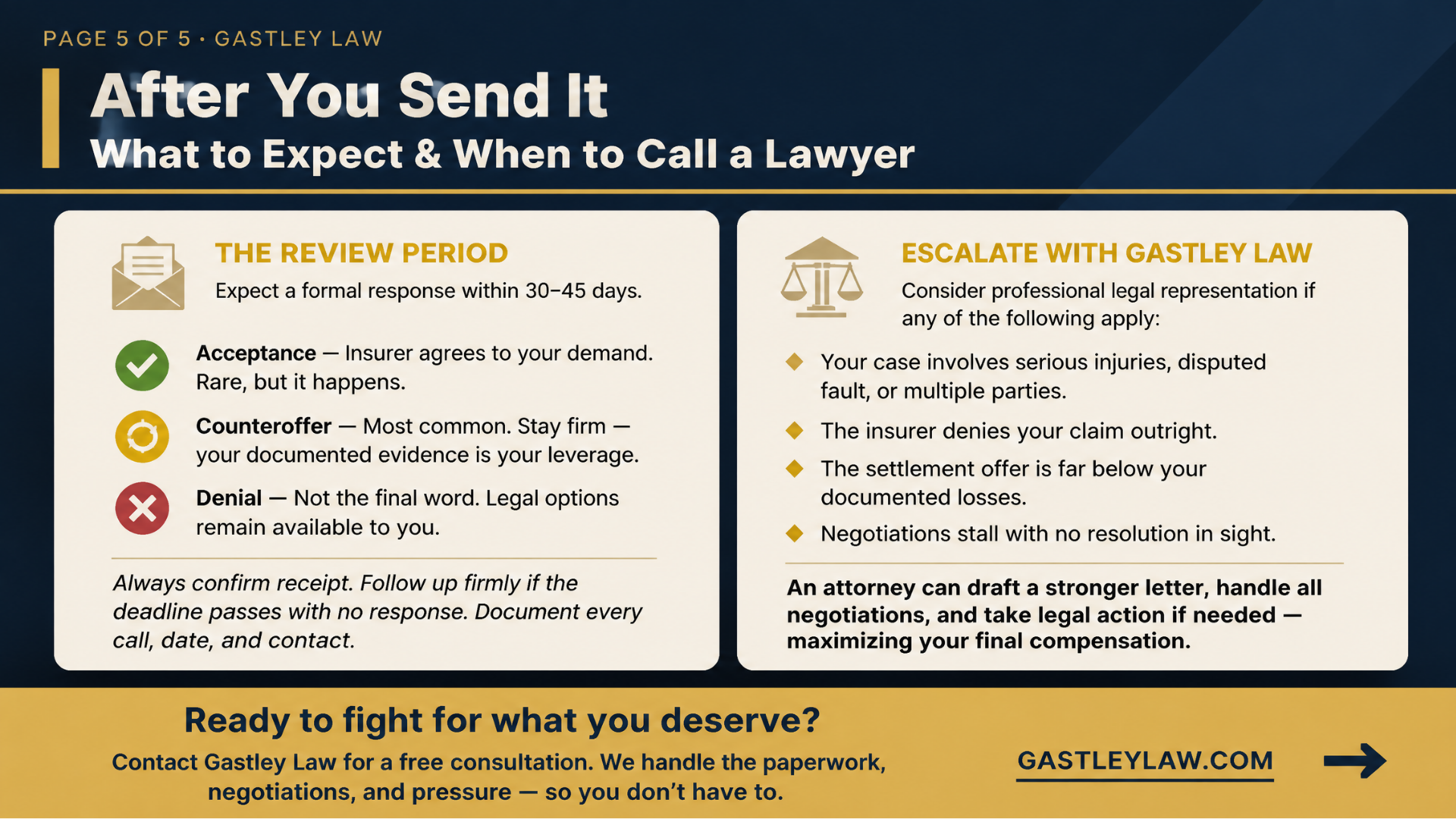
After sending a vehicle demand letter, confirm delivery, preserve the complete claim file, and monitor the insurer’s written response. Compare any acceptance, request for information, counteroffer, or denial with your itemized evidence. A requested response date is not automatically a legal deadline, and the next step depends on the policy, facts, documents, and nature of the disagreement.
Do not assume silence or a quick call resolves the request. Keep a written log of the date, person contacted, subject discussed, and documents exchanged. If the file changes, update the calculation rather than continuing to rely on an outdated total.
An adjuster may compare the letter with the claim file, incident records, repair documents, photographs, payment history, and valuation support. The reviewer may ask for clarification or additional records. Respond to the specific question, identify the attachment that answers it, and avoid adding unrelated allegations or unsupported estimates.
The insurer may accept the calculation, request more information, make a counteroffer, or disagree with some or all of the request. There is no universal response timetable for every claim. Follow the claim instructions and ask for a status update in writing. Evaluate a response by its stated reasoning and supporting documents rather than by the number alone.
Confirm receipt shortly after delivery if the insurer’s process allows it. If the requested review date passes, send a concise follow-up that identifies the claim number, original delivery date, amount requested, and documents enclosed. Ask when the insurer expects to respond. Keep the follow-up courteous and preserve the message and delivery record.
Consider legal guidance when the facts, coverage, valuation, or communications are difficult to assess on your own. A lawyer can review the claim file and help determine what evidence and wording are appropriate. A consultation does not guarantee a particular result, so bring the demand letter, correspondence, estimates, invoices, photographs, and valuation materials to the review.
Multiple vehicles, conflicting accounts, disputed coverage, incomplete records, or a substantial difference between valuations can make a claim harder to organize. Keep a factual timeline and do not guess about the legal effect of a document. Ask a qualified attorney to review the issue before making a statement that could affect the claim.
Read the explanation and compare it with your evidence. Ask for the basis of a disputed calculation in writing, then respond with the specific record that addresses the difference. If the insurer continues to reject or undervalue a supported request, a lawyer can help evaluate the correspondence, options, and appropriate next communication.
A successful process starts with accurate records and consistent communication. Use one claim folder, update the itemized calculation when new documents arrive, and keep the original files. Make the insurer’s review easier by using the same claim number, vehicle description, attachment labels, and total throughout the letter and follow-up messages.
Use the delivery method required or accepted by the insurer and save the confirmation. Keep the sent letter, attachment list, photographs, estimates, invoices, receipts, correspondence, and payment records together. If you speak by phone, write a dated summary afterward. Good records help you identify what has been answered and what remains unresolved.
Keep messages short and specific. Identify the claim, state the question, reference the attached document, and request a written answer when the issue affects the calculation. Do not send multiple versions of the demand without explaining which version is current. If you need help reviewing the communication, contact Gastley Law for a case evaluation.
Request a free case evaluation with Gastley Law or call (770) 557-2838 today.
A call can confirm receipt or request a status update, but a formal letter organizes the facts, itemized vehicle losses, supporting documents, and requested amount in one record. Use both when helpful. The letter should remain accurate and should not state that a legal deadline or recovery is guaranteed.
Start with documented repair costs and property-related expenses, then evaluate diminished value separately if it is part of the request. Subtract payments or credits and show the math. If the evidence is incomplete or the valuation is disputed, identify the uncertainty and consider attorney review before sending a final total.
A template can help with structure, but it must be rewritten for the actual Georgia vehicle claim. Replace every placeholder, verify each fact and amount, remove irrelevant language, and attach supporting documents. Treat the template as an educational starting point, not legal advice, and seek review when the claim or legal issue is disputed.
There is no single response timeframe for every insurance claim. Request a reasonable business date in the letter, follow the insurer’s claim instructions, and ask for a written status update if that date passes. The requested date is not automatically a legal deadline, and a delayed response should be evaluated with the policy and claim facts.
Compare the offer with your itemized calculation and the insurer’s stated reasons. Ask for the basis of any disputed repair, expense, or diminished-value figure, then respond with the relevant records. If the gap remains substantial or the explanation is unclear, gather the full file and consider a free case evaluation before choosing the next step.
Request a free case evaluation with Gastley Law or call (770) 557-2838.