Dealing with an insurance company after an accident can feel like an uphill battle. You’ve already handled the stress of the collision and the repairs, only to face another fight for fair compensation. One of the most common areas where insurers try to save money is on your vehicle’s lost value. They hope you don’t know about car accident diminished value or that you’ll accept their first lowball offer without question. They have a playbook of tactics designed to protect their profits, not make you whole. This article is your counter-playbook. We’ll expose their common strategies and give you the knowledge and confidence to stand your ground and secure the full settlement you deserve.
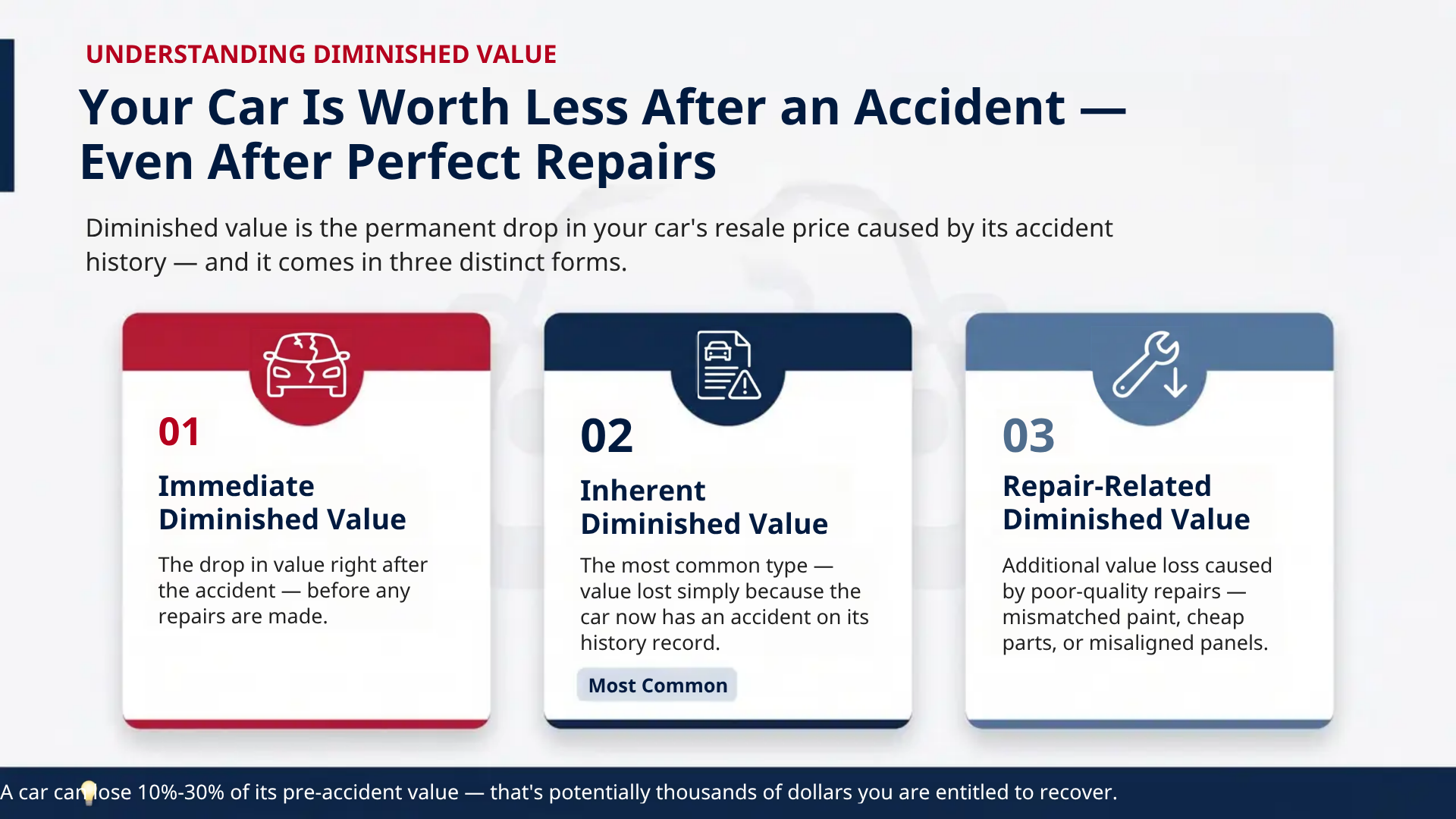
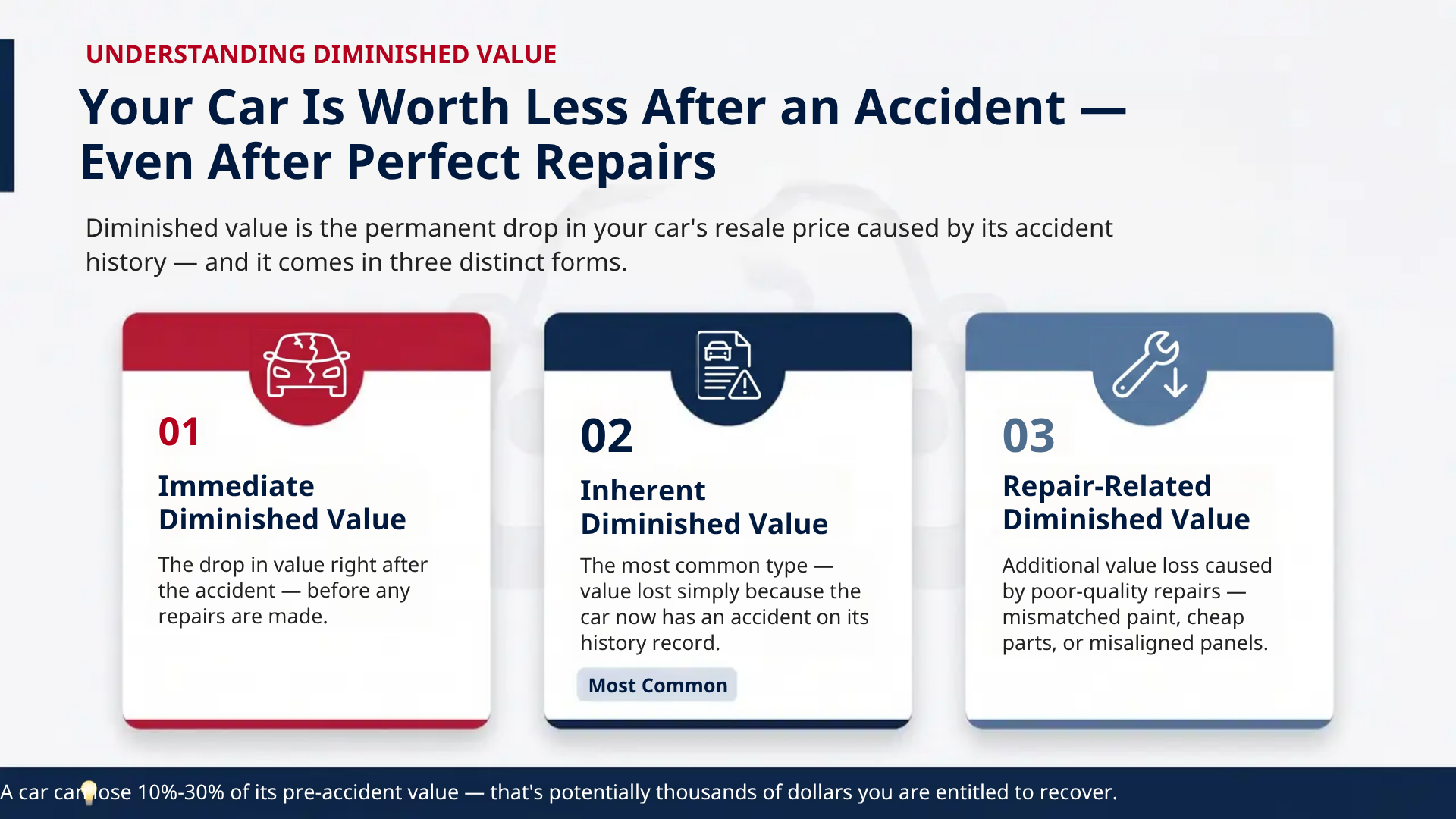
Let’s start with the basics. In simple terms, diminished value is the loss in your car’s resale value after it has been in an accident and repaired. Think about it this way: if you were shopping for a used car and had two identical options, but one had a clean history and the other had been in a wreck, which one would you pay more for? Most people would choose the one without the accident history, or at least expect a significant discount on the one that’s been repaired. That drop in price is the diminished value.
Even if a top-notch body shop makes your car look brand new, the fact that it has an accident on its record permanently lowers its market value. This isn’t just a theoretical loss; it’s a real, tangible financial hit that you’ll feel when you try to sell or trade in your car. Thanks to vehicle history reports like CarFax and AutoCheck, accident information is readily available to any potential buyer. The moment they see an accident reported, the value they are willing to pay drops. This is a real loss, and it’s money you are entitled to recover from the at-fault party’s insurance company. You shouldn’t have to bear the financial burden of someone else’s mistake, and that includes the long-term loss in your vehicle’s worth. Insurance companies, however, are often reluctant to pay these claims because it directly impacts their bottom line, which is why understanding your rights is so important.
It helps to know that “diminished value” isn’t just one single concept. It actually breaks down into three distinct types, and knowing the difference can help you understand your claim better.
So, why should you care about this? Because it involves a significant amount of your money. After an accident, a car can lose anywhere from 10% to 30% of its pre-accident value. For a newer or more valuable car, that can easily translate to thousands of dollars lost. This isn’t just a number on paper; it becomes a real financial hit when you decide to sell or trade in your vehicle. A potential buyer or dealership will pull a vehicle history report, see the accident, and immediately offer you less money.
Filing a diminished value claim is about making you whole again. The goal is to get compensation for this loss so you aren’t left footing the bill for the depreciation someone else caused. Gastley Law offers specialized legal representation to ensure you recover the full amount you’re owed.
The process of filing a diminished value claim can be confusing, and there’s a lot of misinformation out there. Let’s clear up a few common myths so you can approach your claim with confidence.
One major myth is that you can’t file a claim if your car looks perfect after repairs. This is completely false. Your claim is based on the permanent loss of value from the accident history itself, not the cosmetic appearance of the repairs. Another misconception is that it’s not worth the effort. But when you could be losing thousands of dollars in resale value, it’s absolutely worth pursuing.
Finally, don’t believe that the insurance company’s first offer is final. Insurers often use a standard formula that limits the payout, sometimes starting as low as 10% of the car’s value. They may tell you that’s all you can get, but you have the right to negotiate. If you feel like you’re getting the runaround, it might be time to contact us for help.
When you file a claim, the insurance company won’t just take your word for how much value your car has lost. They have their own methods for calculating the number, and their goal is almost always to pay out as little as possible. Understanding how they arrive at their figure is the first step in building a case for the full amount you’re actually owed. While their formulas can seem official, they often don’t capture the true market reality of a post-accident vehicle. Let’s pull back the curtain on the most common methods insurers use.
If you’re dealing with a claim in Georgia, you’ll likely hear about the “17c formula.” This calculation became a standard for many insurers after a specific Georgia court case. It’s a three-step process that starts by taking 10% of your car’s pre-accident market value (using a source like Kelley Blue Book). Next, that number is multiplied by a “damage multiplier,” a factor from 0 to 1 that rates the severity of the damage. Finally, the result is multiplied again by a “mileage multiplier.” While it sounds straightforward, this formula often produces a low number that doesn’t reflect the real-world diminished value of your car.
Another way to determine diminished value is through a market comparison. This method involves researching what similar cars, with similar mileage and features, are selling for in your area. The key is to compare vehicles with a clean history to those that have a reported accident on their record. You can gather this information yourself by looking at online listings from dealerships and private sellers. The price difference between a car with no accident history and one with a history similar to yours can serve as a powerful piece of evidence to show the insurance adjuster how much value your vehicle has truly lost.
The most effective way to counter an insurer’s low offer is with an independent, professional appraisal. A certified appraiser will conduct a thorough inspection of your vehicle and its repair records. They use their industry expertise and access to market data to provide an unbiased report detailing your car’s loss in value. This isn’t just an estimate; it’s a credible document from an expert that carries significant weight in negotiations. Having a professional appraisal shows the insurance company that you’ve done your homework and are serious about receiving fair compensation for your property damage claim.
When you file a diminished value claim, the insurance company doesn’t just pick a number out of a hat. Several key factors determine how much value your car has lost, and understanding them is the first step toward building a strong case. Think of it as a recipe: the final amount depends on a specific mix of ingredients, including your car’s condition before the accident, the seriousness of the damage, and the quality of the repairs.
Knowing what adjusters look for helps you set realistic expectations and gather the right evidence to support your claim. A brand-new luxury sedan with frame damage will have a very different diminished value calculation than a ten-year-old commuter car with a dented bumper. Let’s break down the four most important factors that influence how much you can recover.
A car’s age and mileage play a huge role in its pre-accident value, so it makes sense they heavily influence its loss in value, too. Generally, the newer the car and the lower the mileage, the more significant the diminished value will be. A two-year-old car with only 15,000 miles has a lot more value to lose than a seven-year-old car with 100,000 miles.
Part of what makes a new car so appealing is its pristine, accident-free history. Once that’s gone, it’s impossible to get back. Potential buyers will always be warier of a nearly-new car with an accident on its record, which directly impacts what they’re willing to pay for it.
Not all accidents are created equal. The amount of value your car loses is directly tied to how bad the damage was. A minor fender bender with a few cosmetic scratches is one thing, but an accident that causes structural or frame damage is entirely different. Even if the repairs are done perfectly, the simple fact that the car’s core structure was compromised will permanently tarnish its history and lower its resale value.
Insurance companies know this, but they often try to downplay the impact. Some even use formulas that cap the initial diminished value at 10% of the car’s pre-accident value, regardless of the damage. This is a common tactic used to minimize payouts, and it’s one of the many reasons having professional legal representation can make a difference.
The type of car you drive also matters. Luxury, high-performance, and exotic vehicles typically experience a greater drop in value after an accident than standard daily drivers. Why? Because the buyers for these types of cars expect perfection. They are paying a premium for top-tier engineering, brand prestige, and an unblemished vehicle history.
An accident record on a Porsche or a Mercedes is a much bigger red flag to a potential buyer than one on a standard sedan. The perception of compromised performance, safety, or quality control can send these discerning buyers looking elsewhere. As a result, the market value for a high-end car with an accident history takes a much steeper hit.
Even with the best repairs possible, your car will still have inherent diminished value simply because it now has an accident history. This permanent loss of value is the foundation of any claim. However, the quality of the repair work itself can make things even worse. If the body shop does a poor job, you can suffer an additional loss called repair-related diminished value.
This can include obvious flaws like mismatched paint, panels that don’t align correctly, or the use of aftermarket parts instead of original manufacturer equipment. Shoddy repairs not only look bad but can also lead to future mechanical problems, making your car even less appealing to a potential buyer. Documenting poor repair quality is a critical part of maximizing your property damage claim.
Filing a diminished value claim might seem complicated, but breaking it down into clear steps makes it much more manageable. It’s all about being organized, prepared, and persistent. Think of it as building a case for why you deserve to be compensated for your car’s lost value. With the right approach, you can confidently state your claim and get the full amount you’re owed. Here’s how to get started.
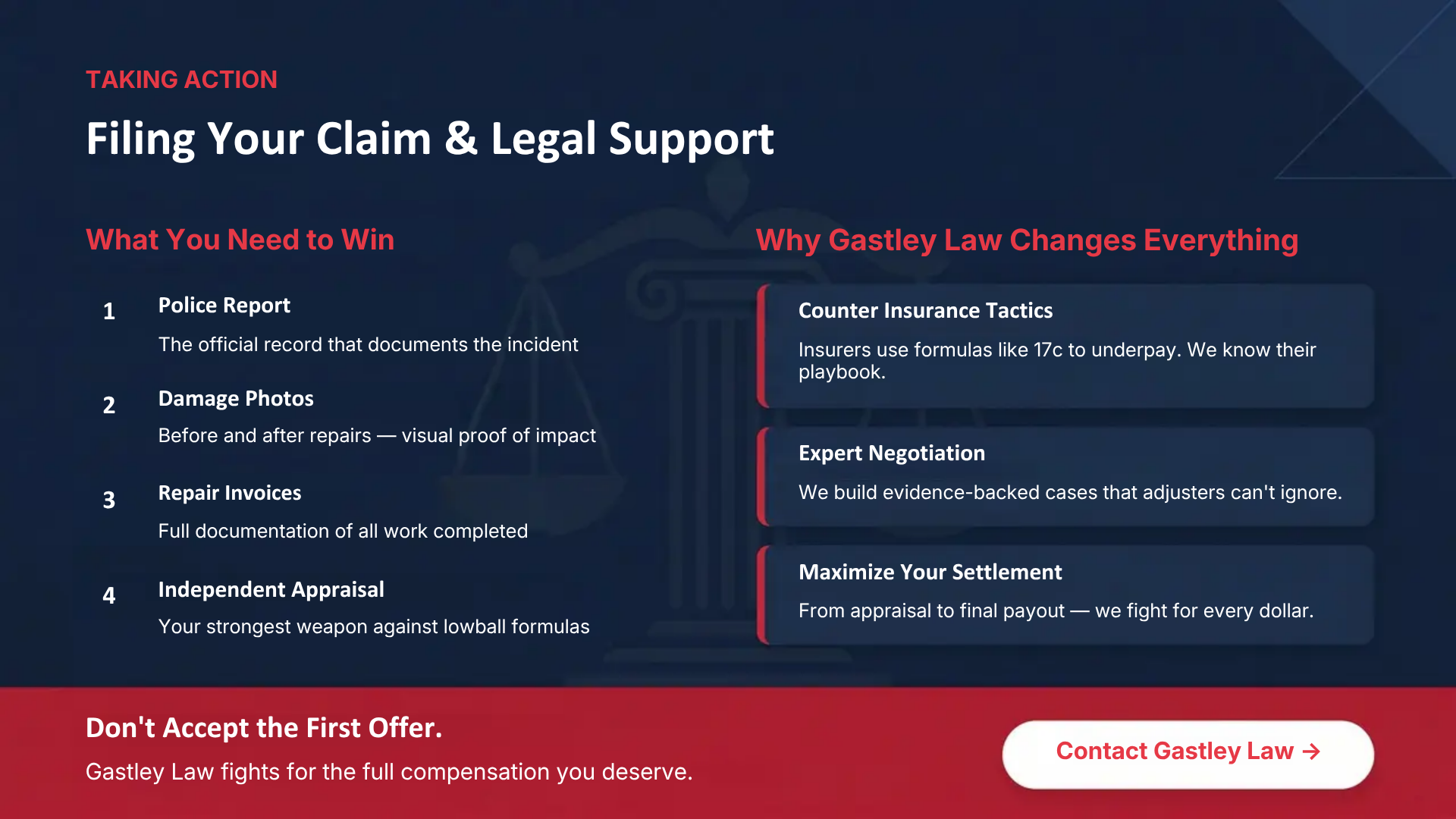
Before you even think about contacting the insurance company, you need to get your evidence in order. A strong claim is built on solid proof. Start by collecting every piece of paper related to the accident and your vehicle. This includes the official police report, all repair estimates and invoices, and photos of the damage before it was fixed. You should also find documents that establish your car’s pre-accident value, like the bill of sale. Most importantly, get a professional, third-party appraisal to determine the exact diminished value of your car. This independent report is your most powerful tool.
Once your documents are organized, it’s time to formally start the claim. You’ll need to contact the at-fault driver’s insurance company, not your own (unless you are filing an uninsured motorist claim). When you call, let them know you intend to file a diminished value claim. Ask them about their specific process and request any necessary forms you need to fill out. Every insurer has a slightly different procedure, so getting clear instructions from the start will prevent delays later on. Be polite and professional, but stick to the facts. Your goal here is simply to get the ball rolling.
This is where your preparation pays off. Submit your claim along with all the documentation you’ve gathered, especially your independent appraisal report. Be prepared for the insurance adjuster to push back or make a low initial offer. Their job is to save the company money, so this is a standard tactic. Stand firm and present your evidence clearly. Explain why your appraiser’s assessment is accurate and why their offer is insufficient. Having a legal expert handle these negotiations can make a huge difference, as they know exactly how to counter the insurance company’s arguments. Our team is experienced in handling these property damage claims.
In Georgia, insurance companies often use a formula called “17c” to calculate diminished value. It starts by taking 10% of your car’s pre-accident market value and then applies multipliers for the severity of the damage and the vehicle’s mileage. While this formula is a common starting point, it is not the law and often results in a lowball offer that doesn’t reflect your car’s true loss in value. It’s important to know that you are not required to accept a 17c calculation. An independent appraisal and a strong case are essential for challenging this formula and securing the fair compensation you deserve.
Once you’ve dealt with the immediate aftermath of an accident, your focus will shift to the insurance company. It’s important to remember that the insurance adjuster’s primary goal is to protect their company’s bottom line, which often means paying out as little as possible. They handle claims like yours every day and have a set process designed to minimize their costs.
This doesn’t mean you can’t get a fair settlement, but it does mean you need to be prepared. Understanding their tactics, knowing how to identify a low offer, and being aware of your rights are the first steps toward protecting your interests. The process can feel intimidating, but with the right information, you can approach the negotiation with confidence. If you find yourself struggling, remember that professional legal representation is available to help you fight for the compensation you deserve.
Insurance companies have a playbook for handling diminished value claims. A common tactic is to use a proprietary formula, like the 17c formula, which often produces a lower value than a real-world market analysis would. They might also tell you that diminished value is difficult to prove or that your car’s value hasn’t really dropped.
Don’t be discouraged by this initial pushback. The adjuster’s job is to settle the claim for the lowest amount. They are counting on you not knowing the true diminished value of your vehicle or the evidence required to prove it. Being aware of these tactics is the first step in countering them effectively.
A lowball offer is the most common tactic you’ll face. Insurance companies often start by limiting the diminished value to a small fraction, sometimes just 10%, of your car’s pre-accident value. For example, if your car was worth $30,000, they might offer you only $3,000, even if the damage was significant.
In other cases, the offer might seem random and incredibly low. It’s not uncommon for an insurer to offer a few hundred dollars for a claim that is actually worth several thousand. If the offer seems too low to be fair, it probably is. Always treat the first offer as a starting point for negotiation, not the final amount.
Filing a diminished value claim is not a quick process, so it’s best to set your expectations accordingly. It takes time to gather all the necessary evidence, including the repair records, photos, and a professional appraisal. Once you submit your claim, the negotiation phase begins, which can involve several rounds of back-and-forth communication with the insurance adjuster.
If the insurance company is unresponsive or unwilling to negotiate in good faith, the timeline can stretch out even longer. Patience and persistence are essential. Keep detailed records of every conversation and correspondence, and don’t be afraid to follow up regularly to keep your claim moving forward.
In Georgia, you have the right to file a diminished value claim against the at-fault driver’s insurance company. It’s important to know that the burden of proof is on you, the claimant. This means you are responsible for providing evidence that your car lost value as a direct result of the accident, even after being properly repaired.
This is where many people run into trouble. Simply stating that your car is worth less isn’t enough; you need to present a convincing case backed by solid documentation. If you feel overwhelmed by the process or believe the insurance company isn’t treating you fairly, it may be time to contact an attorney who can advocate on your behalf.
After an accident, it’s easy to feel like you’re at the mercy of the insurance company. But you have more power than you think. Building a strong diminished value claim is about being prepared, organized, and assertive. The insurance adjuster’s job is to minimize the payout, so your job is to present a case so compelling they can’t ignore it. This means gathering the right evidence and understanding the process from start to finish.
Think of it as telling a clear story with facts. The story is about your car’s value before the accident, the impact of the collision, and the permanent loss in market value it has suffered, even after being repaired. With the right approach, you can confidently counter lowball offers and secure the compensation you deserve. It takes some effort, but taking these steps can make a significant difference in the final settlement amount.
The single most important step you can take is to get a professional, independent appraisal. While online calculators can give you a rough idea, a detailed report from a certified appraiser provides the credible, third-party evidence you need. This isn’t just an opinion; it’s a professional assessment based on market data, the extent of the damage, and the quality of the repairs. An appraisal serves as the foundation of your entire diminished value claim. It gives you a specific, defensible number to present to the insurance company, moving the conversation away from their low-end formulas and toward a fact-based discussion of your car’s actual loss in value.
Once you have your appraisal, it’s time to negotiate. Be prepared for the insurance adjuster to push back or present a much lower offer. It’s their job to protect their company’s bottom line. Your role is to be firm, polite, and persistent. Use your professional appraisal as your anchor point and clearly explain why their offer is insufficient. Have all your documentation ready to support your position. Remember, you don’t have to accept the first offer. If the negotiation feels overwhelming or you’re not making progress, it might be time to get some help from a professional who handles these conversations every day.
A strong claim is an evidence-based claim. Your appraisal is the star player, but you need a solid supporting cast of documents. Collect everything related to the accident and your vehicle. This includes the official police report, photos of the damage before and after repairs, and all repair invoices detailing the work that was done. You should also gather proof of your car’s pre-accident value and condition, such as maintenance records and the original bill of sale. This paperwork paints a complete picture for the insurance company, showing exactly what your car was worth and why it’s worth less now.
Knowing what not to do is just as important as knowing what to do. First, be cautious when choosing an appraiser. Some services that charge a few hundred dollars may provide a generic report that holds little weight with insurers. Do your research and select a reputable, certified professional. Also, understand what you can and cannot claim. For instance, you generally can’t get reimbursed for expenses like insurance payments or property taxes you paid while your car was in the shop. Focusing your claim on the documented loss of market value will keep your argument clear and effective.
Filing a diminished value claim seems straightforward, but you can run into a few common roadblocks. Insurance companies are businesses, and their goal is to pay out as little as possible. This means you need to be prepared for some pushback and have your evidence ready to go. Knowing what to expect can make the process much smoother and help you build a case that’s hard to ignore. From proving your car’s lost value to managing all the paperwork, staying organized and persistent is key to getting the compensation you deserve for your vehicle’s property damage. Let’s walk through the main hurdles you might face.
It’s almost a guarantee that the insurance company’s first offer will be low. Adjusters are trained to minimize payouts, and they may tell you that diminished value isn’t significant or that their calculation is final. Don’t let this discourage you. Be prepared to negotiate and stand firm on your claim. They are counting on you to accept their initial offer without question. Remember that their internal formulas are designed to benefit them, not you. If you meet strong resistance or feel like you’re being stonewalled, it might be time to get professional legal help to advocate on your behalf and show them you’re serious about your claim.
The responsibility for proving your car lost value falls on you, not the insurance company. You can’t just say your car is worth less; you have to show it with solid evidence. The most crucial piece of evidence is a professional appraisal from a certified and independent expert who specializes in diminished value. You should also gather repair estimates, photos of the damage, and the final repair invoice. Reports from trusted sources like Kelley Blue Book can also support your case by showing your car’s market value before the accident. The more documentation you have, the stronger your argument will be when you present it to the adjuster.
In Georgia, you have a limited time to file a property damage claim after an accident. This is known as the statute of limitations, and if you miss this window, you lose your right to pursue compensation forever. For property damage, including diminished value, the deadline is typically four years from the date of the accident. While that might sound like a lot of time, it can pass quickly. Evidence gets lost, memories fade, and delays can weaken your case. It’s always best to start the claims process as soon as your vehicle repairs are complete. Acting promptly ensures you meet all legal requirements and shows the insurance company you are serious.
A successful diminished value claim requires careful organization. You’ll need to collect and manage a file of important documents to support your case. Start by gathering the accident report from the police, as it officially documents the incident. Keep all communication with the insurance company, including emails and notes from phone calls. Your core evidence will include the professional appraisal report, the final repair bill, and photos of the damage before and after repairs. Having all this paperwork in one place makes it easy to present your case clearly and professionally, leaving little room for the insurance adjuster to dispute the facts.
Filing a diminished value claim on your own can feel like a David vs. Goliath situation. You’re up against a massive insurance company with teams of adjusters and lawyers whose main goal is to pay out as little as possible. While you can certainly handle the process yourself, there are times when bringing in a professional is the smartest move you can make. An experienced attorney levels the playing field and shows the insurer you mean business.
Think of it this way: you’re an expert in your field, and a diminished value lawyer is an expert in theirs. They understand Georgia’s specific laws, know the tactics insurance companies use, and have the resources to build a powerful case on your behalf. For drivers facing delays or unfair offers, an experienced Atlanta diminished value attorney can help pursue a stronger settlement with less stress. Hiring an attorney isn’t about giving up; it’s about strategically positioning yourself to get the full compensation you deserve without the headache of fighting alone. They can manage the paperwork, handle the negotiations, and give you the peace of mind to focus on everything else.
Not every scratch and dent requires legal action, but certain red flags signal it’s time to get professional help. If the insurance company’s first offer seems ridiculously low or they deny your claim altogether, it’s a clear sign you need backup. For smaller amounts, the time and cost of a legal battle might not be worth it, but for significant losses, an attorney is essential. You should also consider legal help if your vehicle is a luxury, classic, or high-end model, as the diminished value will be substantial. Finally, if you just feel overwhelmed or intimidated by the process, a lawyer can step in and take that weight off your shoulders.
An attorney does more than just send a few emails. They can make the process much smoother and significantly increase your chances of getting fair compensation. A skilled lawyer will gather the right evidence, work with expert appraisers to accurately determine your car’s lost value, and build a case the insurance company can’t ignore. They are expert negotiators who know how to counter lowball offers and push for a settlement that truly reflects your loss. By having a legal professional manage your property damage claim, you send a clear message that you won’t be pushed around.
When you’re ready to hire help, look for an attorney who specializes in what diminished value is and property damage claims, not just general car accidents. You want someone who lives and breathes this specific area of law. Check their track record and read reviews from past clients. A good lawyer will be transparent about their process and fees. They should be able to clearly explain their strategy and fight to get you a fair settlement, not just the first offer the insurer makes. Don’t hesitate to schedule a consultation to find someone you trust to handle your case.
Yes, absolutely. The core of a diminished value claim is about the permanent loss in resale value due to the car’s accident history, not its current appearance. Even with flawless repairs, a vehicle history report will show the accident to any potential buyer. That history creates a stigma that reduces what someone is willing to pay, and that financial loss is what you are entitled to recover.
While it’s true that newer cars with low mileage see the biggest drop in value, an older car can still have a valid claim. The key is determining the car’s market value before the accident and how much that value has dropped. If your car was in excellent condition and well-maintained, the loss could still be significant enough to pursue, especially if the damage was severe.
No, you are not required to accept an offer based on the 17c formula. This is a calculation that insurance companies in Georgia often use as a starting point because it tends to produce a low number that benefits them. You have the right to challenge this figure by presenting your own evidence, most importantly a professional, independent appraisal that shows the true loss in your car’s market value.
Online calculators can give you a general idea of your car’s lost value, but they are not credible evidence in a negotiation. A professional appraisal is a detailed report from a certified expert who inspects your vehicle, analyzes market data, and provides a defensible assessment of the diminished value. This document carries significant weight with an insurance adjuster and is the strongest tool you have to prove your claim.
In Georgia, a diminished value claim is typically filed against the at-fault driver’s insurance company. If you were the one responsible for the accident, you generally cannot make a diminished value claim under your own collision policy. The purpose of the claim is to recover the loss in value caused by another person’s negligence.