
Third-Party Insurance Claim in Georgia: How It Works

After a Georgia crash, the other driver’s insurer may contact you before you have fully documented the damage. That conversation matters because the insurer is evaluating a claim against its policyholder, while you are trying to recover the loss to your vehicle. A careful record of the collision, repairs, and any reduction in market value can help you respond from a position of knowledge rather than urgency.
Request a free case evaluation with Gastley Law or call (770) 557-2838 today.
A third-party insurance claim in Georgia is made against the at-fault driver’s insurance company, rather than through your own policy. The process typically involves establishing responsibility, documenting property damage and diminished value, and evaluating the insurer’s offer before deciding whether it reflects your full recovery.
Understanding who controls the claim and what information the insurer must evaluate is the first step toward handling the process carefully. From there, the claim follows a series of practical decisions that can affect both the evidence available and the value you are able to pursue.
How Does a Third-Party Insurance Claim Work in Georgia?
A third-party insurance claim in Georgia is made against the insurance company for the driver who caused the accident. You are the injured claimant, or third party, rather than the policyholder who purchased the coverage. The claim may include repair costs, related property damage, and, when supported by the facts, a vehicle’s diminished value. Gastley Law’s Georgia diminished value claim resources explain that separate issue in more detail.
The process is different from using your own collision coverage. You must present evidence showing what happened, why the other driver is responsible, and the full amount of your loss. Georgia’s insurance rules require an insurer to acknowledge receipt of a claim within 15 days of notification. After receiving a completed proof of loss, the insurer generally must affirm or deny liability on a motor-vehicle property-damage claim within 15 days. These rules create communication deadlines, but they do not guarantee approval or determine the value of your claim.
| First-party claim | Third-party claim |
|---|---|
| Filed through your own insurance policy. | Filed against the at-fault driver’s insurance company. |
| Your policy terms, coverage limits, and deductible shape the process. | The other driver’s liability coverage and responsibility for the crash shape the process. |
| Your insurer may pay covered losses first, subject to the policy. | You seek payment from the at-fault driver’s insurer and must support the amount claimed. |
| Often used when you need to access your own collision or other applicable coverage. | Often used to pursue repair expenses, other property losses, or diminished value caused by another driver. |
Even when the other driver appears clearly at fault, do not assume the insurer will evaluate every loss automatically. Preserve photographs, repair records, estimates, and other evidence that connects the damage to the collision. If the claim includes broader property damage claims, separating repair costs from diminished value can help keep the demand clear and supported.
Understanding which type of claim you are pursuing helps you communicate with the correct insurer and avoid overlooking recoverable losses. It also gives you a clearer framework for evaluating an offer before accepting it.
Immediate Steps to Protect Your Third-Party Claim After a Georgia Accident
The first hours after a collision can affect how clearly you can prove what happened. Focus on safety, preserve evidence, and communicate carefully. These steps can help protect a claim against the other driver’s insurer while you assess vehicle damage and any possible diminished value.
-
Check for injuries and contact law enforcement
Move to a safe location if you can do so without creating another hazard, then call 911 when anyone may be injured or the scene is unsafe. Georgia requires drivers to file an accident report when a collision causes injury, death, or property damage exceeding $500. The Georgia Office of the Commissioner of Insurance also recommends getting the responding officer’s name and badge number, along with the police station’s address and phone number. Request the report or learn how to obtain it before submitting your claim.
-
Do not admit fault at the scene
Exchange required information, but avoid statements about who caused the crash, how fast a vehicle was traveling, or whether you were responsible. Do not argue about liability with the other driver or give an oral or written statement assigning blame. The Georgia Office of the Commissioner of Insurance advises drivers not to discuss the specifics of the accident or make statements about responsibility at the scene. A calm description of what you observed is safer than a rushed conclusion about fault.
-
Notify your own insurance company
Even when another driver appears responsible, notify your insurer or agent promptly and follow your policy’s notice requirements. This does not turn the claim into a first-party claim. It preserves your options and lets your insurer explain any applicable coverage or process. Tell the truth, keep the report factual, and save the date, time, and method of your notification.
-
Photograph the scene and make a simple diagram
From a safe position, photograph the vehicles, damage, road layout, traffic controls, debris, lane markings, weather conditions, and visible skid marks. Take wide shots that show the surrounding setting as well as close-ups of each damaged area. If photographs are not possible, draw a simple diagram showing the roads, travel directions, point of impact, and final vehicle positions. The state insurance office recommends noting the exact place where the vehicles collided.

-
Record witnesses and your own observations
Gather names and reliable contact information for witnesses, passengers, and the other driver. Write down the date, time, location, traffic signals, road conditions, approximate vehicle positions, and what you remember before details fade. Keep copies of the police report, photographs, diagrams, repair estimates, messages, and every communication with an insurer in one file. Organized evidence can make it easier to support the property damage portion of your claim and evaluate whether the vehicle lost market value after repairs.
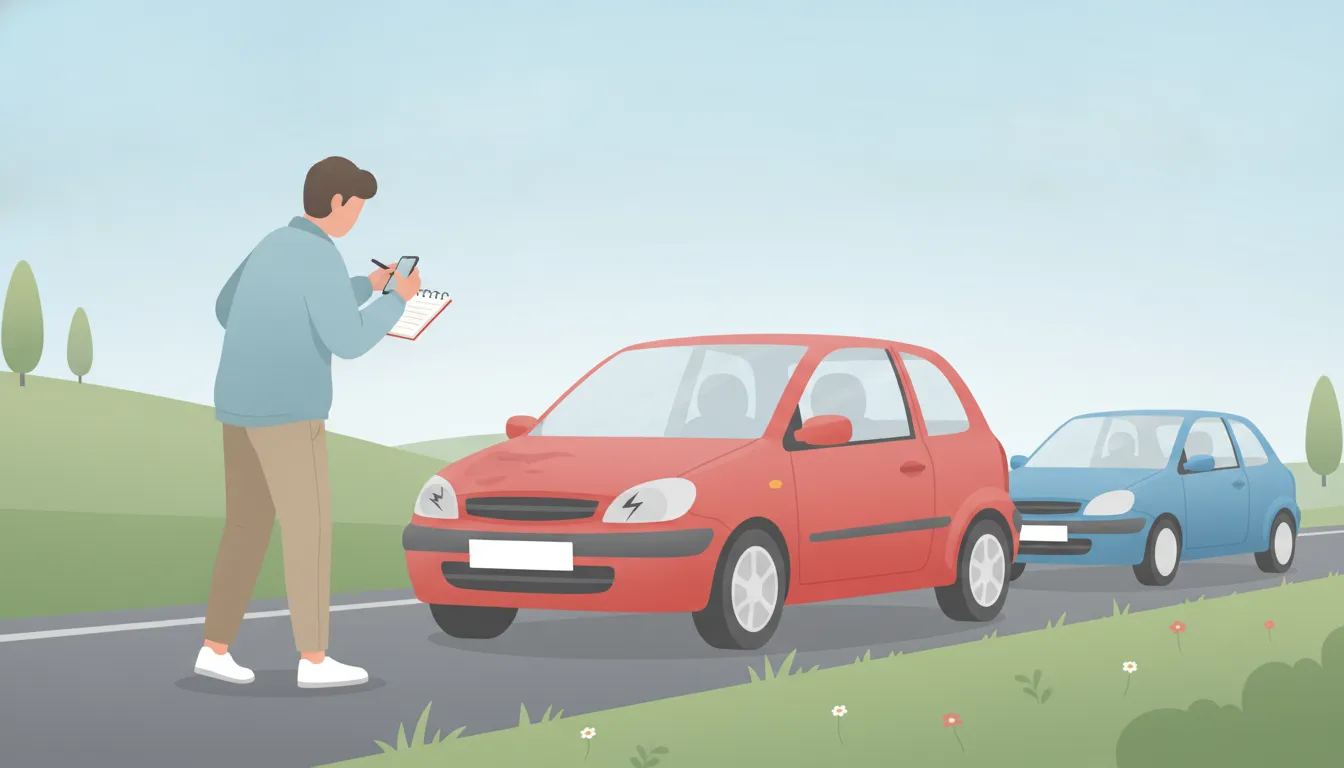
These steps do not require you to accept an insurer’s early assessment. Preserve the evidence first, then review the claim carefully before signing a release or accepting a settlement.
What to Expect During Settlement Negotiations
Settlement discussions are a review of the evidence, the claimed losses, and the insurer’s position on payment. Approach them as a documented business negotiation, not an informal conversation. A third-party adjuster works for the at-fault driver’s insurance company, not for you, so protect your interests by keeping communications accurate, focused, and supported by records.
How Do You Build a Strong Demand Package?
Organize the materials that explain what happened and what you are requesting. Depending on the claim, that may include the accident report, repair estimates, photographs, vehicle records, valuation evidence, and documentation of diminished value. Tie each item to a specific loss rather than sending a collection of documents without explanation. A clear demand should identify the amount sought and show how the evidence supports it.
Georgia’s claim-handling rules require an insurer to acknowledge receipt of a claim within 15 days of notification, unless payment is made during that period. The same rules address a separate 15-day period for affirming or denying liability after the insurer receives a completed proof of loss. These deadlines do not guarantee that the insurer will accept your valuation, but they provide useful points for tracking whether the claim is moving forward. Review the Georgia claim-handling rule for the applicable language.
What Should You Do With a Low Settlement Offer?
Do not assume an adjuster’s first number reflects the full value of the claim. Ask how the offer was calculated, then compare the assumptions against your repair records, vehicle condition, comparable evidence, and any diminished-value assessment. Respond in writing with the specific parts of the offer you dispute and the evidence supporting your position. Avoid making statements that could be read as accepting the amount before you understand the release or settlement terms.
If the valuation remains difficult to resolve, you may need a more formal method of challenging it. Gastley Law’s guide explains how to fight unfair third-party insurance offers using the policy’s appraisal process when that option applies.
When Should You Push Back or Seek Help?
Push back when the insurer overlooks documented damage, applies an unsupported valuation, disputes liability without addressing your evidence. Or asks you to accept a settlement that does not account for the losses you can substantiate. Once coverage is confirmed and the full claim amount is determined and not in dispute, Georgia’s rules require payment to be tendered within 10 days. That rule applies to an undisputed amount, so a continuing disagreement about value may still need to be resolved first. Read the payment-timing provision alongside the rest of the regulation.
If the insurer denies the claim rather than negotiating it, review these next steps for a denied third-party insurance claim. An attorney can help evaluate the evidence, identify omitted losses, and determine an appropriate response without promising a particular result.
Georgia Deadlines and Laws That Set Your Claim Timeline
Georgia law gives a damaged vehicle owner time to pursue compensation, but waiting can make the claim harder to prove and resolve. A clear timeline helps you preserve evidence, respond to the insurer, and distinguish property damage from diminished value when evaluating the full loss.
What deadlines apply after a Georgia accident?
For a vehicle damaged in a collision, Georgia’s statute of limitations generally allows four years to bring an action involving damage to personal property. Motor vehicles fall within that category. The four-year period is described in Georgia Code section 9-3-31, but the safest approach is not to treat the deadline as a reason to wait. The date a legal right accrues and the effect of claim communications can depend on the facts, so a lawyer should evaluate a time-sensitive dispute.
Georgia also requires an accident report when a crash causes an injury, death, or property damage exceeding $500. The Georgia Office of the Commissioner of Insurance advises drivers to notify police immediately and obtain identifying information for the responding officer and station. A report can preserve important details about the collision and support the documentation used in a third-party claim. Read Georgia Code section 9-3-31 and the Georgia OCI auto claim tips.
How do the 15-day and 10-day insurance rules affect timing?
Georgia insurance regulations establish several deadlines, but they do not guarantee that every claim will be paid on a fixed schedule. After receiving notification of a claim, an insurer generally must acknowledge receipt within 15 days unless it pays within that period. After receiving a completed proof of loss for a motor-vehicle property damage claim, the insurer must affirm or deny liability within 15 days.
A separate 10-day payment rule applies after coverage is confirmed, the full amount is determined, and the amount is not in dispute. In other words, the payment period does not necessarily begin on the day of the crash or the day you first call the insurer. It depends on the claim reaching the conditions described in the regulation. See Georgia insurance regulation 120-2-52 for the applicable language.
Keep copies of the notice, proof of loss, estimates, photographs, appraisal materials, and every insurer response. Those records make it easier to identify missed deadlines, disputed issues, or an incomplete evaluation of the vehicle’s repair-related and diminished-value losses.
How Gastley Law Helps You Maximize Recovery on a Third-Party Claim
A strong third-party claim requires more than forwarding a repair estimate to the other driver’s insurer. Gastley Law reviews the available evidence, identifies every category of vehicle-related loss, and documents damages that an insurer’s initial evaluation may overlook. That can include a Georgia diminished value claim when an accident has reduced the vehicle’s market value, even after repairs.
Start with a free case evaluation with Gastley Law by completing the free case evaluation form.
Building a complete damages picture
Gastley Law’s approach is centered on documentation. The firm examines the accident circumstances, repair history, vehicle information, insurance communications, and the effect of the collision on the vehicle’s value. The goal is to present a supported claim rather than accept an adjuster’s first number as the full measure of your loss. As its third-party claim guidance explains, Gastley Law helps maximize recovery by carefully documenting all damages, including diminished value when applicable.
An independent appraisal can provide additional support when the vehicle’s post-accident value is disputed. Gastley Law advances costs, including independent appraisal expenses that may range from $200 to $1,500 depending on the circumstances. That lets the evaluation focus on the evidence needed for the claim instead of requiring the client to absorb those costs at the outset.
Representation without an upfront legal bill
Gastley Law handles qualifying matters on a contingency fee basis. You can discuss the claim, the available documentation, and the potential next steps during the initial evaluation without treating legal fees as an immediate barrier. The firm explains its fee arrangement and the scope of representation before moving forward, so you can make an informed decision.
Ready to negotiate or pursue the next step
A third-party adjuster represents the insurance company, not you. Gastley Law prepares to challenge unsupported valuations and address gaps in the insurer’s analysis. If negotiation does not resolve the dispute, the firm remains prepared for litigation and small-claims proceedings where appropriate. That readiness matters because a claim should be evaluated on its evidence and legal options, not only on whether an insurer prefers to settle quickly.
Clients also receive personal access to dedicated case managers, including direct cell phone access. You can ask questions, provide documents, and understand where the claim stands without being left to navigate the process alone. Gastley Law’s documented focus on diminished value and property damage claims informs the review, while the free case evaluation helps determine whether representation is appropriate for your situation.
Frequently Asked Questions
How do I file a claim against another driver in Georgia?
Gather the other driver’s insurance and contact information, report the accident when required, photograph the vehicles and scene, and collect witness details. Notify your own insurer promptly as well, even when another driver caused the collision. Submit repair records, estimates, and other proof supporting each part of your property damage claim.
Does Georgia require third-party liability insurance?
Georgia requires drivers to carry liability coverage that can respond when they cause covered injuries or property damage. The at-fault driver’s policy may therefore provide a path to recovery, but coverage disputes, policy limits, and fault questions can affect what the insurer pays.
What should I do if the other driver’s insurer denies responsibility?
Ask for the denial and its stated basis in writing, then preserve the evidence supporting your account. Including photographs, diagrams, the police report, witness information, repair documentation, and proof of diminished value when applicable. An attorney can evaluate the evidence and help determine whether further negotiation or litigation is appropriate.
How long do I have to pursue property damage after a Georgia accident?
Georgia generally provides four years to bring an action involving damage to personal property, including a damaged motor vehicle. See O.C.G.A. section 9-3-31: Georgia’s property-damage limitation. Do not treat that outer deadline as a reason to delay evidence collection or claim negotiations.
When should I get legal help with the claim?
Consider legal guidance when the insurer disputes fault, undervalues repairs or diminished value, delays the claim, or asks you to accept a release before all losses are understood. A review can help identify overlooked damage and clarify the options for pursuing a fair recovery without making unsupported promises about the result.
Ready to discuss your Georgia insurance claim?
Request a free case evaluation with Gastley Law or call (770) 557-2838 today.
Gastley Law can review the circumstances and help you understand practical next steps with your third-party insurance claim in Georgia.