
How Much Diminished Value Claim Georgia Payout Guide
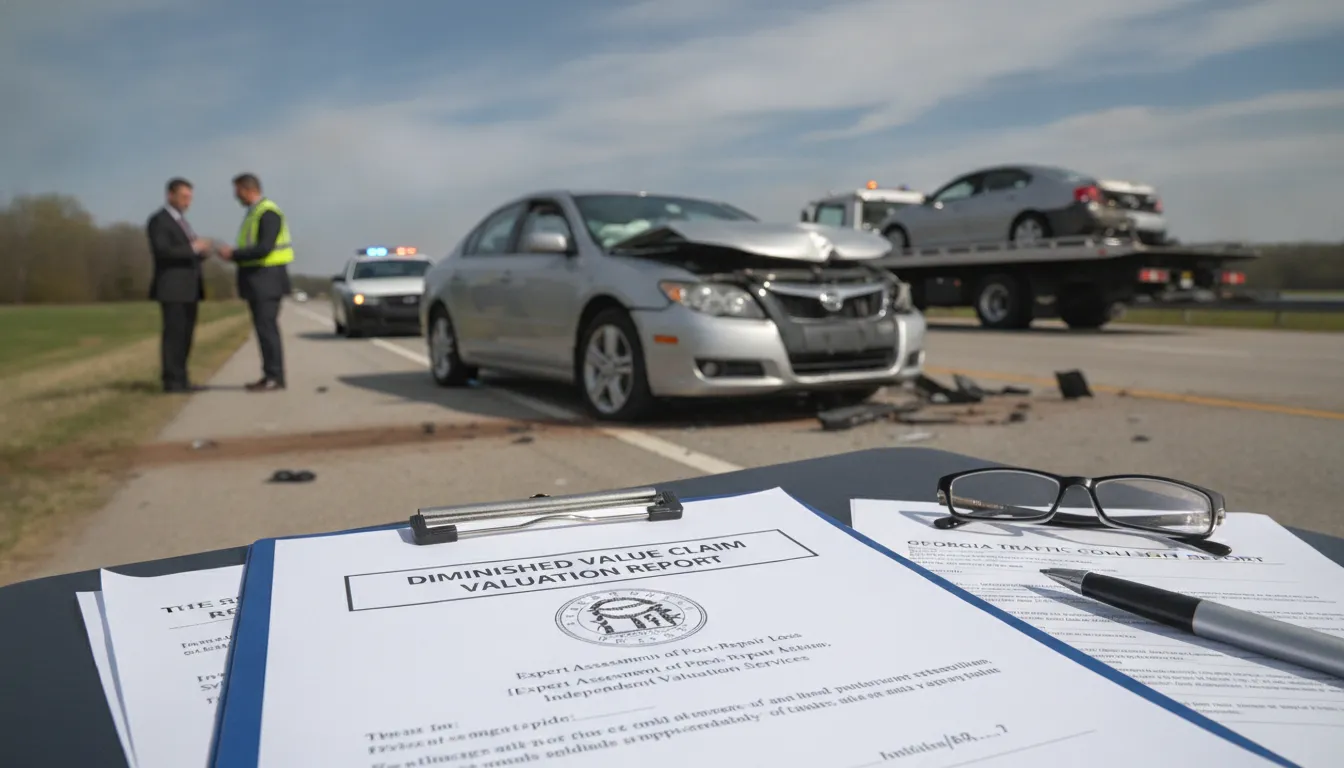
Your car’s trade-in value drops the second an accident report hits its vehicle history. Even if the bumper looks like new, buyers will pay less for a repaired car. This real market loss is your diminished value.
Finding how much diminished value claim Georgia insurers must pay requires looking at actual vehicle market data. While insurance companies use a shortcut formula to pay less, this method is not the law. Your payout should reflect the real-world difference in your car’s resale value before and after the crash. According to a landmark Georgia Supreme Court ruling, insurance providers must pay you for this loss alongside physical repair costs. Depending on your car’s condition and the damage, your rightful payout could range from thousands to tens of tens of thousands of dollars. An independent appraisal of your car’s value is the best way to prove what you are owed and get a fair payout.
To get the full payout you deserve, you must understand the rules for diminished value in Georgia. You might wonder how insurers decide what your car is worth after a wreck. The answer is found in the section below, which details How Is Diminished Value Calculated in Georgia?
How Much Diminished Value Claim Georgia: How Is Diminished Value Calculated in Georgia?
After a car crash, insurance firms must assess the loss in your car’s worth. Most insurance adjusters in Georgia use a formula called “17c” to decide how much diminished value you should get. This formula uses a strict four-step process to find your payout.
The Four Steps of the 17c Formula
First, the insurer looks up your car’s pre-accident value. They often use trade-in values from a service like NADA. Second, they apply a ten percent cap to that value. This cap sets the most they will pay. If your car was worth $20,000, the cap is $2,000. Under this rule, your claim can never be more than ten percent of the car’s pre-accident value.
Third, the firm applies a damage multiplier. This number ranges from 0.00 up to 1.00. They use 0.00 for no damage or 0.10 for minor cosmetic flaws. They only use 1.00 for severe structural damage. Fourth, they apply a mileage multiplier from 1.00 down to 0.00 based on your miles. If your car has over 100,000 miles, they use a 0.00 multiplier. This step fully wipes out your claim, even if your car was in perfect shape before the crash.
Why the 17c Formula Is Not the Law
The Georgia Supreme Court ruled on this right in the Mabry v. State Farm case. The court said insurance firms must pay for lost value, but it did not set a formula. The court held that insurers must consider diminished value when you make a claim. The 17c formula was only a one-time shortcut used in a class-action settlement. It was meant to help process a large group of claims quickly. It is not a legal standard, and you are not bound by it.
The Georgia Insurance Commissioner has also stepped in. The Commissioner directed carriers not to call 17c the legal or final word on diminished value. In fact, the state does not endorse 17c at all. Insurers must look at any real market proof of loss that you provide. They cannot force you to accept their fixed shortcut.
How to Challenge a Low 17c Offer
When filing a diminished value claim, you do not have to accept a low offer. You can reject a payment that is based on the 17c formula. You can fight back with real market facts. An independent appraisal can show how much value your car actually lost in the real world. A detailed market report is much stronger than an unfair math formula.
How Much Can You Expect From a Georgia Diminished Value Claim?
When you file a Georgia diminished value claims case, the payout depends on many factors. Most payouts range from 2,500 dollars to over 30,000 dollars. The exact amount depends on your car’s age, make, and pre-accident value. Georgia law protects your right to seek this loss, as shown in the Mabry v. State Farm case. Every car loses some market value after a crash, even if it is repaired perfectly.
Real vehicle claim examples
To see what you might expect, look at real cases from local auto appraisers in Georgia. These cases show the gap between what insurers offer and the true market loss of a vehicle. For instance, a 2025 Porsche 911 had an appraised loss of 30,000 dollars, but the insurer offered zero dollars. This shows how high-end cars suffer huge drops in resale value after a crash. Even a 2013 Infiniti G37 with more age was appraised at 2,500 dollars of lost value, while the insurer still offered nothing.
The insurer payout gap
Insurers often offer far less than your car actually lost in value. They use basic math rules that do not account for the real auto market. Look at these three other real case examples from Georgia drivers:
- A 2024 Kia Sorento had an appraised loss of 5,500 dollars. The insurer offered just 979 dollars, showing a five-to-one gap.
- A 2026 Toyota Tundra lost 6,200 dollars in value after its crash. The insurer offered zero dollars, which is common for new trucks.
- A 2017 Acura MDX had a real value loss of 3,000 dollars, but the insurer offer was zero dollars.
How vehicle type affects your payout
Your payout depends a lot on the type of vehicle you drive. Newer luxury cars and heavy-duty trucks tend to lose the most value after a wreck. This is because these cars have high starting prices, and buyers are very picky about past wrecks. For a standard sedan or SUV, the loss may be smaller but is still a big deal. The key is to find the real market loss instead of taking the insurer’s first offer.
Expected valuation ranges
Across these five cases, the total appraised loss in value was 47,200 dollars. Yet, the total of all insurer offers was only 979 dollars. These examples show that payouts vary based on your car’s type and the damage. You cannot assume your payout will match these cases since every claim is different. Still, these examples show how insurance offers fail to cover your car’s real loss in market value. To get a fair payout, you must show the insurer real market sales data.
What Factors Affect Your Diminished Value Claim Amount?
Under Georgia law, car owners have a clear legal right to get back the lost worth of their car after a crash. Many drivers ask how much diminished value claim Georgia auto insurers owe after a crash. The answer is that a claim can range from 10% to 50% of the car’s pre-crash value. How much you get depends on several key facts about your car and the wreck.
How Mileage and Car Age Impact Your Payout
Your car’s age and mileage are the first things an insurer will check. Cars that are up to 6 years old are in the best spot to get a high payout. If your car is older or has very high mileage, its lost value is much lower. Under the common 17c formula, insurance companies use a strict scale to cut your claim based on miles. Here is how that scale works:
- 0 to 19,999 miles: 1.00 multiplier
- 20,000 to 39,999 miles: 0.80 multiplier
- 40,000 to 59,999 miles: 0.60 multiplier
- 60,000 to 79,999 miles: 0.40 multiplier
- 80,000 to 99,999 miles: 0.20 multiplier
- 100,000 miles or more: 0.00 multiplier
If your car has over 100,000 miles, the 17c formula drops your payout to zero. But real buyers in the market still care about a crash history, even on older cars.
Why Frame Damage Pays More Than Surface Flaws
The type of damage your car took plays a big role in your final payout. Simple surface flaws like a scratched bumper or a chipped door do not hurt resale value for long. Deep damage to the frame or core parts of the car is much more serious. Under the standard formula, deep frame damage gets a full 1.00 multiplier. Surface or minor body work gets a much lower scale, like 0.25 or 0.50. Buyers are very wary of cars with major structural history, so these claims are worth far more.
The Role of Car Brand and Repair Parts
Your car’s make and model will also change your claim size. High-end sports cars and luxury brands lose much more cash value than common sedans. If you own a high-end car, you may need to prove your diminished value claim with real market sales. The quality of the repairs matters too. If the shop used cheap copy parts instead of factory parts, your car’s value will drop even more. Strong claims show that only factory parts can keep your car in top shape.
Why Do Insurance Companies Pay Less Than Your Claim Is Worth?
Insurance firms are businesses. Their main goal is to protect their own money. Because of this, they want to keep payouts as low as possible. You may want to find out how much diminished value claim Georgia drivers can recover. To learn more about diminished value in Georgia, you have to look at how carriers value loss. But you cannot trust the insurance adjuster to give you a fair number.
The arbitrary limits of the 17c formula
Most carriers use a process known as the 17c formula. They present this formula as the only way to calculate your claim. In truth, there is no law that says they must use it. The Georgia Insurance Commissioner has directed insurers not to call 17c the legal standard. Yet, carriers still use it because its rules are built to pay you less.
This formula has three major flaws that hurt your payout. First, it places an arbitrary ten percent cap on your vehicle’s pre-accident value. Second, it uses a damage multiplier that does not match real market data. Third, it uses a mileage multiplier that zeros out value for older cars. If your car has high mileage, the formula says its loss is worth nothing.
For example, the formula cuts your claim in half if your car has over fifty thousand miles. If your vehicle has over one hundred thousand miles, the mileage multiplier drops to zero. This means the insurance company will offer you nothing for your loss, even if your car was in perfect shape before the crash. Such rules are not based on real car sales.
Real case evidence and lowball insurer tactics
Real case data shows how unfair these insurer offers can be. In a study of five Georgia cases, four of the five insurers offered zero dollars. The only carrier that made an offer paid just nine hundred and seventy-nine dollars. Yet, the real appraised loss for that vehicle was fifty-five hundred dollars. This is a five-to-one gap between the real loss and the insurer’s offer.
Under Georgia common law established in Mabry v. State Farm, carriers must evaluate and pay for diminished value. But they hope you will not fight their low offers. They count on drivers not knowing the law. To fight back, you need to show the real market loss with a professional appraisal.
How an Independent Appraisal Can Increase Your Settlement
Insurance carriers often use a basic method to find your payout. But this method does not show your true loss. Under Georgia law, you have a right to payment for your car’s drop in value, as shown in the landmark case of Mabry v. State Farm. An independent appraisal is the best way to prove this loss.
Real Georgia claim examples
To see how much diminished value claim Georgia drivers can really get, look at these real cases. The table below shows the big gap between what the insurer offers and the true market loss.
| Vehicle | Repair Cost | Insurer Offer | Appraised DV |
|---|---|---|---|
| 2013 Infiniti G37 | $5,370 | $0 | $2,500 |
| 2024 Kia Sorento | $26,553 | $979 | $5,500 |
| 2025 Porsche 911 Cabriolet | $77,312 | $0 | $30,000 |
| 2026 Toyota Tundra | $20,904 | $0 | $6,200 |
| 2017 Acura MDX | $11,861 | $0 | $3,000 |
As the data shows, insurance companies often offer nothing at all. Four out of five cars in this list got an initial offer of zero dollars. But an expert appraisal proved the true loss was thousands of dollars.
Why market appraisals beat 17c
Insurers like to use a standard formula called 17c. This formula has a strict cap of ten percent and ignores the local market. An expert, market-based appraisal looks at real sales of similar cars in your area. This puts a strong, defensible number on the table that the insurance carrier cannot ignore.
Our contingency appraisal model
Getting an expert report can sometimes cost money upfront, but Gastley Law has a better way. We work on a pure contingency model, which means we front all appraisal costs for you. There is zero risk to you because you pay nothing unless we win. We can help you use the Georgia appraisal clause to demand a fair payout.
How Long Does a Diminished Value Claim Take in Georgia?
Many drivers wonder how much diminished value claim Georgia insurers will pay and how long the process will take. The time it takes to get your money often depends on how you handle the claim. If you are filing a diminished value claim in Georgia, you should know that some insurers try to delay the process on purpose.
Your right to recover this loss is protected by law, even if repairs make your car look like new. As explained in a study by the University of San Francisco Law Review, state courts require insurers to pay for this lost value.
Typical timeline to get paid
Most claims that involve a dispute are settled in 30 to 45 days. This clock starts once you challenge their initial low offer. If you accept their first low offer, you might get paid faster, but you will lose thousands of dollars.
The step-by-step dispute process
First, you file the claim with the at-fault insurer and wait for their lowball offer. Once they send it, you must reject the offer. Next, you hire an expert to write an independent appraisal report, which usually takes under a week. The remaining steps to resolve your claim include:
- Submitting the independent appraisal report to the insurer.
- Negotiating a fair payout based on real market data.
- Signing the final agreement and receiving your check.
Legal deadlines and court options
If the insurer still refuses to pay, you have legal options in Georgia. Under state law, you have a four-year statute of limitations for property damage claims. This means you must file a lawsuit within four years. But Gastley Law targets claims for cars damaged within the last six years, focusing on newer models.
If you must sue, you can take the insurer to small claims court. In Georgia, the small claims court limit is $15,000, and you can bring an attorney to help you win.
Frequently Asked Questions
Can you claim diminished value if you are at fault in Georgia?
Yes, you can still claim diminished value under your own policy in Georgia even if you caused the accident. According to the Georgia Supreme Court, insurance companies must pay for the lost resale value of your vehicle under first-party collision coverage. This rule applies to any covered accident from the last six years.
How long do you have to file a diminished value claim in Georgia?
Georgia law gives you different deadlines depending on who was at fault. For a claim against another driver, you have a four-year deadline for property damage under Georgia law. If you file under your own insurance policy, you have up to six years under written contract rules.
Can you file a diminished value claim if your car is financed?
Yes, you can still claim diminished value even if you are still paying off your car loan. As the registered owner of the vehicle, you are the person who suffers the loss when its resale value drops. The insurance check is sent directly to you rather than your lender because the damage reduces your equity in the car.
Is the 17c formula the only way to calculate diminished value in Georgia?
No, the 17c formula is not the final word on your vehicle’s value. The Georgia Insurance Commissioner has directed insurance carriers that 17c is not the definitive method for calculating loss. You have the right to challenge their low offer by presenting a professional market appraisal that shows your car’s true loss in value.
Ready to find out what your claim is worth?
Insurance companies often use low numbers to save their own money. If you do not challenge these unfair offers quickly, you risk losing the full payout for your car’s lost value. Waiting too long makes it harder to gather proof and dispute their decisions. Taking action now ensures you have the help needed to fight for a fair settlement before the legal deadline passes.
Our team works on a no-win, no-fee model, so you pay nothing upfront to start your case. We front all appraisal costs and only get paid when we recover money for you. This removes the financial risk so you can focus on getting your car’s lost value back.
Ready to get started? Call (770) 557-2838 to schedule a free case evaluation.