After a car accident, most people focus on one thing: the repair bill. But the true cost of the damage often goes much deeper. Even after your car is perfectly fixed, its resale value takes a permanent hit. This is called diminished value, and it’s a real financial loss that insurance companies are reluctant to pay. Fortunately, you don’t have to accept their initial offer. You can pursue all your losses, including diminished value, by filing a small claims court property damage claim. This guide explains how to calculate your total damages—both the obvious and the hidden—and present a rock-solid case to ensure you recover everything you’re entitled to.
If you’re dealing with a property damage claim, you might hear the term “small claims court.” Think of it as a more straightforward and faster version of court designed to handle disputes over smaller amounts of money. In Georgia, what most people call small claims court is officially known as Magistrate Court. It’s a place where you can sue for money or property valued up to $15,000.
The main goal of Magistrate Court is to resolve cases fairly and quickly, without the complex and lengthy procedures of higher courts. The trials are less formal, and you can often represent yourself. This makes it an accessible option if an insurance company is refusing to pay for damages to your car or personal property after an accident. While you can handle these cases on your own, managing the process to get the full amount you’re owed can still be tricky. Understanding your options, including when to seek legal support for your property damage claim, is the first step toward getting compensated.
A property damage case in small claims court is exactly what it sounds like: you’re asking to be compensated because someone else’s carelessness damaged or destroyed your property. To win your case, you generally need to prove negligence. This boils down to showing three key things: the other party was careless, your property was damaged, and their carelessness directly caused the damage.
To do this, you’ll need solid evidence. Start gathering documents like police reports, repair bills, and written estimates from mechanics. Photos and videos of the damage are also incredibly powerful. If anyone saw what happened, their witness statements can be a huge help. This includes damage to your vehicle and even the loss of your car’s resale value, also known as diminished value.
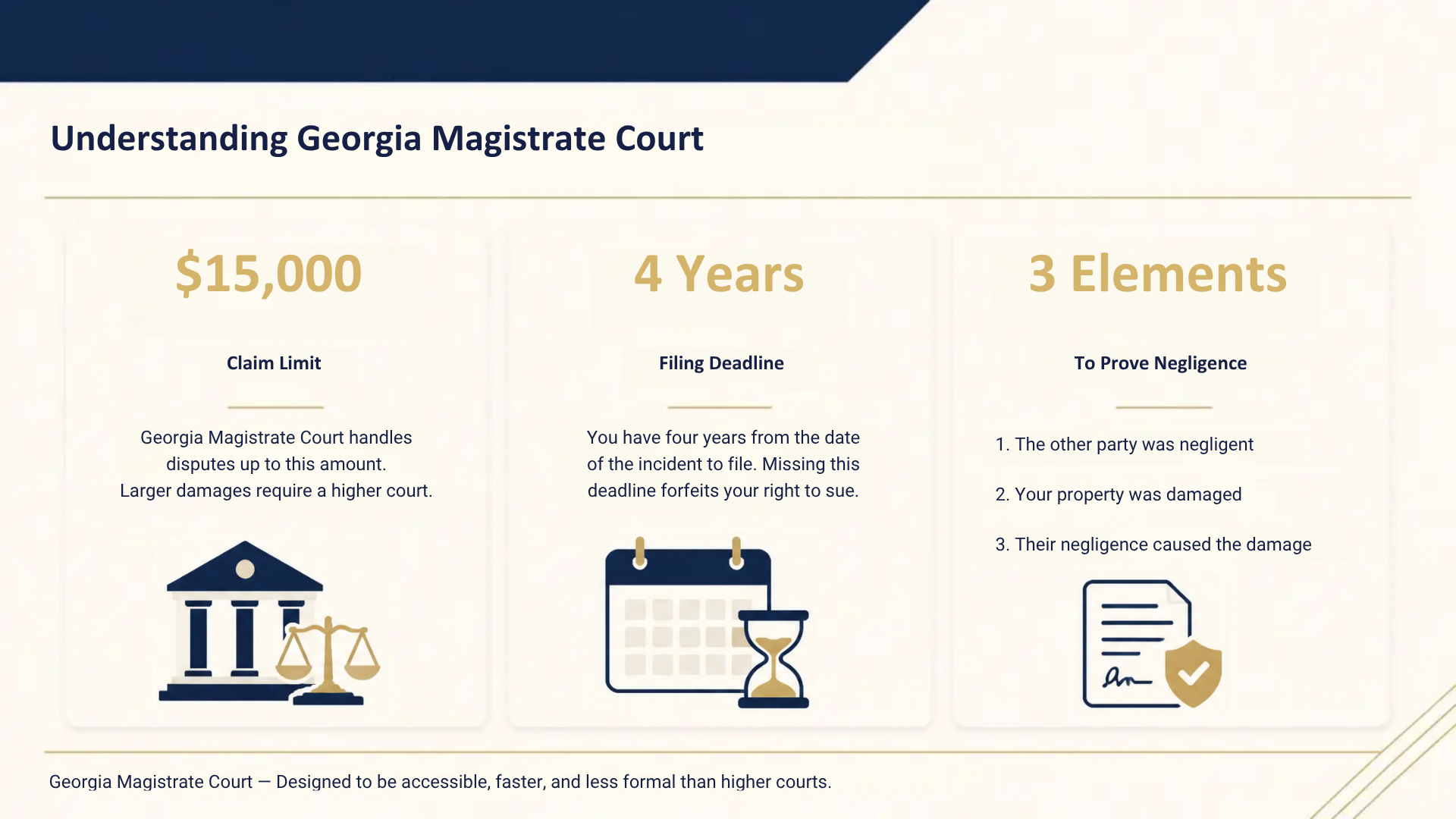
When we talk about “limits” in small claims court, it’s not just about money. It’s also about time. Every state has a strict deadline, called the statute of limitations, for filing a property damage case. In Georgia, you have four years from the date of the incident to file your claim. If you miss this deadline, you unfortunately lose your right to sue for damages.
On top of the time limit, remember Georgia’s monetary limit for Magistrate Court is $15,000. If your damages exceed this amount, you’ll need to file in a different court. Because these deadlines and rules are so firm, it’s crucial to act quickly after an accident. If you’re feeling overwhelmed by the process or are getting close to the deadline, it might be time to get in touch with an expert who can help.
When you hear “property damage,” your mind probably jumps straight to your car’s crumpled bumper. While that’s a huge part of it, the term covers more than you might think. In the eyes of the court, property damage can be any harm to your belongings that reduces their value or makes them unusable. This includes both “real property” (like your house or land) and “personal property” (like your car, phone, or laptop).
Understanding what you can claim is the first step in getting the compensation you deserve. Small claims court is a great venue for straightforward property damage claims, but you need to know what falls under its jurisdiction. Whether it’s a fender bender, a damaged laptop that was in your trunk, or even a dispute with a neighbor, the key is documenting the damage and its value. We’ll break down the most common types of property damage you can claim in small claims court so you can build a clear and effective case.
This is the most common reason people end up dealing with property damage claims. After an accident, the at-fault driver’s insurance company is responsible for the cost of repairs. An adjuster will inspect your car to estimate the repair costs or, if the damage is severe enough, declare it a “total loss.” But the story doesn’t end there. Even after your car is perfectly repaired, it’s worth less than it was before the accident. This loss in resale value is called diminished value, and you are entitled to be compensated for it. Insurance companies often don’t volunteer this payment, so you have to demand it.
Think about what was inside your car during the accident. A laptop for work? Your kid’s expensive car seat? A pair of designer sunglasses? These are all considered personal property, and if they were damaged or destroyed in the crash, you can claim their value. Your claim isn’t limited to just the vehicle itself. Make a detailed list of every item that was damaged, find the original receipts if you can, and research their current replacement cost. Strong documentation is your best friend when it comes to getting fully compensated for these additional losses.
While car accidents are a primary focus, small claims court also handles other types of property damage. For example, if your neighbor’s dead tree falls and crushes your fence, you can file a claim to cover the repair costs. Similarly, if a landlord wrongfully withholds your security deposit to cover “damages” that were just normal wear and tear, you can use small claims court to get your money back. These cases hinge on proving who was responsible and the exact cost of the damage they caused.
Small claims court is designed for resolving disputes quickly and without complicated legal procedures. Because of this, there are limits. In Georgia, you can’t sue for more than $15,000 in Magistrate Court, which functions as the state’s small claims court. If your damages, including vehicle repairs, personal items, and diminished value, exceed this amount, you’ll need to file your case in a higher court. Small claims court also doesn’t handle every type of case; for example, you generally can’t file for divorce or bankruptcy there. Knowing these limits helps you start in the right place.
Winning in court is all about proving your case with solid evidence. It’s not just what you say, but what you can show. This is where you lay the groundwork for getting the compensation you deserve for your property damage claim. Think of yourself as a detective building a case file. Every photo, receipt, and report adds another layer of proof that strengthens your position and makes it harder for the other side to argue against you. Let’s walk through the essential evidence you need to collect.
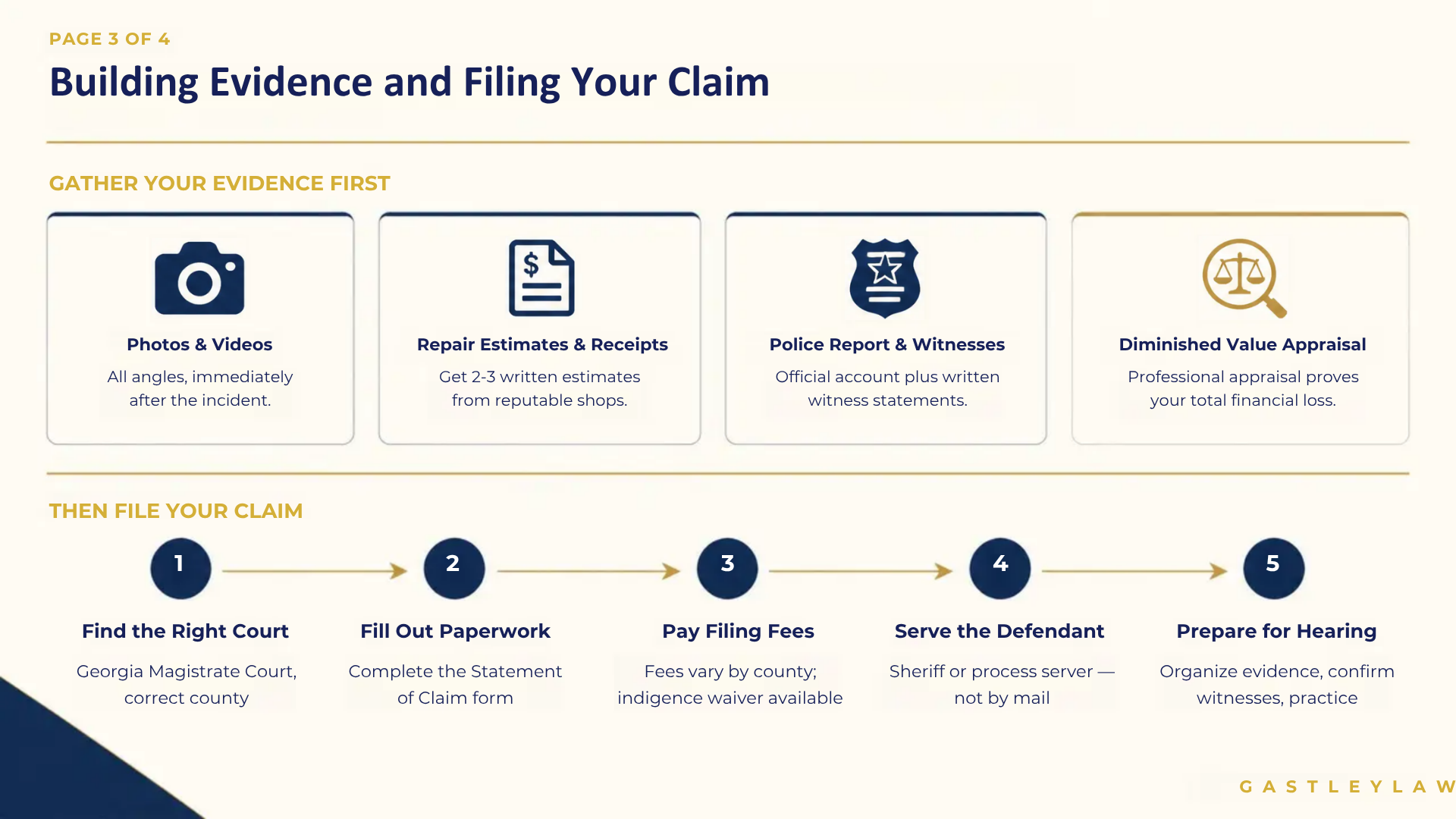
A picture is worth a thousand words, especially in court. If you can, take photos and videos immediately after the damage occurs. Capture the damage from every possible angle, both close-up to show specific details and from a distance to show the full context of the situation. Don’t forget to video the scene as well, as it can capture details that still photos might miss. As you document everything, be sure to write down the date, time, and a brief note about what happened. This creates a clear timeline and connects your visual proof directly to the incident, leaving no room for doubt.
You need to prove the financial cost of the damage, and the best way to do that is with official documents. Make it a point to get at least two or three written estimates from different reputable repair shops. This shows the judge you’ve done your homework to find a reasonable cost and prevents the other party from claiming you’re inflating the price. Also, hold on to every single receipt related to the incident. This includes any out-of-pocket expenses for temporary solutions, rental cars, or related costs, as these can all be part of your claim. Keep everything organized in a folder so it’s ready when you need it.
If your property damage was the result of a car accident, the police report is one of the most critical pieces of evidence you can have. It serves as an official, unbiased account of what happened. Additionally, if anyone saw the incident, their account can be incredibly helpful. Ask for their contact information and see if they are willing to provide a brief written statement about what they observed. These witness statements add a credible, human element to your case and support your version of events. A third-party perspective can make a huge difference in how a judge views the situation.
Sometimes, repair costs don’t tell the whole story. This is especially true for vehicles, which often lose resale value after an accident, even if they’re perfectly repaired. This loss is called diminished value, and you have a right to claim it. To prove this loss, you need more than a repair bill; you need a professional appraisal from a qualified expert. An expert’s report provides an authoritative assessment of your total financial loss, which carries significant weight in court. It’s a powerful tool for ensuring you are fully compensated for the accident’s true impact on your car’s worth.
Ready to take action? Filing a property damage claim in small claims court might seem intimidating, but it’s a process designed for people to use without a lawyer. Think of it as a series of steps. By following this guide, you can confidently prepare your case and ensure you’ve covered all your bases. We’ll walk through the entire process, from figuring out where to file to getting ready for your day in court. This guide is focused on the process in Georgia, so you’ll have the specific information you need.
Your first move is to file in the right place and against the right person. In Georgia, small claims cases for property damage are handled in Magistrate Court, sometimes called “the people’s court.” This court can hear cases for claims up to $15,000. It’s just as important to name the correct defendant, the person or company you are suing. Naming the wrong party can lead to your case being dismissed, so double-check all names and addresses before you file. You can find the correct Magistrate Court for your county online.
Next, you’ll need to fill out the official court form, called a “Statement of Claim.” On this form, you will clearly state who you are, who you are suing, and the details of your claim. You need to explain what happened, what property was damaged, and exactly how much money you are seeking for repairs or replacement. Be concise but thorough. You can usually get this form from the court clerk’s office or download it from your county’s Magistrate Court website. Filling it out accurately is your first chance to tell your story to the court.
Starting a lawsuit requires paying a filing fee to cover the court’s administrative costs. The amount varies from county to county in Georgia, so you’ll need to check with the clerk of the Magistrate Court where you plan to file for the exact cost. There may also be a separate fee for having the sheriff serve the papers to the defendant. If you can’t afford the fees, you can ask the court to file an “Affidavit of Indigence,” which is a request to waive the fees due to financial hardship.
After you file your claim, the defendant must be officially notified. This legal step is called “service of process,” and it’s not optional. In Georgia, service is typically handled by the county sheriff’s department or a private process server for a fee. This ensures there is an official record that the defendant received the lawsuit papers. You can’t just mail the documents yourself. Proper service gives the defendant a chance to respond and is a fundamental requirement for your case to proceed. Without it, a judge can’t hear your case.
Once your case is filed and the defendant is served, the court will set a hearing date. Now is the time to prepare. Gather and organize all your evidence: photos, videos, repair estimates, receipts, and police reports. If you have witnesses, make sure they are willing and able to attend. Practice explaining your case out loud so you can present it clearly to the judge. While Magistrate Court is less formal, being organized shows the judge you are serious. If this part feels overwhelming, remember you can always seek legal advice. Our team at Gastley Law is here to help you get what you’re owed; you can contact us for support.
Walking into a courtroom can feel intimidating, but small claims hearings are designed to be less formal than what you see in movies. Think of it less as a dramatic trial and more as a structured conversation where a judge listens to both sides of the story. You and the person you’re suing (the defendant) will each get a chance to speak, present your side, and ask questions.
The main goal is for the judge to understand the facts of your property damage case. This is your opportunity to explain what happened, show the proof you’ve gathered, and clearly state what you believe you are owed. The judge is there to listen and make a fair decision based on the information presented. Being organized and calm is your best strategy. The hearing is your chance to have your case heard directly by a decision-maker, so it’s important to be ready to make the most of it.
When it’s your turn to speak, you’ll explain your case to the judge and present the evidence you’ve collected. This is where all your preparation pays off. You can show the judge your photos, videos, repair estimates, and receipts. If you have a witness, they can speak on your behalf, but they will need to be sworn in first. The judge can accept any evidence that helps prove the facts of the case. Speak clearly and stick to the point. Explain what happened in a simple, chronological order and use your evidence to back up every part of your story. It helps to practice your explanation beforehand so you feel confident and prepared.
After hearing from both you and the defendant, the judge will decide who wins the case. To win, you must prove how much you are owed. It isn’t enough to just say the other party was at fault; you have to show the specific dollar amount of your damages with receipts, expert appraisals, and repair estimates. The judge might award you the full amount you asked for or a smaller amount if they feel only some of your claim was proven. This is especially important for complex damages like getting your car’s diminished value back, where a professional appraisal is critical to proving your loss.
Sometimes, before or even during the hearing, the court may offer mediation. Mediation is a process where a neutral third person helps you and the other party try to reach an agreement without the judge making the final decision. It can be a good way to resolve the issue more quickly and with less conflict. If you’re offered mediation, it’s worth considering. However, you don’t have to accept a settlement you feel is unfair. If you can’t reach an agreement, you can still proceed with the hearing. It’s often wise to get legal advice before accepting any offer, so you know you’re getting what you deserve. You can always contact us to review a settlement offer.
If you win your property damage case in small claims court, the judge will order the other party to pay you money to cover your losses. This is known as “compensatory damages,” and the goal is simple: to put you back in the same financial position you were in before your property was damaged. It’s not about punishing the other person or getting a windfall, it’s about making things right.
The amount you can receive depends entirely on the specific damages you can prove. This usually includes the direct costs to fix or replace your property, but it can also cover other related financial hits you took because of the incident. For vehicle accidents, this often involves more than just the initial repair bill. You might be entitled to compensation for the permanent drop in your car’s value, a loss that many people overlook. Understanding what you can legally claim is the first step toward getting the full amount you are owed. We’ll break down the most common types of compensation you can pursue in a Georgia small claims court.
The most straightforward type of compensation covers the cost of repairs. If your car was damaged, you can claim the amount quoted by a reputable body shop to fix it. Be sure to get multiple estimates to show the judge the cost is reasonable. However, if the damage is so severe that the cost of repairs is more than the car is worth, the insurance company will declare it a “total loss.”
In that case, you won’t get the money for repairs. Instead, you are entitled to the car’s “Actual Cash Value” (ACV). ACV is what your vehicle was worth the moment before the accident happened. This value considers its age, mileage, and overall condition. The court will award you compensatory damages to either repair your property or replace it if it’s totaled.
Even after your car is perfectly repaired, it’s worth less than it was before the accident. This loss in resale value is called diminished value, and in Georgia, you have the right to be compensated for it. Think about it: a potential buyer will almost always pay less for a car that has been in an accident, even if it looks and drives like new. That difference in value is a real financial loss you’ve suffered.
You can file a claim for this loss separately from your repair costs. This is a crucial point that many people miss. Just because the at-fault driver’s insurance paid for the repairs doesn’t mean their obligation is over. We specialize in helping clients understand what diminished value is and how to prove it in court to recover that lost value.
Sometimes, winning your case is surprisingly simple. If you properly served the defendant with the lawsuit and they fail to show up for the court date, the judge will likely issue a “default judgment” in your favor. This means you win the case without having to argue its merits because the other party didn’t appear to contest it. You will still need to prove your damages, but you won’t have to prove the defendant was at fault.
If the case is heard and you disagree with the judge’s decision, you have the right to appeal. In Georgia, you must file an appeal within 30 days of the judgment. The case will then be heard again in a higher court. Keep in mind that the other party has the same right to appeal if they lose.
Filing a property damage claim in small claims court is designed to be straightforward, but a few simple missteps can unfortunately sink your case before it even gets a fair hearing. The good news is that these common errors are entirely avoidable. Knowing what to watch out for is the first step toward making sure your claim is as strong as possible. From paperwork to preparation, paying attention to the details is key. Let’s walk through the most frequent mistakes people make so you can steer clear of them.
Every state has a strict time limit for filing a lawsuit, known as the statute of limitations. In Georgia, you generally have four years from the date of the incident to file a claim for property damage. This might sound like a lot of time, but it can pass quickly, especially when you’re dealing with repairs and insurance negotiations. If you miss this deadline, you lose your legal right to sue for compensation, no matter how strong your case is. It’s a hard and fast rule, so keeping an eye on the calendar is critical from day one.
Small claims courts are meant for smaller disputes, so they have a cap on the amount of money you can sue for. In Georgia, the limit for Magistrate Court (our version of small claims court) is $15,000. If your total damages, including repair costs and your car’s diminished value, add up to more than this, you have a choice. You can either waive the amount over $15,000 to stay in small claims court, or you’ll need to file your case in a higher court. Be sure to calculate your damages accurately before filing to make sure you’re in the right place.
Procedural details matter immensely. You must use the correct legal forms when you file your claim; in Georgia, this is typically a “Statement of Claim” form that you get from the court. Filing the wrong paperwork can lead to frustrating delays or even dismissal of your case. Just as important is a step called “service of process.” This means you must ensure the person or company you are suing (the defendant) is officially notified of the lawsuit according to legal rules. Usually, the sheriff’s office handles this for a fee. If the defendant isn’t properly served, the court cannot proceed with your case.
While small claims court is less formal than what you see on TV, you can’t just show up and expect to win. You are responsible for proving your case. This means arriving with all your evidence neatly organized and ready to present to the judge. Have your photos, repair estimates, receipts, and witness statements in order. Practice explaining what happened and how you calculated your damages clearly and concisely. If the thought of gathering evidence and presenting a case feels overwhelming, remember that getting expert legal help is always an option. Our firm offers a range of legal services to help you build the strongest case possible.
After you’ve presented your evidence and the defendant has had their turn, the judge will make a decision. This is the moment you’ve been working toward, and it can feel a little nerve-wracking. While every case is unique, the outcome will generally fall into one of three categories. Understanding what can happen next helps you prepare for the judge’s ruling and decide on your next steps. Whether you win, lose, or end up somewhere in between, knowing your options is key to feeling in control of the process. Let’s walk through what each of these outcomes looks like.
A win is the best-case scenario. If the judge rules in your favor, they will issue a judgment ordering the defendant to pay you. This award might be for the full amount you requested, or it could be a lesser amount that the judge feels is justified by your evidence. This is why it’s so important to clearly and effectively demonstrate exactly how much you are owed. Your repair estimates, receipts, and a diminished value appraisal are the documents that do the talking for you. A strong, well-organized case leaves little doubt in the judge’s mind and gives you the best shot at receiving the full compensation you deserve.
It’s a tough reality, but sometimes the judge may rule in favor of the defendant. This can happen for a few reasons. The most common and avoidable reason is simply failing to show up for your court date. If you, the plaintiff, are not present, the judge will likely dismiss your case or rule for the other party. A loss can also happen if the judge finds your evidence wasn’t strong enough to prove your claim or that the defendant wasn’t legally responsible for the damages. It’s a disappointing outcome, but it doesn’t always have to be the final word on the matter.
If you disagree with the judge’s decision in your Georgia small claims case, you have the right to appeal. An appeal essentially asks a higher court (either the State or Superior Court) to hear your case from scratch for a new trial. It’s important to act quickly, as you must file your appeal within 30 days of the judge’s ruling. This process is more formal than your initial hearing, and the rules are stricter. Because an appeal moves your case into a more complex legal arena, this is a critical point to seek professional guidance. If you’re considering an appeal, you should contact an attorney to discuss your options and strategy.
While small claims court is a fantastic tool for straightforward disputes, some property damage cases have hidden complexities that can make them difficult to handle on your own. If your claim involves significant damage, a stubborn insurance company, or questions about who was at fault, it might be time to consider getting professional legal help. Taking on a large insurance corporation by yourself can be an uphill battle, especially when they have teams of lawyers working to pay out as little as possible. Recognizing when your case has outgrown the small claims system is the first step toward getting the full compensation you deserve.
It’s smart to consider legal representation when things get complicated. According to the California Courts, it’s especially important to get advice from a lawyer if the damage is extensive or if there’s an injury involved. Other red flags include situations where it’s not clear who is at fault or if you might be partially responsible. These cases often require a deeper understanding of the law and a more strategic approach than a simple small claims hearing allows. If you’re facing any of these issues, an experienced attorney can help you understand your options and build a much stronger case than you might be able to alone.
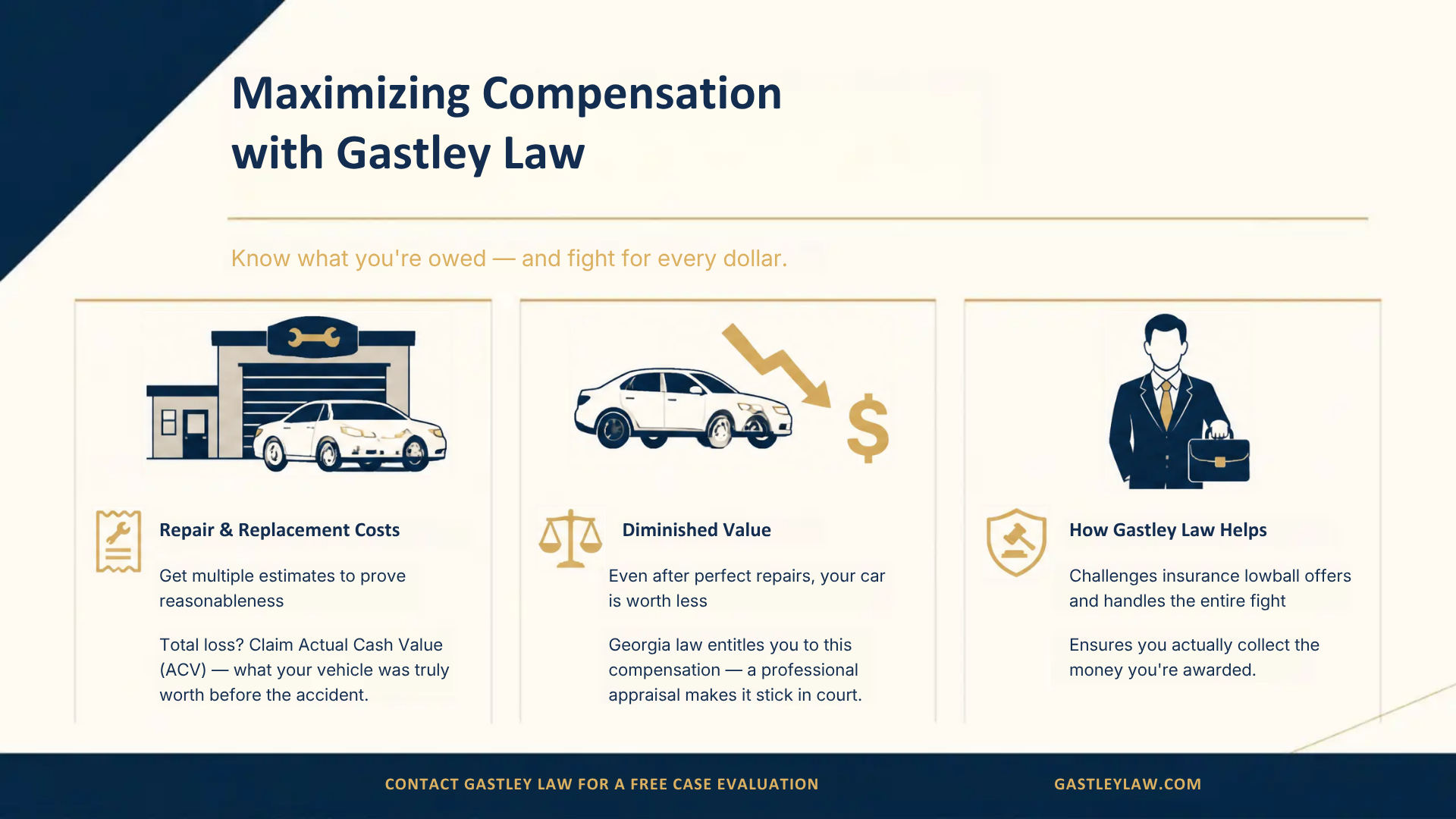
Winning in court feels like the final step, but it isn’t always. A judgment in your favor simply means the court agrees that you are owed money; it doesn’t force the other party to pay up immediately. The Virginia Judicial System notes that winning a judgment doesn’t mean you automatically get paid and that you may need help with the collection process. This is where having a dedicated legal team makes all the difference. At Gastley Law, we handle the entire fight for you, from challenging the insurance company’s lowball offer to ensuring you actually receive the money you’re awarded. We take the pressure off your shoulders so you can focus on moving forward. If you’re ready to get what you’re truly owed, contact us for a case evaluation.
Yes, absolutely. Think of them as two separate types of damage. The payment for repairs covers the cost to fix the physical harm to your car. Diminished value, on the other hand, compensates you for the loss in your car’s resale value that happens simply because it now has an accident history. An insurance company’s obligation isn’t finished just because they paid the body shop; you can and should still file a claim to recover that lost market value.
Winning a judgment is a huge step, but it’s a court order, not cash in your hand. If the defendant doesn’t pay voluntarily, you have to take further legal action to collect the money you’re owed. This can involve steps like garnishing their wages or placing a lien on their property. This collection process can be complicated, which is why having legal support is so valuable even after you’ve won.
You are not required to have a lawyer in Magistrate Court; it’s designed for people to represent themselves. However, having professional legal help can be a major advantage. An attorney is especially helpful if your case has tricky elements, if the insurance company is fighting you hard, or if you want to be certain you’re claiming everything you’re entitled to, like diminished value. A lawyer can help you build the strongest case and handle the process for you.
This is a great question. If your total damages are over Georgia’s $15,000 Magistrate Court limit, you have two main choices. You can choose to waive any amount over $15,000 and still file in small claims court for a faster, simpler process. Your other option is to file your case in a higher court, like State or Superior Court, to pursue the full amount. These courts have more formal rules, so this is a point where getting legal advice is highly recommended.
In Georgia, you have a strict deadline of four years from the date the damage occurred to file your lawsuit. This is known as the statute of limitations. While four years might seem like a long time, it’s crucial to act much sooner. Evidence can disappear, witness memories can fade, and building a strong case takes time. If you miss that four-year window, you unfortunately lose your right to sue for damages.