Georgia drivers often learn about diminished value only after an insurance company makes a low offer. A repaired car can still be worth less because the accident history follows the vehicle, and that lost resale value may be recoverable through a diminished value claim.
A diminished value claim in Georgia asks the responsible insurance company to pay for the market value your vehicle lost because of the accident, even after repairs are complete. The strength of the claim usually depends on repair documentation, accident photos, vehicle history, and an independent appraisal that explains the real-world loss.
Have questions about a Georgia diminished value claim? Call Gastley Law at 770-557-2838 or request a free case evaluation.
Yes, Georgia drivers can generally pursue a diminished value claim when a vehicle loses market value after an accident. The claim may be made against the at-fault driver’s insurer or, in some situations, through your own policy. The right path depends on fault, coverage, policy language, and the evidence available.
A diminished value claim is not a guarantee of payment. Insurance companies can dispute liability, argue the repairs restored the vehicle’s value, or rely on formula-based estimates that reduce the payout. That is why the claim should be supported with documentation instead of assumptions.
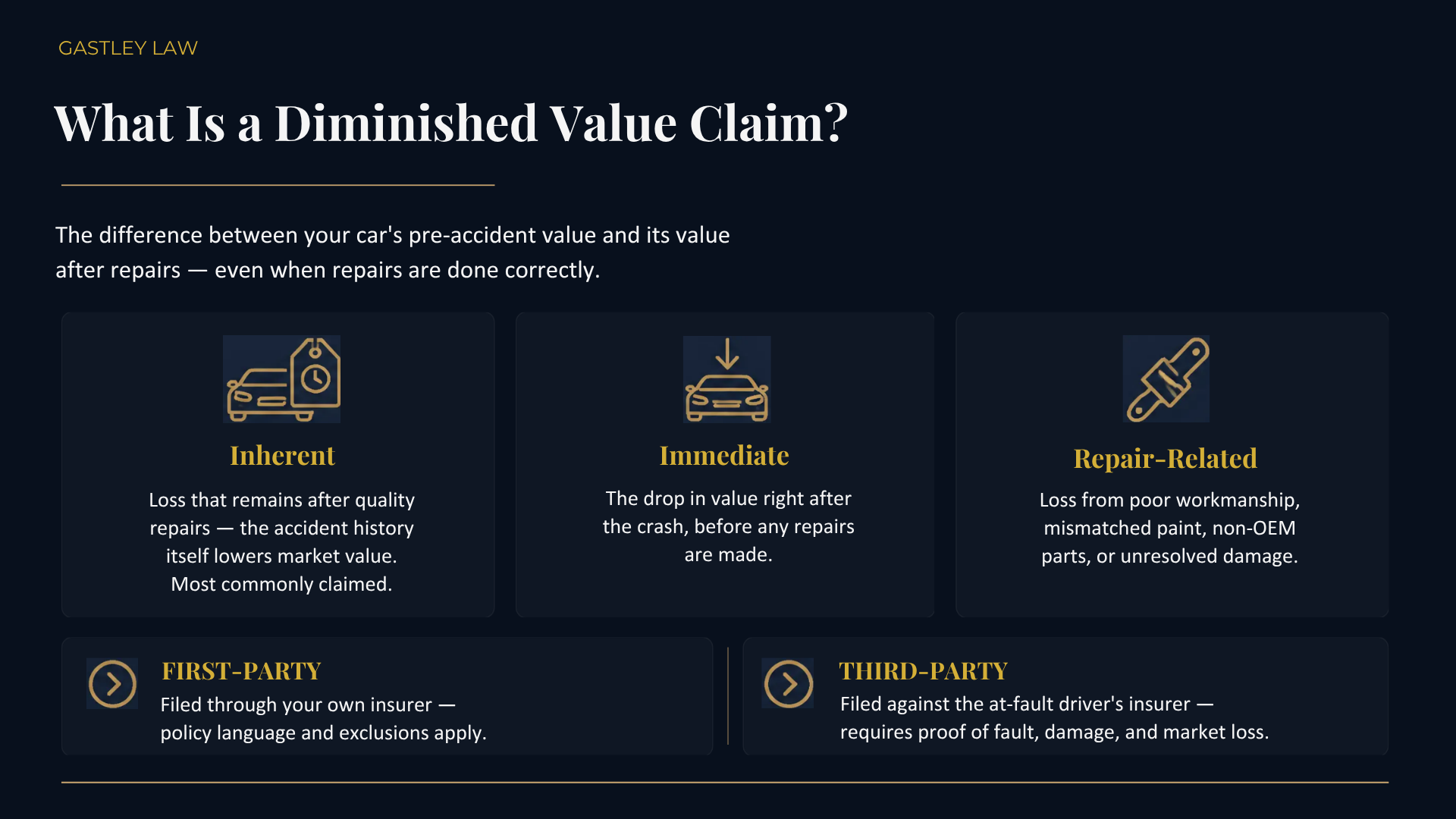
A diminished value claim seeks compensation for the difference between what your car was worth before the accident and what it is worth after repairs. Buyers, dealers, and valuation tools often treat accident history as a negative even if the car looks and drives correctly after repair.
For example, two vehicles may be the same year, make, model, mileage, and condition, but one has a clean history and the other has a reported collision. The vehicle with accident history is usually less attractive to buyers. That market discount is the core of a diminished value claim.
Gastley Law focuses on Georgia diminished value claims and property damage claims, helping clients evaluate whether an insurer’s offer reflects the real loss in market value.
An accident can affect value in several ways. A vehicle history report may show the collision. Dealers may reduce trade-in offers because the car is harder to resell. Private buyers may negotiate more aggressively because they worry about hidden structural damage, aftermarket parts, or future reliability issues.
This loss is not only emotional frustration. It can become a measurable financial loss when you sell, trade, refinance, or compare your vehicle with similar cars that have clean histories. A good diminished value claim translates that market reality into organized proof.
Diminished value is usually discussed in three categories. Understanding the difference helps you explain what you are claiming and why the insurer’s number may not be enough.
Inherent diminished value is the loss that remains after quality repairs are complete because the vehicle now has accident history. This is the most common focus of Georgia diminished value claims.
Immediate diminished value is the difference in value immediately after the crash and before repairs. It reflects the drop from a clean, undamaged vehicle to a damaged one.
Repair-related diminished value occurs when the repairs themselves reduce value, such as mismatched paint, non-OEM parts, poor workmanship, frame issues, or unresolved mechanical concerns.
The insurance path matters because first-party and third-party claims involve different rights, policy terms, and proof issues.
A first-party claim is made through your own insurance company. Your policy language controls what is covered, what exclusions apply, and whether an appraisal clause may help resolve a valuation dispute. Some first-party diminished value claims are disputed because insurers argue the policy does not cover the loss or limits how value is measured.
A third-party claim is made against the at-fault driver’s insurance company. These claims usually require proof that the other driver was responsible, that the accident caused property damage, and that your repaired vehicle is worth less in the marketplace. If you are preparing this type of demand, a focused guide to the third-party diminished value claim process can help you understand the moving parts.
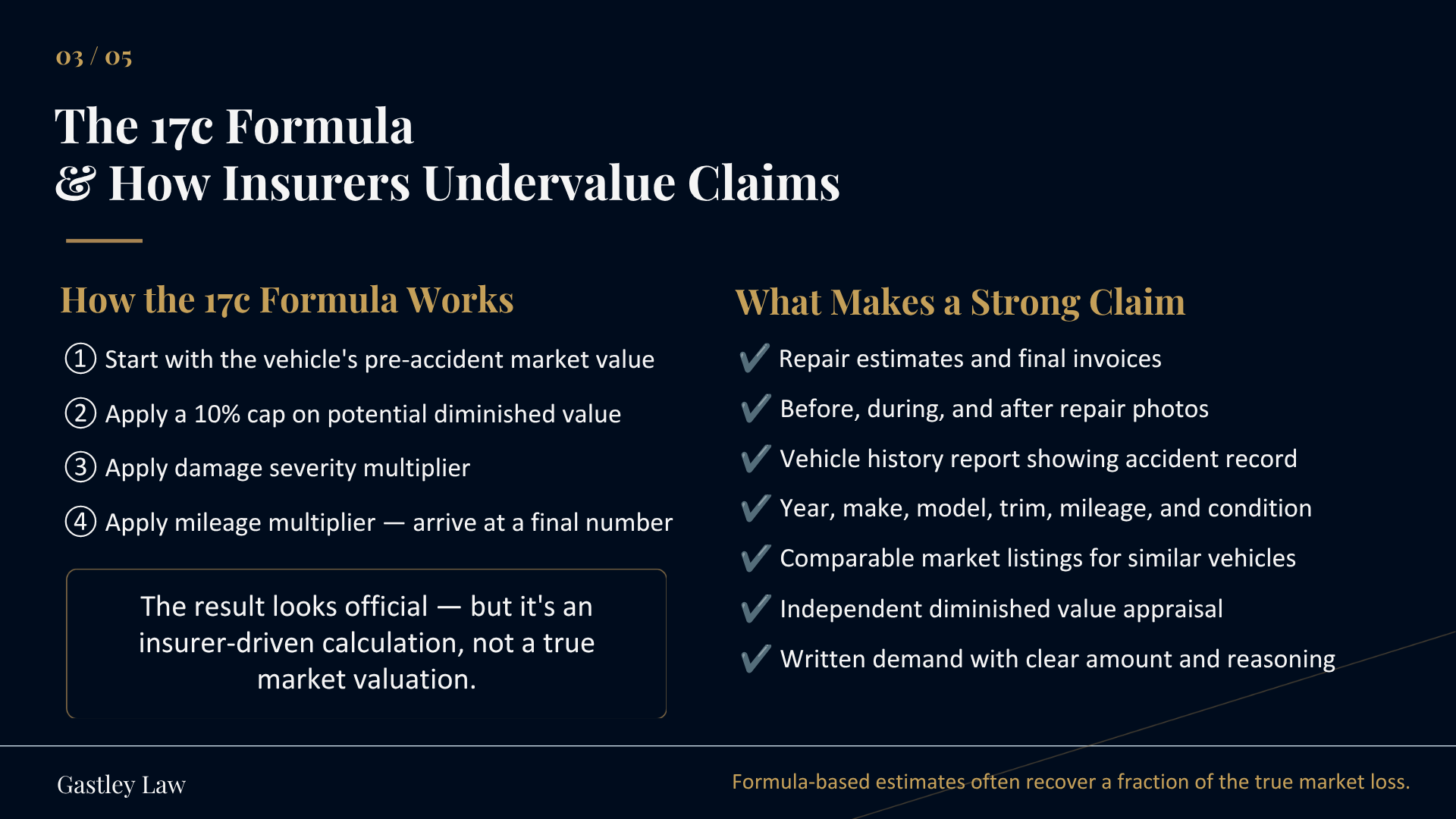
Many insurers use the 17c formula to estimate diminished value. The formula often starts with a vehicle value, applies a cap, then reduces the number with damage and mileage multipliers. The result may look official, but it is an insurer-driven calculation rather than a complete market valuation.
The problem is that 17c can undervalue a real claim. A formula may not fully account for your specific vehicle, local market demand, documented damage, repair quality, vehicle history, or buyer behavior. For a deeper explanation, see Gastley Law’s guide to the 17c diminished value formula.
If the insurer’s number seems low, Gastley Law can review the diminished value claim and explain next steps. Contact Gastley Law or call 770-557-2838.
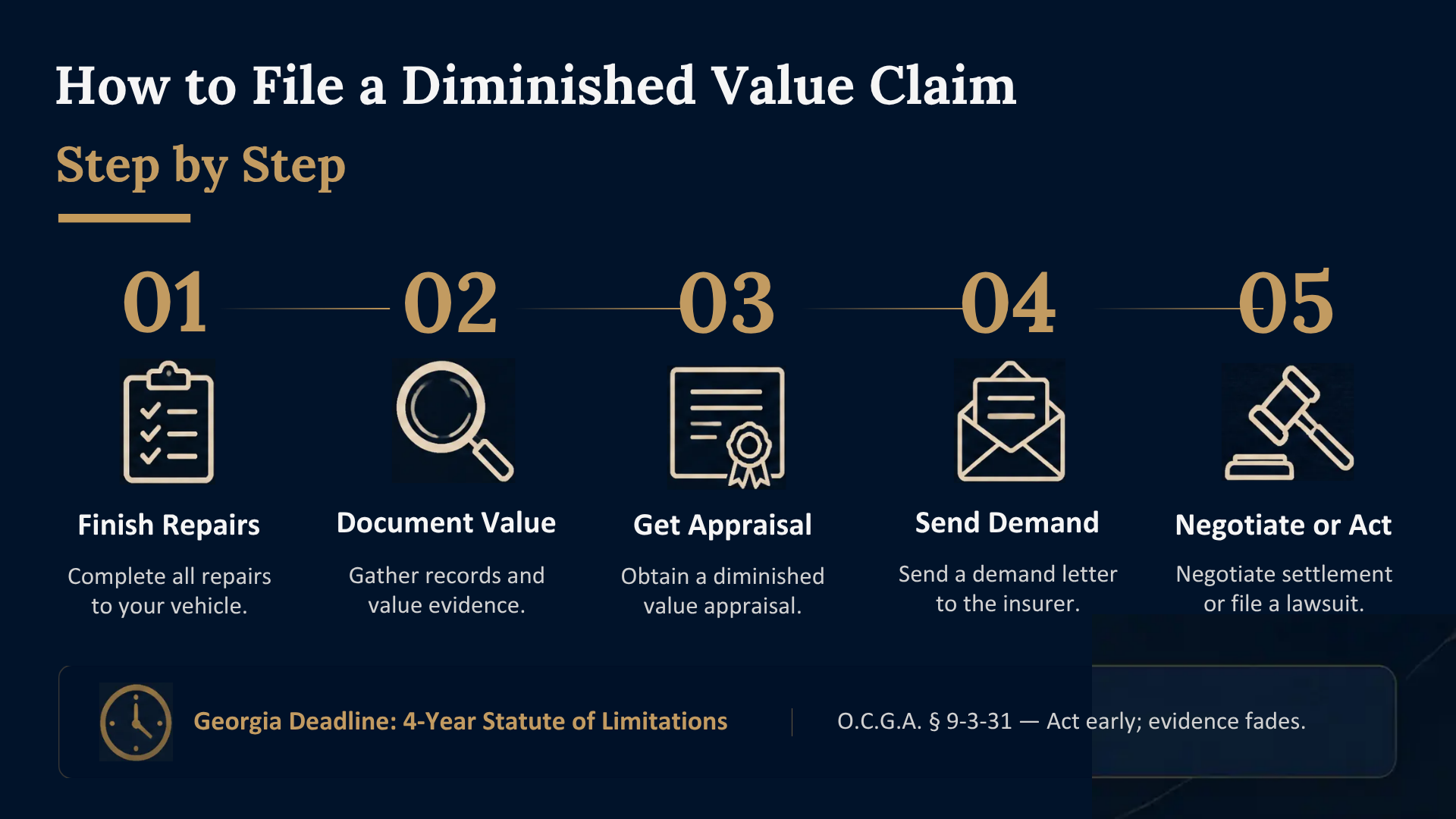
A strong Georgia diminished value claim is built step by step. The goal is to make the insurer respond to evidence, not just a request for more money.
Wait until repairs are complete when possible, then gather the estimate, final invoice, parts information, repair notes, photos, and any documentation showing structural or frame damage. Keep copies of all insurance communications.
Collect information showing the vehicle’s condition before the crash, including mileage, trim, options, maintenance history, and comparable listings. After repair, document the accident history and any remaining issues that could affect market value.
An independent appraisal can explain the market-based loss for your specific vehicle. Online calculators may provide rough numbers, but an appraisal is usually stronger because it ties the loss to repair records, vehicle condition, local market data, and accident history. Learn more about why a diminished value appraisal can strengthen your position.
Submit a clear demand package with the appraisal, repair documents, photos, vehicle history, and a concise explanation of the amount requested. If you need help structuring the demand, Gastley Law’s diminished value demand letter template and diminished value claim letter resources explain what to include.
If the insurer responds with a low offer, ask for the basis of the calculation in writing. Depending on the claim path and policy language, an appraisal clause may be available. In other situations, negotiation or court action may be considered. These choices depend on the facts, the amount in dispute, and the available evidence.
Georgia property damage claims are generally subject to a four-year statute of limitations under O.C.G.A. § 9-3-31. That deadline is important, but it should not be treated as a reason to wait.
Acting early helps preserve photos, repair records, valuation evidence, witness information, and communication history. It also makes it easier to challenge a low offer before a release is signed or the claim file becomes stale. This is general legal information, not legal advice for any specific case.
A strong claim is specific, documented, and organized. Useful evidence often includes:
The more complete the file, the harder it is for the insurer to reduce the claim to a generic formula.
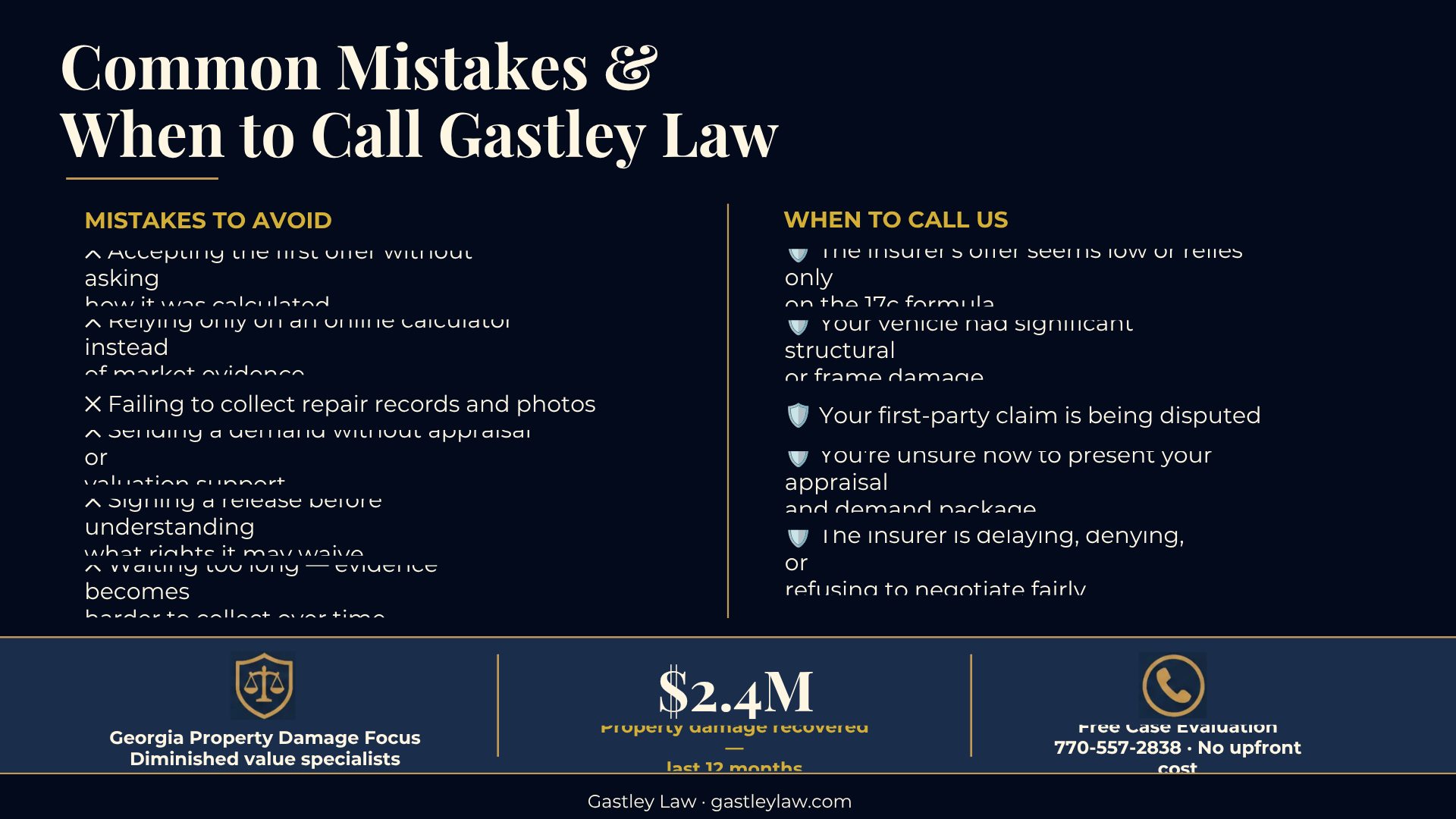
Even valid claims can become harder to prove when key steps are missed. Common mistakes include:
Stay calm in negotiations, keep everything in writing, and require the adjuster to explain any low number with facts.
Consider calling Gastley Law if the insurer’s offer seems low, your vehicle had significant damage, the insurer relies only on 17c, your first-party claim is being disputed, or you are unsure how to present your appraisal and demand package.
Gastley Law handles Georgia diminished value and property damage claims on a contingency model when a case is accepted. The firm fronts costs on accepted matters and is paid only from a successful recovery. In the last 12 months, Gastley Law has recovered $2.4 million in property damage claims for clients.
Call 770-557-2838 or contact Gastley Law for a free case evaluation.
A diminished value claim asks an insurer to pay for the market value your car lost because of accident history after repairs. The claim is usually supported with repair records, photos, vehicle history, comparable market data, and an independent appraisal.
Georgia property damage claims are generally subject to a four-year limitations period under O.C.G.A. § 9-3-31. You should still act early because evidence can become harder to collect over time.
Sometimes. A first-party claim depends on your policy language, coverage, exclusions, and any appraisal clause. If another driver caused the crash, a third-party claim against that driver’s insurer may also be available.
The 17c formula is a method many insurers use to estimate diminished value with caps and multipliers. It is commonly used by insurers, but it may not reflect the full market loss for a specific vehicle.
An appraisal is not always legally required, but it is often one of the strongest pieces of evidence. A credible appraisal can explain your vehicle’s loss in market value more persuasively than a generic calculator.
Ask for the calculation in writing, compare it against your repair records and appraisal, and do not sign a release until you understand what it covers. Gastley Law can review a low offer and explain possible next steps.
If an insurer’s offer does not reflect your vehicle’s real lost value, a Georgia diminished value claims lawyer can review the evidence and explain your options.
Deadlines can affect your leverage, so review the Georgia diminished value statute of limitations before waiting too long to act.