
So, the insurance company’s offer came in, and it’s a joke. It doesn’t even cover the estimate from your trusted repair shop, let alone account for the fact that your car will now be worth less forever. It’s natural to feel angry, but don’t get discouraged. An initial low offer is a standard negotiation tactic. When an insurance settlement offer is too low, it’s your cue to prepare a strong response. This isn’t about arguing; it’s about presenting facts. We’ll show you how to calculate your total losses, including often-overlooked costs like diminished value, and draft a counteroffer that gets their attention.
That first settlement offer from the insurance company can feel like a punch to the gut. After everything you’ve been through, seeing a number that barely scratches the surface of your expenses is frustrating and disheartening. But here’s something you need to know: that initial offer is almost always a starting point for negotiation, not the final word. Insurance adjusters are trained to minimize payouts, so they often begin with a lowball figure, hoping you’ll accept it and move on.
Before you even think about responding, your first job is to understand the true, total value of your claim. A fair settlement isn’t just about covering the immediate repair bill. It should account for every single loss you’ve suffered because of the accident. This includes everything from medical costs and lost income to the permanent drop in your car’s resale value, also known as diminished value. By taking a step back to calculate your actual damages, you shift the power back into your hands and prepare to argue for the compensation you rightfully deserve.
The most straightforward part of your claim is the tangible, out-of-pocket expenses. Start by gathering every single bill and receipt related to the accident. For your vehicle, this means getting multiple repair estimates from shops you trust, not just the one recommended by the insurer. If your car was totaled, research its actual cash value by looking at what similar vehicles are selling for in your area. Don’t just accept the insurer’s valuation. For your injuries, compile all medical bills, from the ambulance ride and emergency room visit to physical therapy, prescriptions, and specialist appointments. You need to know your actual costs before you even consider the insurer’s number.
The financial impact of a car accident often extends far beyond your immediate bills. Did you have to take time off work to recover or attend doctor’s appointments? Your settlement should reimburse you for that lost income. Gather pay stubs and a letter from your employer detailing your rate of pay and the hours you missed. If your injuries are severe and may affect your ability to work in the future, that loss of earning capacity must also be considered. A fair settlement should cover all your costs, not just the most obvious ones. Don’t let the insurance company ignore the full impact the accident has had on your career and financial stability.
Some of the most significant damages from an accident aren’t listed on an invoice. Pain and suffering is a legal term for the physical discomfort and emotional distress you’ve endured. This includes anxiety, depression, sleepless nights, and the loss of enjoyment in activities you once loved. While it’s harder to put a number on these damages, they are a very real and compensable part of your claim. Keeping a daily journal to document your pain levels, emotional state, and how the injuries affect your daily routines can be powerful evidence. A good settlement covers everything, including the profound way an injury can change your life.
You don’t have to accept the insurance adjuster’s assessment of your vehicle’s damage or value. If you believe their estimate is too low or they are ignoring key aspects of your loss, you have the right to get a second opinion. For property damage, this means hiring an independent appraiser to provide an unbiased report on repair costs or your vehicle’s pre-accident value. This is especially critical for a diminished value claim, where a specialized appraisal can prove how much value your car has lost even after being perfectly repaired. An independent appraisal gives you a credible, evidence-based figure to use in your counteroffer, making your argument much stronger.
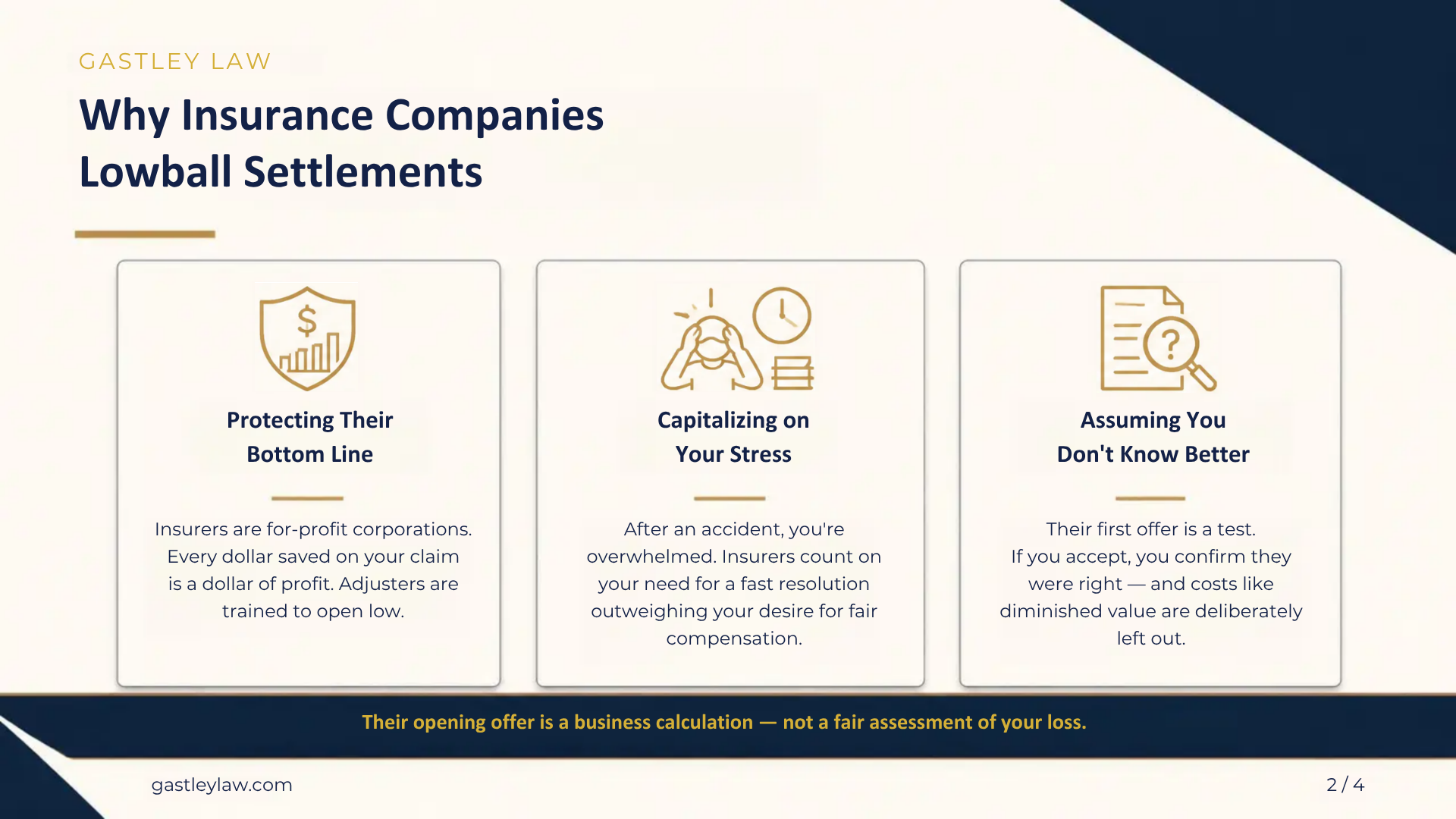
It’s frustrating to get a settlement offer that doesn’t even begin to cover your costs. It can feel like a personal slight, but it’s rarely about you. For insurance companies, it’s simply a business strategy. They are for-profit corporations, and their primary responsibility is to their shareholders, not to you as a claimant. This means their goal is to resolve claims for the lowest possible amount. Understanding the motives behind a lowball offer is the first step in fighting back for the compensation you actually deserve.
At its core, an insurance company’s business model involves collecting more in premiums than it pays out in claims. Every dollar they don’t pay you is a dollar that contributes to their profitability. Because of this, insurance adjusters are often trained to start with low offers. They want to pay as little as possible, not what is fair for your property damage or the diminished value of your vehicle. Their first offer is just a starting point in a negotiation, one that is intentionally set low to see if you’ll accept it without question. It’s a calculated move designed to protect their bottom line above all else.
After an accident, you’re likely dealing with a lot of stress. You might be without a car, juggling repair shop appointments, and trying to get your life back to normal. Insurance companies know this. They count on the fact that you’re overwhelmed and may be worried about mounting bills. By presenting a quick, low offer, they are hoping you’ll take the money and run, just to get the whole ordeal over with. They are banking on your desire for a fast resolution to outweigh your desire for fair compensation, effectively using your own difficult circumstances against you.
Insurers handle thousands of claims and have a very clear idea of what each one is worth. They assume you do not. They expect that you haven’t calculated the full extent of your losses, especially less obvious costs like your car’s loss in resale value. The initial offer is a test to see if you understand the true value of your claim. If you accept it, you confirm their assumption and save them money. This is why it’s so important to have a clear understanding of your damages before you even think about accepting an offer. If you feel outmatched, our team is here to evaluate your case and ensure you’re on a level playing field.
That sinking feeling when you see the insurance company’s offer is completely valid. It’s often far less than what you need to get your car properly repaired and make up for its lost value. The good news is that their first offer is just that: a first offer. It’s a starting point for a negotiation, not the final word. Before you fire back a response, it’s critical to take a few strategic steps to build your case. This isn’t just about getting angry; it’s about getting organized. By pausing and gathering the right information, you shift the power dynamic and prepare yourself to effectively counter their lowball number. These initial actions set the stage for the entire negotiation process and are your best chance at securing the full compensation you’re entitled to.
First, take a breath. An adjuster’s job is to close claims quickly and for as little money as possible. They might pressure you to accept the offer on the spot, but you are under no obligation to do so. Remember, you don’t have to accept the first offer. Cashing a check or signing any release forms will likely end your ability to negotiate for more money, even if you discover additional damage later. Politely tell the adjuster you need time to review the offer and all the related documents. This simple pause gives you the space to evaluate the offer properly without the pressure of a fast-talking representative on the phone.
You can’t argue with a number if you don’t know how they came up with it. Your next step is to send a written request, either by email or certified mail, asking for a detailed breakdown of their offer. How did they calculate your vehicle’s value before the accident? What repair estimates are they using? What comparable vehicles did they look at? This document is incredibly important. It forces the insurer to justify their position and often reveals where they cut corners, such as using aftermarket parts, underestimating labor hours, or completely ignoring your right to a diminished value claim.
I know, reading an insurance policy is about as fun as watching paint dry, but it’s a crucial step. You need to understand exactly what your policy covers. Look for specifics on rental car reimbursement, the use of original equipment manufacturer (OEM) versus aftermarket parts, and any clauses related to property damage and value assessments. Understanding your policy is your best defense against an adjuster telling you something isn’t covered when it actually is. If you’re fighting the at-fault driver’s insurance, get a copy of the police report, which will be key evidence. Knowing your rights and the insurer’s obligations is fundamental to this process.
Don’t let the insurance company be the only one doing the math. Before you even think about a counteroffer, you need to calculate the true, full value of your claim. This includes the cost of complete and proper repairs from a trusted mechanic, not just the insurer’s preferred shop. It also includes the inherent diminished value your car has now suffered, even after being repaired. Get independent repair estimates and a professional contact us for help.
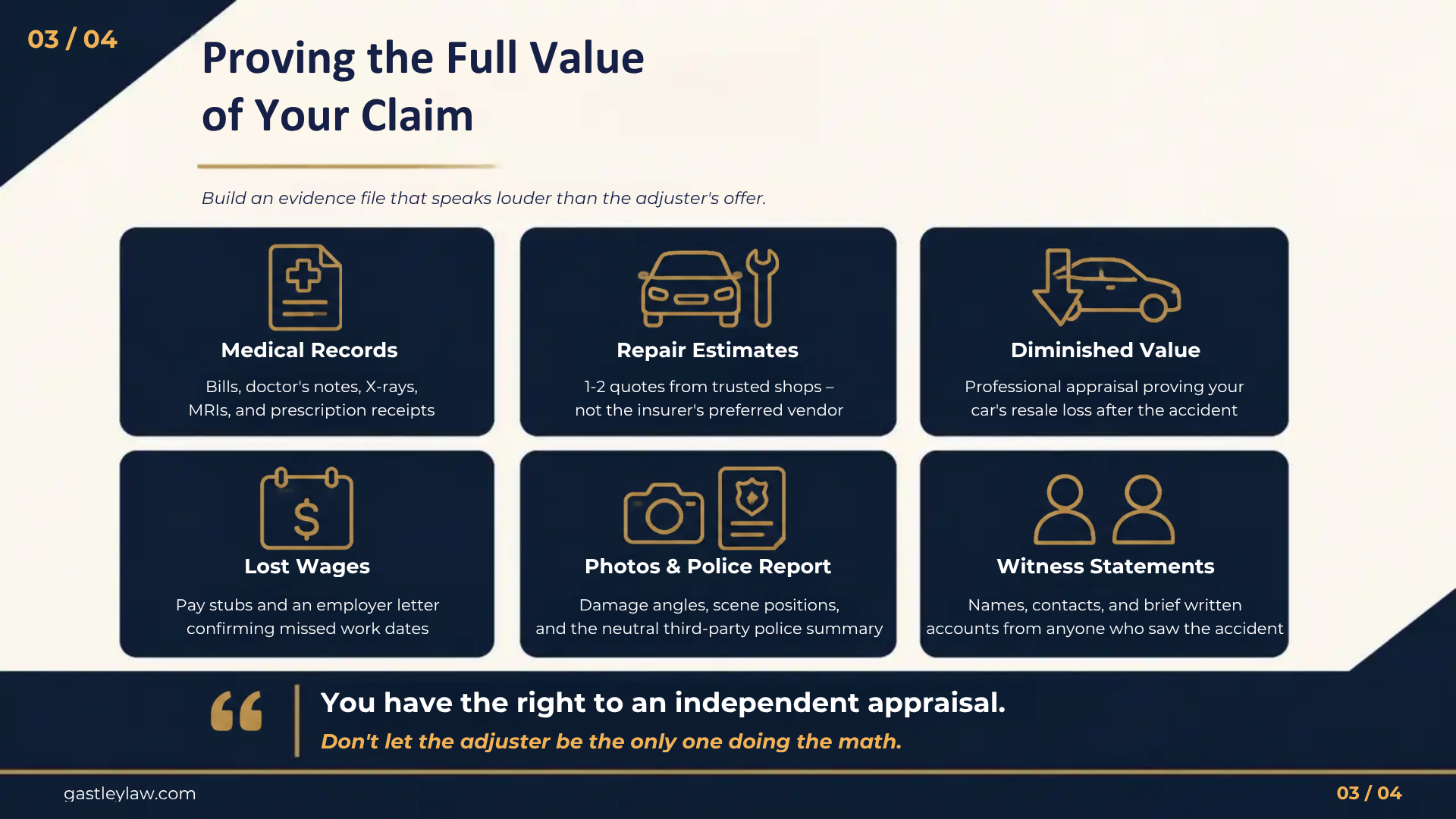
After a lowball offer, your most powerful tool is evidence. Think of it as building your own case file. The insurance company has one, filled with adjuster notes and estimates designed to minimize their payout. Your file will tell the true story of your accident and its impact, backed by undeniable proof. A strong, organized collection of documents and records is the foundation for a successful negotiation. It shows the insurer that you are serious, prepared, and fully aware of what your claim is worth.
Presenting a mountain of credible evidence makes it much harder for an adjuster to justify their low offer. It shifts the conversation from their opinion to the facts. Each document you collect, from a simple receipt to an expert report, adds another layer of support to your claim. This process is your opportunity to take control of the narrative and demonstrate the full extent of your financial, physical, and personal losses. At Gastley Law, we use this exact type of evidence to build compelling arguments for our clients, ensuring every aspect of their claim is accounted for. Our legal services are designed to help you gather and present this information effectively.
Your health is the top priority, and documenting your medical journey is critical for your claim. You need to collect every single piece of paper related to your treatment. This includes records from the emergency room, your primary care physician, specialists, and physical therapists. Don’t just save the final statements; request the detailed, itemized bills. These documents break down the cost of every service, procedure, and supply, creating a clear picture of your medical expenses. Keep a running folder with all doctor’s notes, diagnostic reports (like X-rays or MRIs), and prescription receipts. This thorough documentation proves the extent of your injuries and justifies the costs you’re asking the insurance company to cover.
The official police report is one of the most important documents you can have. It serves as a neutral, third-party summary of the accident, created by a law enforcement officer at the scene. The report typically includes crucial details like the date, time, and location of the crash, contact information for all parties and witnesses, a diagram of the scene, and the officer’s initial observations. While the officer’s opinion on who was at fault isn’t the final word legally, insurance adjusters give it significant weight. You can usually get a copy of your report from the local police department or sheriff’s office that responded to the call, sometimes through an online portal.
Visuals tell a story that words can’t. The photos and videos you take at the accident scene are powerful pieces of evidence. Use your phone to capture everything: the damage to all vehicles from multiple angles, the positions of the cars, skid marks on the road, relevant traffic signs or signals, and the overall scene. If you have visible injuries, document them as well. Beyond photos, witness statements are incredibly valuable. If anyone saw the accident, get their name and phone number. A brief, written statement from a witness about what they observed can corroborate your version of events and counter any attempts by the other driver to change their story later.
An accident’s financial impact goes beyond immediate bills. If your injuries forced you to miss work, you are entitled to compensation for that lost income. Gather pay stubs to show your regular earnings and ask your employer for a letter confirming the dates you were unable to work because of the accident. Just as important is your vehicle’s diminished value. This is the drop in your car’s resale value that happens simply because it now has an accident history, even after it has been perfectly repaired. Insurance companies rarely offer to pay for this unless you demand it, but it is a real loss that you deserve to recover.
The insurance company’s repair estimate is not the final word; it’s their opening offer. Take your vehicle to one or two independent, trusted body shops for your own estimates. This will give you a much more realistic assessment of the actual repair costs and provide a strong basis for your counteroffer. For more complex claims involving serious injuries or questions of fault, you may need other expert opinions. These could come from accident reconstruction specialists or medical experts who can speak to your future treatment needs. Gathering these professional opinions strengthens your position and shows the insurer you have a team of experts ready to back up your claim. If you feel overwhelmed, it might be time to contact us for help.
Receiving a low settlement offer can feel like a slap in the face, but it’s important to remember that this is just the start of the conversation. Insurance adjusters are trained to protect their company’s financial interests, which often means starting with an offer that’s much lower than what you’re actually owed. Don’t get discouraged; get prepared. Negotiating is a normal and expected part of the claims process.
Your job is to respond not with emotion, but with a clear, evidence-based case that demonstrates the true value of your claim. This means shifting the dynamic from them telling you what your claim is worth to you showing them the facts. The following steps will walk you through how to build and present a strong counteroffer. By approaching this as a business transaction where you have the facts on your side, you can confidently push for the fair compensation you deserve. This is a core part of the legal representation we provide for our clients every day.
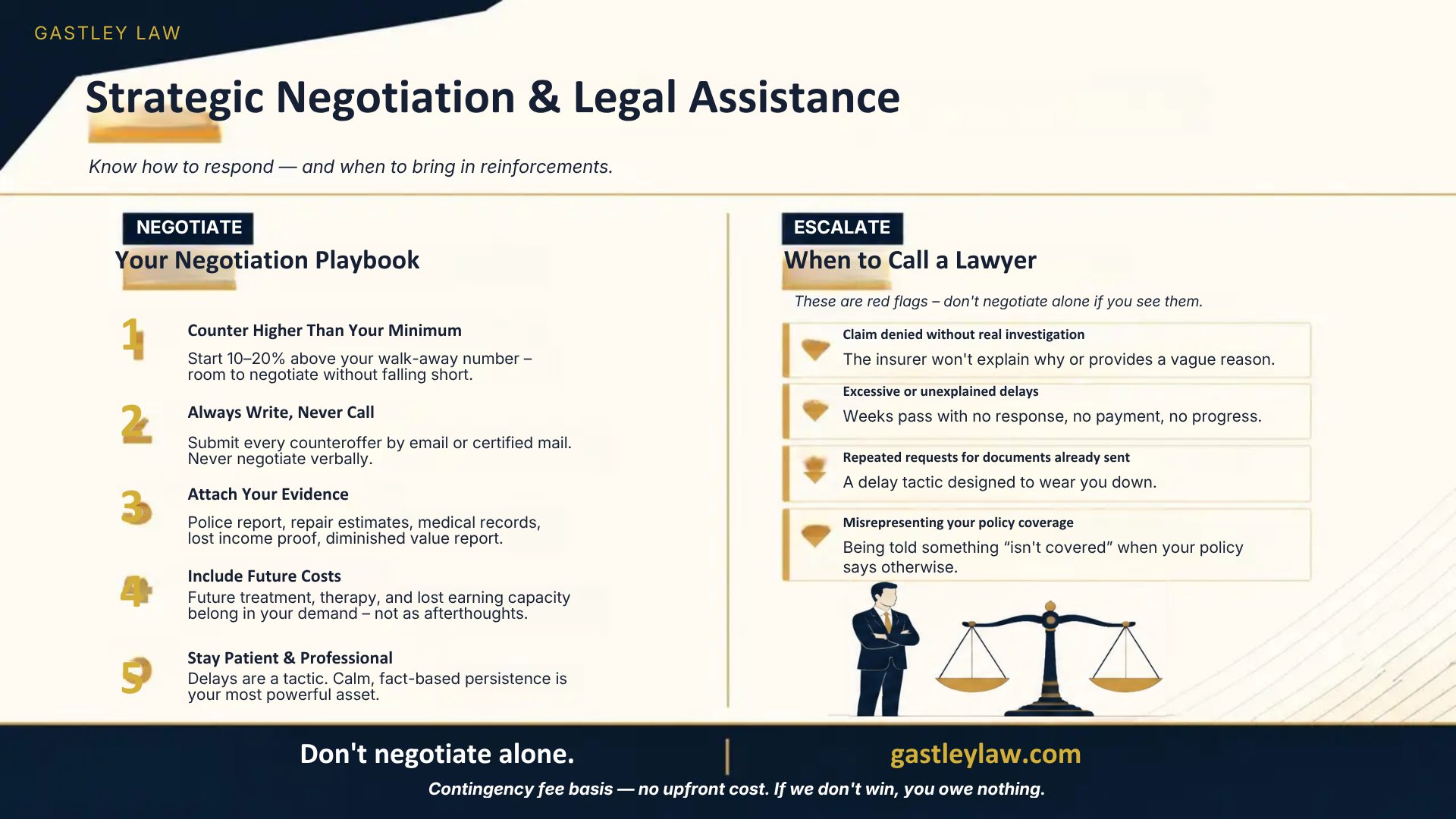
Before you even think about what number to send back, you need to determine your “walk-away” number, the absolute lowest amount you would accept. Calculate this based on your total documented losses: repairs, medical bills, lost wages, and your vehicle’s diminished value. Once you have that number, don’t use it as your counteroffer. Instead, make a counteroffer that is reasonably higher, often about 10% to 20% more than your minimum.
This strategy isn’t about being greedy; it’s about smart negotiating. It gives you a buffer and leaves room to meet in the middle without dipping below your essential needs. The adjuster expects you to negotiate, so starting higher signals that you know your claim’s value and are prepared to discuss it seriously.
Never make a counteroffer over the phone. A verbal agreement can be easily misinterpreted or denied later. Instead, draft a formal demand letter and send it via email or certified mail. This creates a paper trail and ensures your position is clearly understood. Your letter should be professional, concise, and organized. State the amount you are demanding and then systematically break down why you are entitled to it.
This is where all the evidence you’ve gathered comes into play. Attach copies of everything: the police report, repair estimates, medical records, proof of lost income, and a professional report detailing your car’s diminished value. Presenting a well-documented, logical argument shows the adjuster you are serious and have a strong basis for your claim, making it much harder for them to justify another low offer.
A fair settlement doesn’t just cover the bills you have today; it should cover the full scope of your losses, including future expenses. If your doctor anticipates you’ll need ongoing physical therapy, or if your injuries may require future procedures, these costs must be factored into your demand. Similarly, if you’ve suffered a permanent injury that affects your ability to work, your settlement should account for that loss of future earning capacity.
Don’t let an adjuster rush you into accepting a settlement before you understand the full extent of your damages. A quick payout might seem tempting, but it could leave you paying for long-term, accident-related costs out of your own pocket. Make sure your demand letter clearly outlines any anticipated future expenses, supported by statements from medical or vocational experts.
Insurance adjusters handle negotiations every day. They often use time and frustration as tools to get you to accept less. They might delay responses or make you jump through hoops, hoping you’ll get tired and give up. Don’t fall for it. Patience is one of your most powerful assets in this process. Understand that it may take several rounds of offers and counteroffers to reach a fair agreement.
Throughout the process, keep your communication professional and fact-based. Avoid getting emotional or making threats. Simply restate your position, refer back to your evidence, and remain firm in your demand for fair compensation. Persistence shows the adjuster that you aren’t going away and that you have the conviction to see your claim through to a just resolution.
There’s a difference between tough negotiation and acting in bad faith. Insurance companies have a legal duty to handle your claim fairly and promptly. If your adjuster is refusing to communicate, intentionally delaying the process, misrepresenting facts, or trying to deny your claim without a valid reason, they may be acting in bad faith. These tactics are not just unethical; they can be illegal.
If you feel the insurer is not dealing with you fairly, document every interaction. Note the dates of calls, who you spoke to, and what was said. Send follow-up emails confirming conversations. If you believe you’re facing bad-faith practices, it’s time to stop negotiating on your own. This is a clear sign that you need an experienced attorney to step in and protect your rights. If you’re in this situation, it’s best to contact a professional for guidance.
Negotiating with an insurance company can feel like an uphill battle, and sometimes, you reach a point where handling it alone is no longer in your best interest. While you can manage straightforward negotiations yourself, certain situations call for professional backup. If the insurance company is playing games, your claim is complicated, or you simply feel outmatched, bringing in a lawyer can make all the difference. Recognizing these moments is key to protecting your right to fair compensation.
Insurance companies have a legal duty to handle your claim fairly. When they don’t, it’s known as “bad faith,” and it’s a major red flag. Bad faith isn’t just about a low offer; it’s about the insurer’s unreasonable conduct. This can look like denying your claim without a real investigation, taking an excessively long time to pay, or repeatedly asking for documents you’ve already sent. They might also misrepresent your policy’s coverage to justify a smaller payout. If you feel the insurer is deliberately stalling or being dishonest, it’s time to stop talking to them and start talking to an attorney. An experienced lawyer can provide the specialized legal representation needed to hold them accountable.
If your accident resulted in more than just minor cosmetic damage, your claim is likely more complex than you think. A fair settlement should cover all your losses, not just the immediate ones. This includes current and future medical bills, lost wages from time off work, and compensation for your pain and suffering. Calculating these future costs is tricky, and insurers rarely offer to pay for them willingly. The same goes for property damage. A claim involving a total loss or significant repairs requires a careful calculation of your car’s diminished value, which is the loss in resale value even after it’s fixed. A lawyer ensures these complex damages are properly valued and fought for.
Let’s be honest: insurance adjusters are professional negotiators. It’s their full-time job to resolve claims for the lowest amount possible. You, on the other hand, are likely going through this for the first time. Hiring a lawyer instantly changes this power dynamic. It signals to the insurance company that you’re serious and won’t accept a lowball offer. An attorney understands how to accurately value a case, what evidence is most compelling, and which tactics to use against insurers. They take over the stressful communications and negotiations, allowing you to focus on your recovery. Having a legal expert on your side often makes the insurer take your claim more seriously from the start. If you’re ready to level the playing field, it’s time to contact us.
After an accident, the last thing you want is a fight with an insurance company. But when they come back with an offer that doesn’t even begin to cover your costs, that’s exactly where you find yourself. It’s a frustrating position, but you should know that initial lowball offers are a standard tactic. Insurers are protecting their profits, not your best interests. That’s where we come in. We handle the fight so you can focus on what matters: getting your life back on track.
Our first move is to conduct a thorough case evaluation to determine what your claim is actually worth. Insurance companies often present a low number hoping you’ll take it without question. We look at the complete picture. This includes not just your immediate repair bills, but also the long-term financial impact. We factor in medical expenses, lost wages from time off work, and the diminished value of your vehicle after the accident. A proper settlement should cover everything, and we make sure no detail is overlooked.
Next, we build a powerful case backed by solid evidence. A strong claim isn’t just about what you say; it’s about what you can prove. We gather everything needed to support your claim, from police reports and medical records to professional repair estimates and expert opinions. This detailed preparation shows the insurance company that we are serious and fully prepared to justify the compensation you deserve. We use this evidence to prepare a formal written demand that clearly outlines the full extent of your damages and why their initial offer is unacceptable.
Armed with a rock-solid case, we take over all communication with the insurer. Our team is skilled at negotiating and pushing back against the delay tactics and lowball offers insurers rely on. We handle all the back-and-forth, providing you with peace of mind. You can learn more about our services and how we specifically tailor our approach to each case. You don’t have to accept an unfair settlement. If you’re ready to fight for the compensation you rightfully deserve, contact us for a consultation. Let us put our expertise to work for you.
I completely understand the urge to accept the first offer just to close this chapter. You’re stressed, you need your car fixed, and the insurance company is offering a quick check. The problem is that this quick fix often leaves you paying for long-term costs. That initial offer is a business calculation designed to be just tempting enough for you to accept, while saving the insurer as much money as possible. By accepting it, you could be giving up your right to compensation for proper repairs, your car’s lost resale value, and other expenses you haven’t even thought of yet.
Diminished value is the loss in your car’s market price simply because it now has an accident history. Think about it: if you were buying a used car and had two identical options, but one had been in a major wreck, you would expect to pay less for the wrecked one, right? That difference in price is its diminished value. Insurance companies rarely offer to pay for this because it’s a direct loss for them, and they know most people don’t know to ask for it. You are legally entitled to recover this loss, but you almost always have to demand it with proof.
You can certainly handle the negotiation yourself, especially if the damage is minor and the insurer is being reasonable. However, you should consider hiring a lawyer the moment you feel outmatched or when the stakes are high. If the insurance company is using delay tactics, denying valid parts of your claim, or if your car has significant damage, a lawyer levels the playing field. Their involvement signals to the insurer that you won’t be pushed around and that your claim must be taken seriously, which often leads to a better offer.
This is a great question, and the answer depends on your state’s laws. Here in Georgia, we have what’s called a “modified comparative negligence” rule. In simple terms, this means you can still recover damages as long as you are found to be less than 50% at fault for the accident. Your final compensation would then be reduced by your percentage of fault. For example, if you were found to be 20% at fault, you could still recover 80% of your damages. Don’t assume you get nothing just because you may share some of the blame.
This is one of the biggest concerns people have, and it’s a valid one. Most reputable attorneys who handle these types of cases, including our firm, work on a contingency fee basis. This means you don’t pay any fees upfront. The lawyer’s fee is a percentage of the money they successfully recover for you from the insurance company. If they don’t win your case or get you a settlement, you don’t owe them a fee. This structure allows you to get expert legal help without any financial risk.