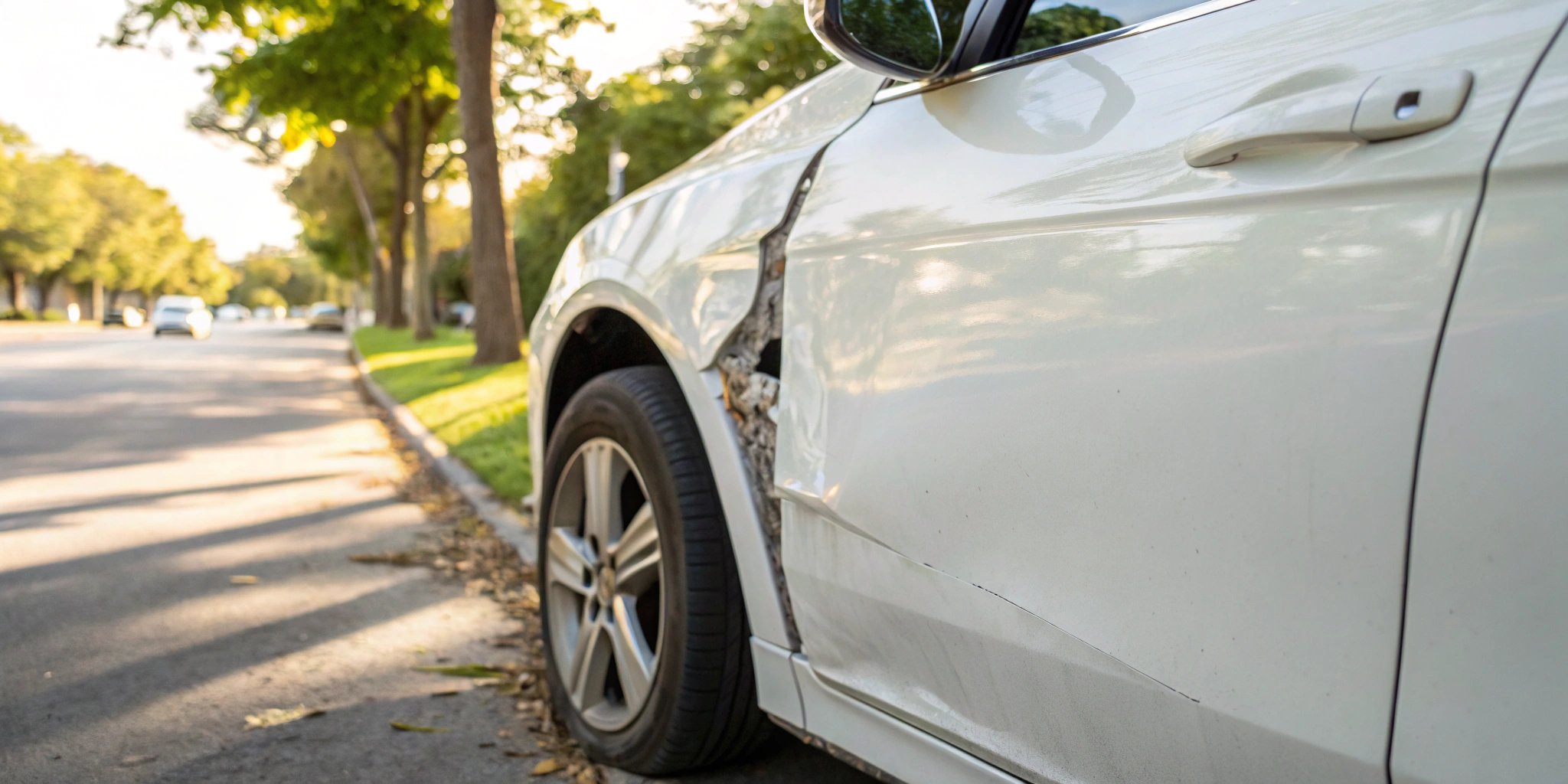

Insurance companies have a playbook for handling diminished value claims—and it’s designed to protect their bottom line, not yours. They lean on formula-driven estimates (often the “17c” approach) that routinely understate what a real buyer would subtract from your car’s price after an accident. The result is predictable: a low offer delivered with confidence, hoping you won’t challenge it.
Here’s the truth: your vehicle can be repaired perfectly and still lose real money in the marketplace the moment it has an accident on its record. In Georgia, the at-fault driver’s insurer is typically responsible for that loss. This guide breaks down what diminished value is, how insurers try to minimize it, what proof makes a claim hard to ignore, and how to negotiate with an adjuster like it’s a business discussion—because that’s exactly what it is.
Need help now? Visit our Car Accident Lawyer page to learn how property damage fits into a broader Georgia accident claim,
Key Takeaways
-
Your strongest evidence is a professional appraisal. Don’t let a self-serving formula like 17c define your payout. A credible, independent diminished value appraisal—supported by repair invoices and photos—puts real leverage behind your claim.
-
Treat negotiations like a business discussion. Prepare a complete claim file, stay calm, stick to facts, and require the adjuster to justify any low offer in writing.
-
A lowball offer isn’t the final word. If the insurer won’t act reasonably, legal action may be the next step. Be careful with release forms—never sign something that could waive rights you still need.
What Is a Diminished Value Claim?
Picture this: you’re shopping for a used car. You find two vehicles that are identical—same year, mileage, features, and condition. One has a clean history. The other was in an accident but has been repaired. Which one would you pay more for?
Most buyers choose the vehicle with no accident history. That difference in buyer behavior is the foundation of diminished value.
A diminished value claim is your right to recover the loss in your car’s market value after it has been damaged and repaired. Even when the body shop does excellent work, the accident record still follows your vehicle through services like CarFax and AutoCheck. That “stigma” lowers what dealers will offer and what private buyers are willing to pay.
In Georgia, diminished value is typically pursued against the at-fault driver’s insurance company as part of property damage. If you’re also dealing with injuries, you may want to review our Personal Injury Lawyer page to understand your full range of options.
How an Accident Impacts Your Car’s Resale Value
The moment your vehicle is involved in a collision, its history changes permanently. That accident is likely to appear on a vehicle history report, and future buyers will see it. The market reads accident history as risk—even if the repairs look perfect.
Buyers often worry about hidden structural issues, long-term reliability, or whether aftermarket parts were used. Dealers account for this risk by lowering trade-in offers. Private buyers negotiate harder. That reduction isn’t theoretical—it’s money you lose when you sell, trade, or refinance.
The Different Types of Diminished Value
Diminished value is typically broken into three categories. Knowing them helps you understand what you’re actually claiming:
Immediate Diminished Value
This is the loss in value right after the crash, before repairs—essentially, the difference between “clean” and “wrecked.”
Inherent Diminished Value
This is the most common and the focus of most claims. It’s the permanent loss in value that exists even after quality repairs, simply because the car now has an accident history.
Repair-Related Diminished Value
This happens when repairs are subpar—mismatched paint, poor workmanship, non-OEM parts, or lingering mechanical problems that lower value beyond the inherent loss.
Most Georgia diminished value negotiations revolve around inherent diminished value, because it applies even when repairs are done correctly.
How Insurance Companies Calculate Your Car’s Lost Value
If you file a diminished value claim, understand this up front: the insurer’s calculation method is rarely designed to reflect real market behavior. It’s designed to reduce payouts.
Decoding the 17c Formula
Many insurers in Georgia use the “17c formula” to generate a diminished value number. It sounds official. It isn’t a true market valuation.
Here’s how it typically works:
-
They start with a pre-accident value (often from Kelley Blue Book or similar data).
-
They apply a 10% cap, limiting your potential diminished value at the outset.
-
They apply a damage multiplier to lower the number.
-
Then they apply a mileage multiplier to shrink it further.
Layered reductions like this almost always produce a low offer. If you accept it without pushing back, that’s exactly what the insurer is counting on.
Build Your Case: Essential Documents for Your Claim
Think of this like building a file you’d be comfortable presenting to a neutral decision-maker. The stronger and more organized your proof, the harder it is to dismiss you.
Repair Records and Invoices
Your repair records create the timeline and scope of damage. Gather:
-
The estimate
-
The final itemized invoice
-
Receipts for parts and labor
-
Notes about structural or frame work (if applicable)
These documents show the severity of the collision and why the market discount is justified.
Photos and Vehicle History
Visual proof is persuasive. Take photos:
-
Immediately after the crash (multiple angles)
-
During repairs (if possible)
-
After repairs are complete
Pair photos with a vehicle history report to show how accident history will affect resale perceptions.
A Professional Appraisal vs. DIY Market Research
You can do your own comparisons online—but if you want leverage, a professional diminished value appraisal is often the best evidence available. A qualified appraiser can provide an independent report explaining the valuation method and the real-world market impact for your specific vehicle.
If you’re unsure whether your documentation is strong enough or how to package your claim, start with our Contact page or review how we approach car accident property damage on our Car Accident Lawyer page.
How to Negotiate Diminished Value With an Insurance Adjuster
Adjusters negotiate for a living. Most people don’t. Your advantage comes from preparation, not volume.
How to Prepare for the Call
Before you speak with the insurer:
-
Organize your repair invoices and photos
-
Obtain a professional appraisal if possible
-
Identify your demand amount and why it’s supported
-
Be ready to explain—briefly—why a formula-based offer isn’t market-based
You don’t need to argue emotionally. You need to present evidence.
Effective Communication Strategies
When you talk to the adjuster:
-
Stay calm and professional
-
Stick to facts and documents
-
Take notes (date, time, name, summary of discussion)
-
Ask for everything important in writing
And be careful with paperwork. Don’t sign anything you haven’t read completely—and never sign a general release that could waive rights beyond the diminished value issue.
Handling Common Pushback
Common adjuster tactics include:
-
“Your car is repaired, so there’s no loss.”
-
“Our formula is the standard.”
-
“That appraisal isn’t valid.”
-
“This is the best we can do.”
When they push back, your move is simple: ask them to justify their number in writing and request the data behind it. If they dismiss your appraisal, ask for a specific reason and what valuation evidence they’re relying on instead.
Diminished Value Calculators vs. Professional Appraisals
Online calculators can be tempting because they’re quick. The problem is credibility.
Many calculators are generic and aren’t accepted by insurers or courts as proof. They can provide a rough estimate, but they’re not a substitute for a defensible valuation method.
A professional appraisal is tailored to your vehicle, your market, and your damage profile. It’s the kind of document that forces the adjuster to deal with facts instead of pushing a canned formula.
What to Do When the Insurance Company Won’t Be Fair
If negotiations stall, don’t assume the adjuster’s “final offer” is truly final. It’s often a pressure tactic.
Know Your Legal Options
If the insurer won’t negotiate in good faith, you may have the option to pursue the claim through legal channels. Depending on the amount, some diminished value disputes can be handled in Magistrate Court (small claims), but the process still requires strong documentation and clear presentation.
Be Careful With Releases
One of the most common mistakes is signing a release that is broader than you realize. If you’re unsure what you’re being asked to sign, it’s smart to get legal guidance first—especially if injuries are involved.
If you’re dealing with an accident that includes both property damage and injuries, start with our Personal Injury Lawyer page.
Common Mistakes That Weaken a Diminished Value Claim
Trusting Online Value Calculators: Adjusters often dismiss calculator outputs immediately. If your valuation isn’t supported by a credible method, it’s easier to ignore.
Signing Away Rights Too Soon: A rushed signature can cost you more than diminished value—especially if the document is a general release.
Submitting an Incomplete File: A claim that includes only an appraisal with no supporting records invites delays and denials. Build a complete package: appraisal + invoices + photos + report + vehicle history.
Waiting Too Long to Escalate: If the insurer is stalling or ignoring your evidence, escalation may be the only way forward.
Who Can File a Diminished Value Claim in Georgia?
You may have a strong diminished value claim when:
-
Another driver was at fault
-
Your vehicle had meaningful market value before the wreck
-
The car was in good condition prior to the collision
-
Repairs were completed and documented
-
You can demonstrate a real reduction in value with credible evidence
Insurers often argue that your car is “too old” or has “too many miles” to qualify. Those factors may reduce the amount of diminished value—but they don’t automatically eliminate the claim. The key is proof.
Related Articles
- Maximize Your Car Accident Diminished Value Settlement
- Diminished Value Claims – Gastley Law Advocates
- What is a Diminished Value Claim? A Simple Guide
- What’s a Fair Diminished Value Settlement? Find Out
Frequently Asked Questions
Can I file a diminished value claim if the accident was my fault? In Georgia, diminished value is typically pursued against the at-fault driver’s insurance policy. If you caused the crash, your own insurance usually does not pay you for the loss in resale value unless your policy includes specific coverage.
Is it still worth filing a claim if my car is older or has high mileage? It can be. While newer cars often have larger diminished value amounts, the real issue is your vehicle’s market value and condition before the crash. If it was well-maintained and still worth a meaningful amount, the accident can still cause a real financial loss.
How long do I have to file a diminished value claim in Georgia? Georgia generally allows four years from the date of the accident to file a lawsuit for property damage, which can include diminished value. But waiting is rarely in your favor—starting sooner makes it easier to gather strong documentation and avoid delays.
Why can’t I just use a free online calculator to determine my car’s lost value? Because insurers rarely treat them as credible evidence. Many calculators use generic assumptions and can’t explain their method in a way that holds up under scrutiny. A professional appraisal is typically more persuasive because it’s tailored to your vehicle and supported by real valuation methodology.
Do I really need an attorney to handle my claim? Not always but it can make a major difference when the insurer denies your claim, delays the process, or refuses to negotiate fairly. Legal help also protects you from signing the wrong release or missing key procedural steps if litigation becomes necessary.
What if the adjuster says repairs restored my car’s value? That argument ignores how the market works. Accident history changes buyer behavior, trade-in value, and resale pricing—even when repairs are excellent. Your goal is to prove that real-world loss with documentation and, ideally, an independent appraisal.