
Travelers Diminished Value Claim in Georgia Guide

Travelers Diminished Value Claim in Georgia
A repaired vehicle can look good and still be worth less because its history now includes an accident. If Travelers insures your vehicle or the driver who caused the crash, that loss may support a diminished value claim in Georgia. The claim is separate from the cost of repairing the car. It focuses on the difference between the vehicle’s value before the collision and its value after repairs, based on the facts and evidence in your case.
Request a free case evaluation with Gastley Law or call (770) 557-2838 to discuss your Georgia diminished value claim.
This guide explains how to organize a Travelers diminished value claim, what Travelers’ public claim resources do and do not say about the process, and how to evaluate negotiation, appraisal, regulatory, or legal options. It is general information, not a promise that a claim will be accepted or that a particular amount will be recovered.
What Is a Travelers Diminished Value Claim in Georgia?
A Travelers diminished value claim is a request for compensation for the vehicle’s post-repair loss in market value after an accident. Diminished value is different from repair damage. A repair estimate addresses the cost to return the vehicle to a safe, pre-loss condition. Diminished value addresses the separate stigma and market impact of an accident history.
For a Georgia vehicle owner, the strongest claim starts with a clear answer to one question: What was this specific car worth immediately before the collision, and what is it worth after the repairs? A credible evaluation should account for the vehicle’s year, make, model, mileage, trim, condition, prior history, repair history, structural or safety work, and the quality of the evidence supporting the post-repair conclusion.
Diminished value is not the same as depreciation
Normal depreciation occurs as a vehicle ages and accumulates mileage. Diminished value is the additional loss tied to a collision and the vehicle’s accident history. A car can experience both at the same time. A claim should isolate the accident-related loss instead of treating every decline in market value as recoverable.
That distinction matters when an insurer reviews a claim. A carrier may focus on the repair bill, the vehicle’s current market value, or a formula-based estimate. Those items can be relevant, but they do not automatically answer the full valuation question. Georgia’s Office of Insurance and Safety Fire provides consumer claim resources, and Georgia case law has addressed diminished value in the context of first-party physical damage coverage. The policy, claim facts, and evidence still control the analysis.
For a broader explanation of the legal framework, see Gastley Law’s Georgia diminished value law guide. This Travelers-specific article narrows the discussion to the carrier, claim documentation, and next-step choices.
Does Travelers Owe Diminished Value on a Georgia Claim?
Whether Travelers owes diminished value depends on the claim pathway, policy language, applicable Georgia law, facts, and proof. A carrier-specific article should not turn a possible claim into a guaranteed result. The first step is to identify whether you are pursuing a third-party claim against the at-fault driver’s liability coverage or a first-party claim under your own Travelers policy.
| Claim pathway | Who may be involved | Key question | What to document |
|---|---|---|---|
| Third-party claim | The at-fault driver’s insurer, including Travelers when applicable | Can the evidence prove an accident-related loss tied to the other driver’s liability? | Crash facts, liability evidence, repairs, valuation, and communications |
| First-party claim | Your own Travelers policy | What does the policy require for a covered physical damage loss and valuation? | Policy, declarations, claim file, estimates, repairs, and valuation proof |
| Disputed claim | Insurer, adjuster, appraiser, regulator, or attorney | Why did Travelers reduce, deny, or limit the request? | Written explanation, calculations, evidence submitted, and response history |
The Georgia Supreme Court’s decision in State Farm Mutual Automobile Insurance Co. v. Mabry is an important part of the state’s diminished value background, particularly for first-party physical damage issues. That case does not establish that every vehicle owner has the same claim, the same valuation, or the same result with every insurer. Travelers may review the policy and evidence differently depending on the facts.
First-party and third-party claims need different questions
In a third-party claim, the central dispute may involve liability, causation, and the amount needed to compensate for the loss caused by another driver’s conduct. In a first-party claim, the policy language and the carrier’s contractual obligations become especially important. Do not assume that an answer for one pathway automatically applies to the other.
Gastley Law has a separate resource on a first-party diminished value claim in Georgia. Use it for the broader first-party discussion, then keep the Travelers-specific evidence and communications in this article’s claim roadmap.
What Does Travelers’ Public Auto-Claim Process Tell You?
Travelers’ public claim resources describe the mechanics of reporting damage, obtaining an estimate, and moving a vehicle through repair. They do not publish a blanket promise that every repaired vehicle qualifies for diminished value or that one formula decides every Georgia claim. That distinction helps you use the sources accurately.
Start with a complete claim record
Travelers’ file-a-claim page directs customers to select the claim type and says an individual customer may need a 13-digit policy number. Keep the claim number, policy information, loss date, accident report, photographs, and every message in one folder. If you speak with an adjuster by phone, write down the date, name, subject, and any promised follow-up.
Travelers’ auto claim next steps guide says the claims team reviews the claim, follows up about next steps, and may use photographs to begin the damage appraisal process. Those statements can help you understand the repair workflow. They do not replace a separate diminished value evaluation.
Understand the estimate and supplements
Travelers’ auto estimate guide explains that an estimate can include line-item repairs or replacement parts, labor and paint times, deductible information, adjustments, and a net repair cost. It also explains that hidden or additional damage, parts changes, labor, or calibrations can create a supplement during repairs.
Keep the first estimate, every supplement, the final invoice, repair orders, parts information, alignment records, calibration records, and photographs before and after the work. A repair file that is missing the final documents can make it harder to show exactly what happened to the car.
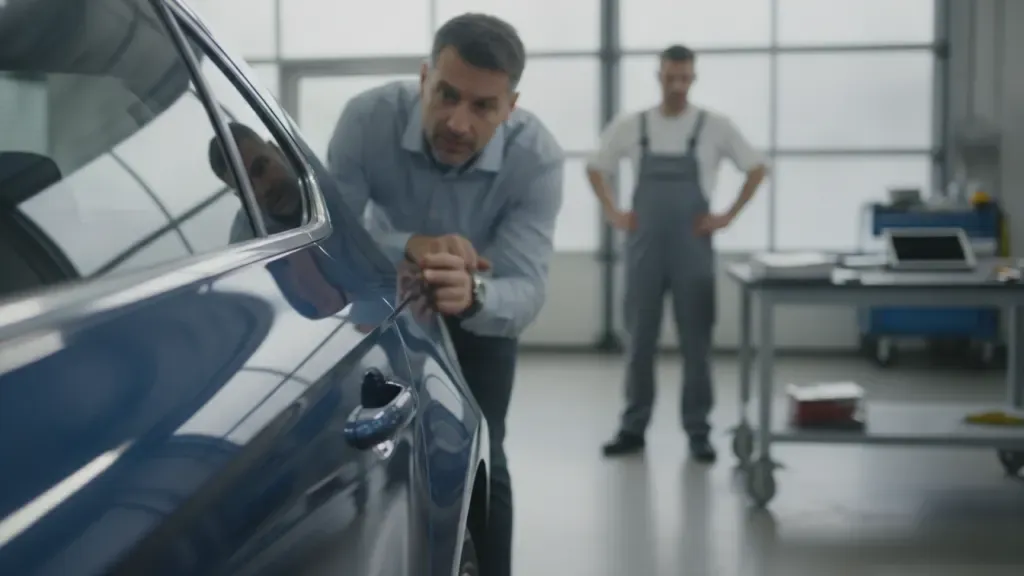
Do not confuse repair appraisal with diminished value appraisal
Travelers’ auto appraisal methods page describes virtual inspections, local field inspections, and repair-network options for assessing damage. It also notes that state-specific rules can affect where a vehicle is appraised or repaired. These methods are useful for assessing physical damage and repair needs. They are not automatically a post-repair market valuation.
Ask what an appraisal or inspection is intended to measure before relying on it. A repair estimate answers, “What may it cost to fix the physical damage?” A diminished value evaluation asks, “How did the accident and repair history affect this vehicle’s market value?” Both can belong in a complete claim file, but they serve different purposes.
What Evidence Should You Gather for a Travelers Diminished Value Claim?
Evidence should make the claim understandable to someone who did not see the crash, the vehicle before the loss, or the repair process. Organize the file chronologically and label each document. A practical evidence checklist includes:
- Policy and claim information: the declarations page when relevant, policy number, claim number, loss date, adjuster contact information, and written coverage communications.
- Accident records: the incident report, photographs of the scene and damage, driver information, witness information, and documents that help establish liability.
- Vehicle identity: VIN, year, make, model, trim, mileage before and after repair, options, ownership records, and maintenance history.
- Repair records: the initial estimate, supplements, final invoice, parts records, paint and labor entries, alignment or calibration records, and photographs of the work.
- Prior condition: service records, photographs, listings, inspection records, or other reliable evidence showing the car’s condition before the collision.
- Post-repair condition: a final inspection, photographs, repair-quality concerns, warning lights, calibration issues, or any evidence that the vehicle was not returned to its prior condition.
- Valuation support: a qualified diminished value evaluation that explains the methodology, comparable vehicles, market area, assumptions, and connection to this vehicle’s accident history.
- Claim communications: the amount requested, supporting documents sent, Travelers’ response, any valuation or calculation it provided, and the reasons for a reduction or denial.
Use valuation evidence that explains the conclusion
A number without an explanation is easy to challenge. A useful report should identify the vehicle, describe the damage and repairs, explain the valuation method, identify comparable market evidence, and show how the accident history affects buyer demand. It should also avoid treating a generic formula as a guaranteed measure of the loss.
Georgia’s insurance regulator has cautioned consumers through its claim resources that claim disputes should be supported by relevant information and documentation. A well-organized file does not guarantee payment, but it gives the adjuster, appraiser, attorney, or regulator a clearer record to review.
Need help evaluating the evidence for a Travelers diminished value claim? Request a free case evaluation with Gastley Law or call (770) 557-2838.
How Do You File a Travelers Diminished Value Claim in Georgia?
The exact process can vary by claim pathway and policy. The following sequence helps reduce avoidable gaps while preserving a clear record:
- Confirm the claim path. Identify whether the request is against the at-fault driver’s Travelers coverage or under your own Travelers policy. Record the policy and claim numbers.
- Preserve the vehicle record. Save photographs, estimates, supplements, repair orders, invoices, and any report about alignment, sensors, cameras, or structural work.
- Request the claim position in writing. Ask what Travelers has accepted, what it disputes, what documents it needs, and whether it has performed or relied on a diminished value evaluation.
- Obtain a supported valuation. Use an evaluation that addresses the actual vehicle and post-repair history rather than relying on an unexplained online estimate.
- Prepare a demand package. Present the timeline, liability or coverage basis, repair history, valuation evidence, requested amount, and supporting documents in a logical order.
- Allow a reasoned response. If Travelers makes an offer, ask how it was calculated. Compare its assumptions with the vehicle’s actual condition and the evidence in your file.
- Choose the next step carefully. Depending on the policy and facts, the options may include negotiation, an appraisal provision, a Georgia insurance complaint, or legal review. None is an automatic guarantee of recovery.
Gastley Law’s Georgia diminished value claim filing guide provides a broader step-by-step framework. For this carrier-specific claim, keep the Travelers communications and the reason for any offer or denial at the center of the file.
How Should You Respond to a Low Travelers Offer or Denial?
A low offer or denial should be treated as a question to investigate, not as the final word automatically. Read the written response closely and separate the carrier’s position into individual issues. Travelers may dispute liability, coverage, causation, the amount of diminished value, the quality of the valuation, or the documents submitted.
Ask what assumption caused the gap
Compare the insurer’s position with your evidence. Did it use the correct year, trim, mileage, options, and pre-loss condition? Did it consider the actual repair history? Did it treat the repair estimate as the entire loss? Did it rely on a formula without explaining why that method fits the vehicle and Georgia claim? A focused response is more persuasive than repeating the requested amount without addressing the carrier’s assumptions.
Send a concise counter-package
Respond with a short cover letter, a numbered exhibit list, and the specific correction for each disputed point. Include the valuation report, repair records, photographs, and prior communications. State that the materials are submitted for review and request a written response. Do not exaggerate the vehicle’s condition or present an uncertain valuation as a guaranteed fact.
Negotiation is a process, not a promise. Some claims resolve after the evidence is clarified. Others remain disputed because the parties disagree about policy language, liability, causation, or value. If the amount is material or the carrier’s explanation is unclear, consider having a Georgia diminished value attorney review the file before signing a release.
When Should You Consider Appraisal, a Georgia Complaint, or Legal Review?
Escalation should match the dispute. It is usually better to identify the unresolved issue first than to select a process based only on frustration.
Appraisal or policy dispute process
Some policies contain an appraisal provision for disagreements about the amount of a covered loss. Appraisal is not necessarily a decision about every coverage or liability question, and the wording of the policy matters. Read the provision carefully and confirm what issue it addresses before invoking it. Travelers’ public appraisal materials describe physical damage appraisal methods, but they do not replace the terms of your policy or a case-specific review.
For more background on vehicle valuation evidence, see Gastley Law’s diminished value appraisal guide for Georgia owners. The right appraisal evidence should answer the claim’s actual valuation question rather than simply produce a number.
Georgia Office of the Commissioner of Insurance and Safety Fire
Georgia’s Office of the Commissioner of Insurance and Safety Fire provides insurance claim tips and a consumer insurance complaint process. The agency says consumers should try to resolve the issue directly with the insurer first, confirm that the plan and dispute fall within the agency’s jurisdiction, and gather the relevant documentation. A complaint can create another review channel, but it does not guarantee a specific settlement or replace legal advice.
Attorney review or litigation
Legal review may be appropriate when the claim involves a substantial value dispute, a first-party policy question, a release, a limitations concern, a denial that lacks a clear explanation, or repeated failure to address the evidence. A Georgia attorney can evaluate the documents, identify the actual dispute, and explain available options. That review should happen before you make a statement that could affect the claim or sign a final release.
Request a free case evaluation with Gastley Law or call (770) 557-2838 today. A Georgia diminished value attorney can review whether your Travelers claim warrants further evaluation.
Frequently Asked Questions
Can I file a diminished value claim against Travelers in Georgia?
You may be able to pursue a diminished value claim involving Travelers, but eligibility and recovery depend on the claim pathway, policy, facts, vehicle history, repairs, valuation evidence, and applicable law. Travelers may insure your vehicle or the at-fault driver. Do not assume that a repaired vehicle automatically qualifies or that a claim will produce a particular payment.
Does Travelers use the 17c formula for every Georgia diminished value claim?
Do not assume that one formula determines every Georgia claim. Travelers’ public auto-claim pages explain repair estimates and appraisal methods, but they do not establish a universal diminished value formula for every vehicle. Ask how the carrier calculated its position and compare its assumptions with a vehicle-specific valuation.
What documents do I need for a Travelers diminished value claim?
Gather the policy and claim information, accident records, vehicle details, repair estimates and supplements, final invoices, photographs, prior-condition evidence, post-repair inspection information, valuation support, and every written communication. Organize the documents chronologically and explain how each item supports the amount requested.
Can I use a Travelers repair estimate as my diminished value appraisal?
Usually, a repair estimate and a diminished value appraisal answer different questions. A repair estimate addresses the cost of physical repairs. A diminished value appraisal addresses the market value impact of the accident and repair history. Both may belong in the claim file, but the repair estimate alone may not measure post-repair market loss.
What if Travelers denies or undervalues my claim?
Ask for the position and calculation in writing, identify the disputed assumption, and respond with focused evidence. Depending on the policy and facts, you may consider negotiation, an applicable appraisal provision, a Georgia insurance complaint, or attorney review. These options are fact-specific and do not guarantee a settlement or court result.
How long do I have to pursue a Georgia diminished value claim?
Do not wait to investigate a potential claim. The applicable deadline can depend on the claim type, policy, legal theory, and facts. Preserve documents and obtain Georgia-specific advice promptly, especially before signing a release or accepting a final payment.
Request a free case evaluation with Gastley Law or call (770) 557-2838 to discuss your Travelers diminished value claim in Georgia.