
First Party vs Third Party Diminished Value Claim Georgia: Key Differences Explained
Your car loses thousands in market value the moment an accident appears on its history report. This loss is called diminished value, and Georgia law gives you the right to recover it. Many drivers feel confused about their rights after a wreck. The sections below explain the two paths to recovery so you can decide which one fits your situation.
Get a free case evaluation with Gastley Law to learn which claim type applies to your accident. Call (770) 557-2838 today.
First Party vs Third Party Diminished Value Claim Georgia: What Is a First-Party Diminished Value Claim?
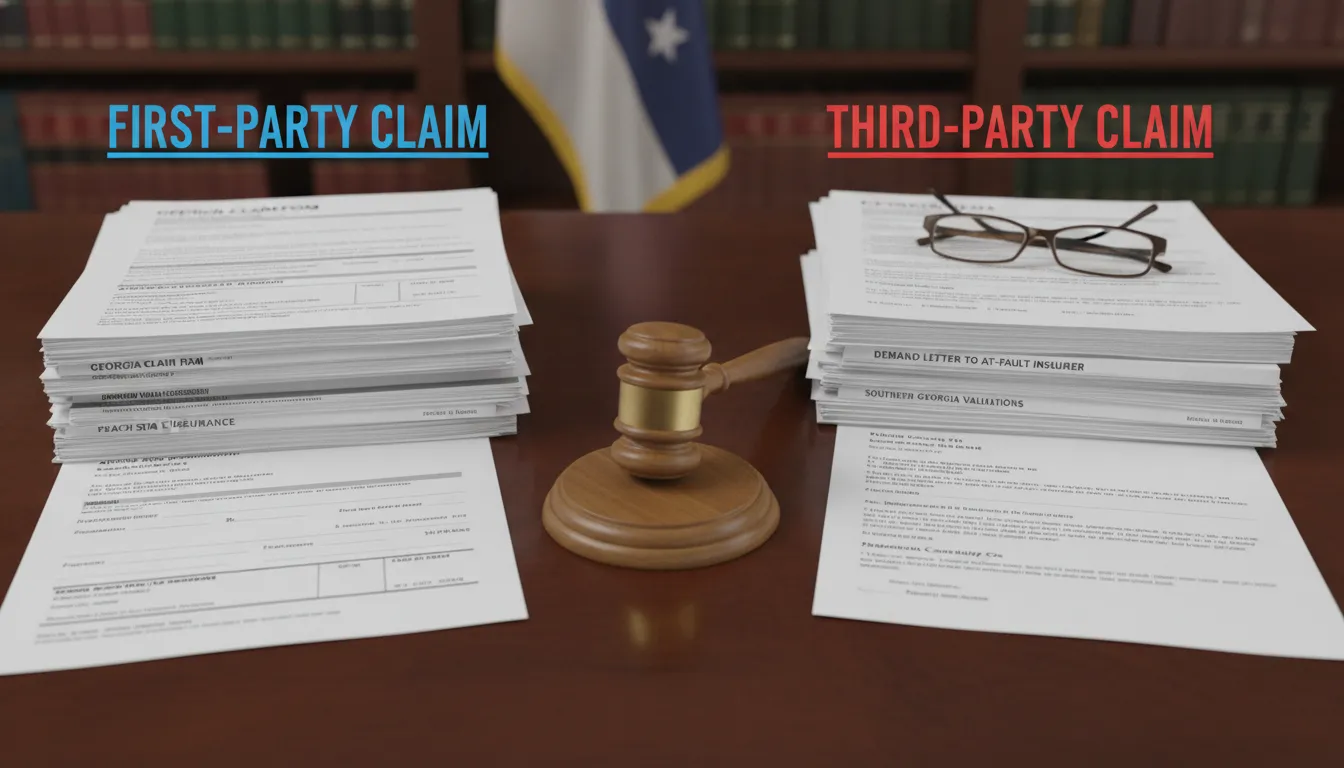
A first-party diminished value claim is filed with your own insurance company. It follows Georgia Regulation 120-2-52 and can be filed even if you caused the wreck. A third-party claim is filed against the at-fault driver’s insurer. Georgia law requires insurers to pay for this lost value, but the process and success rates vary significantly between the two paths.
A diminished value claim allows car owners to recover money they lose after a crash. Even if a shop repairs your car well, the vehicle is still worth less than before the wreck. This happens because most buyers will not pay full price for a car with a crash record. In Georgia, you can ask for this loss through a legal claim.
Market value loss after repairs
Most people think that if an insurer pays for repairs, the car is back to normal. But your car now has a record of damage on its history report. This record reduces its appeal to future buyers. This drop in price is known as diminished value after a car accident in Georgia. It represents the gap between what your car was worth before the wreck and what it is worth now.
Georgia is one of the few states that requires insurance companies to pay for this loss. The state recognizes that a repaired car is not the same as one never damaged. Because of this, you have the right to seek payment for the reduced value, even if the repairs made the car look new again.
Georgia’s unique legal rules
The state has specific rules governing these claims. Under Georgia law, you can pursue a claim for a vehicle damaged within the last six years. The state also has established rules to help settle these cases fairly. For example, Georgia Regulation 120-2-52 outlines the steps insurers must follow for property damage claims, ensuring people receive timely and clear responses.
Georgia law treats these claims as a standard component of a damage case. Insurers must evaluate this loss when handling your file. You do not always have to be the one to raise it first. However, understanding the Georgia diminished value claim requirements will help you achieve a better outcome.
Types of diminished value claims
There are two main ways to file for this loss in Georgia. Which one you use depends on who caused the wreck:
- First-party claims: Filed with your own insurance company.
- Third-party claims: Filed against the insurance company of the driver who hit you.
Both claim types aim to compensate you for your vehicle’s reduced market value. However, the rules for success and the timelines can vary significantly between them.
How Do First-Party Diminished Value Claims Work Under Your Own Policy?
In Georgia, a first-party claim means asking your own insurance company to pay for your car’s loss in value. This often occurs after an accident where you were at fault or when your policy covers the loss. While you might expect fair treatment from your insurer, these claims follow strict state rules that you need to know.
State rules and claim timelines
Under Georgia Insurance Regulation 120-2-52, companies must meet specific deadlines. They must acknowledge receipt of your claim within 15 days. After you submit a proof of loss, the company has 15 more days to approve or deny the claim. These steps keep the process moving, but they do not prevent the company from offering a low amount.
The flawed 17(c) formula
Many insurers use the 17(c) formula to calculate a payout amount. This method is widely recognized for producing low offers that do not reflect the actual loss. Many first-party claims face challenges due to this formula. You may need to challenge these low offers to receive fair compensation.
Steps to file your claim
- Notify your insurance company about the crash immediately to start your property claim.
- Request a specific evaluation of the loss in value once all repairs are complete.
- Watch for acknowledgment from the insurer within 15 days confirming they received your claim.
- Review the offer to determine if they used a calculation method that reduces your true payout.
- Submit a formal proof of loss form to require the company to provide a final decision.
- Seek professional help if the offer is too low to cover your vehicle’s actual loss.
How Do Third-Party Diminished Value Claims Work Against the At-Fault Driver?
A third-party claim is the most common way to recover money after a car crash that was not your fault. In this scenario, you file with the insurance company of the driver who caused the wreck. This process differs from a first-party claim because it rests on tort law rather than your own policy contract. When someone else hits your car, they are legally liable for the full loss, including the drop in market value that persists even after quality repairs.
Legal grounds for third-party claims
Third-party claims are built on tort liability. This means the at-fault driver must make you whole again by paying for all the damage they caused. Unlike claims with your own insurer, these filings are often more straightforward. If you were not at fault, the other driver’s insurance must cover the lost vehicle value after a Georgia accident to fulfill their legal duty. You do not have to contend with the same policy limits found in your own coverage.
High success rates and timelines
The vast majority of third-party diminished value claims are successful because insurance companies know they are responsible for the full loss of value under Georgia’s property damage regulations. Most people receive a settlement within 30 to 45 days. This timeline is often faster than first-party claims, with fewer procedural hurdles. If someone else hit you, act quickly to start your diminished value claim in Georgia before the statute of limitations expires.
What you need to prove
To win a third-party claim, you must establish two key elements. First, prove that the other driver was at fault for the crash. Second, demonstrate exactly how much value your car lost because of the wreck and repair history. Insurance adjusters often use low-ball valuation tools to minimize payouts. Building a strong case is essential. You can begin with a free case review by calling (770) 557-2838 to learn what your claim may be worth.

First-Party vs. Third-Party Claims: Key Differences
Georgia is unique because state law allows drivers to recover diminished value through both first-party and third-party claims. While the core goal is to recover your vehicle’s lost resale value, the legal path you choose depends on who caused the accident. Selecting the right method is essential to ensure fair compensation.
Comparing first-party and third-party paths
The table below outlines the primary differences between filing against your own policy and pursuing the at-fault driver’s insurance:
| Feature | First-Party Claim | Third-Party Claim |
|---|---|---|
| Filed Against | Your own insurance company | At-fault driver’s insurer |
| Success Rate | Moderate (limited by contract terms) | Very high under tort law |
| Legal Basis | Insurance policy contract | Tort liability (negligence) |
| Timeline | 30 to 60 days | 30 to 45 days |
| Valuation Method | Often uses 17(c) formula | Independent appraisal common |
| Availability | At-fault or not-at-fault | Not-at-fault accidents only |
Success rates and legal rights
Third-party claims tend to have much higher success rates because they are based on the at-fault driver’s legal duty to make you whole. First-party claims, by contrast, are bound by the specific language of your insurance contract. This distinction is critical for understanding the Georgia diminished value claim requirements that apply to your situation.
When you file a first-party claim, your insurer may apply the flawed 17(c) formula to limit your payment. However, state rules require companies to acknowledge your property damage claim within 15 days under Georgia regulations. If you were not at fault, a third-party claim typically provides a faster route to full compensation.
Choosing your claim strategy
Understanding these differences helps you decide the best approach to file a diminished value claim in Georgia. Most vehicle owners find third-party claims more straightforward because they avoid the restrictive valuation methods used by their own insurers. However, if the at-fault driver is uninsured, a first-party claim may be your only option to recover your loss.
The Georgia Supreme Court’s Mabry Ruling and How It Affects Your Claim
The legal landscape for Georgia car owners changed significantly in 2001. The state Supreme Court issued a landmark ruling in State Farm Mutual Automobile Insurance Co. v. Mabry that confirmed your right to recover compensation for your vehicle’s lost value after a crash. The court determined that insurance companies must consider this loss even if you do not explicitly request it. This case forms the legal foundation for diminished value claims in Georgia, whether first-party or third-party.
The legal duty to pay
The Mabry ruling was a significant victory for consumers. The court found that when a vehicle is damaged, its resale value drops even with quality repairs. Georgia insurers must evaluate this loss as part of the total damage calculation. This means your own insurance company cannot ignore the drop in market value when you file a claim. The ruling requires them to assess these losses rather than waiting for you to ask.
First-party and third-party rights
Because of this case, you can pursue a claim with your own policy or against an at-fault driver’s policy. In both scenarios, the Mabry ruling ensures that the loss of market value is a recognized component of your property damage recovery under Georgia law.
Limits and time frames
The law supports your right to compensation, but specific rules apply. Georgia has a four-year statute of limitations for filing property damage cases in court. If you cannot reach a fair settlement with an insurer, you may need to litigate. Many people use small claims court for these cases, which handles claims up to $15,000. This covers most diminished value claims. If your claim exceeds this limit, you must meet the state minimum coverage requirement of $25,000.
How to Maximize Your Diminished Value Payout in Georgia
Securing fair compensation for your car’s lost value requires more than just filing a report. Insurance companies often start with low offers and use tools like the 17(c) formula to minimize payouts. You must take proactive steps to prove what your car is worth.
Document your damages
Treat your claim like a business negotiation. You need solid evidence of the damage and repair quality. Keep every estimate and receipt from the body shop. Take high-quality photos of the vehicle after the wreck and after repairs. This documentation demonstrates that the car carries a permanent accident history that affects its market value.

Get an expert appraisal
Most insurers rely on the 17(c) formula, which can reduce your payout by half or more. To strengthen your position, obtain an independent appraisal based on real sales data for your specific vehicle in Georgia. This outside valuation carries more weight in negotiations.
- Keep all records: Save every document, bill, and photo related to the crash and repairs.
- Get an outside appraisal: Hire a professional to value your car rather than accepting the insurer’s calculation.
- Write a clear demand letter: Send a formal letter stating the exact compensation amount you seek.
- Challenge the 17(c) formula: Point out the flaws in this valuation method if the insurer tries to use it.
- Prepare for small claims court: If the insurer refuses a fair settlement, be ready to present your case to a judge.
Why expert legal help matters
Many law firms avoid property damage cases because the dollar amounts are relatively small. At Gastley Law, we take a different approach. We work on a pure no-win, no-fee basis. You pay nothing unless we recover compensation for you. We even advance all costs for your case, including the cost of an expert appraisal.
These reports can cost between $200 and $1,500. We cover these fees so you do not have to pay out of pocket to prove your loss. If the insurance company refuses to offer fair compensation, we are prepared to fight for you in small claims court, something most other firms will not do. Learn more about how to file a diminished value claim to start your case today.
Frequently Asked Questions
Do insurance companies have to pay diminished value in Georgia?
Yes. Georgia law requires insurance companies to pay for the loss in resale value after a car wreck. This rule applies to both your own policy and the at-fault driver’s policy. In the landmark State Farm v. Mabry case, the Georgia Supreme Court ruled that insurers must evaluate this loss in every claim.
Can I recover diminished value if the accident was my fault in Georgia?
Yes. You can file a claim with your own insurance company even if you caused the wreck. This is called a first-party claim and is governed by Georgia Insurance Regulation 120-2-52. You must have collision coverage on your policy to file. While these claims can be more challenging, you still have the right to seek compensation for the loss in value.
How long do I have to file a diminished value claim in Georgia?
In Georgia, you generally have four years from the date of the accident to file a claim. This time limit is set by state law for property damage cases and applies to both first-party and third-party claims. It is advisable to start the claim process as soon as repairs are complete.
What is the difference between a first-party and third-party diminished value claim?
A first-party claim is filed with your own insurance company. A third-party claim is filed against the insurance of the person who caused the accident. In Georgia, third-party claims typically have higher success rates and faster timelines. First-party claims often involve restrictive valuation methods that can reduce the payout.
Get Your Free Diminished Value Case Evaluation Today
Insurance companies routinely use flawed calculations to pay far less than your car is worth after an accident. Georgia law gives you a limited window to file your claim, and waiting too long can cost you your right to recover. Our team at Gastley Law knows how to challenge low offers and fight for every dollar you are owed for your vehicle’s lost value.
Ready to get started? Call (770) 557-2838 to schedule your free case evaluation with a Georgia diminished value attorney today.